Black History Month: Moses Williams

The Association for the Study of African American Life and History has proclaimed African Americans and Labor as the theme for this year’s celebration of Black History Month:

The 2025 Black History Month theme, African Americans and Labor, focuses on the various and profound ways that work and working of all kinds – free and unfree, skilled, and unskilled, vocational and voluntary – intersect with the collective experiences of Black people. Indeed, work is at the very center of much of Black history and culture. Be it the traditional agricultural labor of enslaved Africans that fed Low Country colonies, debates among Black educators on the importance of vocational training, self-help strategies and entrepreneurship in Black communities, or organized labor’s role in fighting both economic and social injustice, Black people’s work has been transformational throughout the U.S., Africa, and the Diaspora. The 2025 Black History Month theme, “African Americans and Labor,” sets out to highlight and celebrate the potent impact of this work.

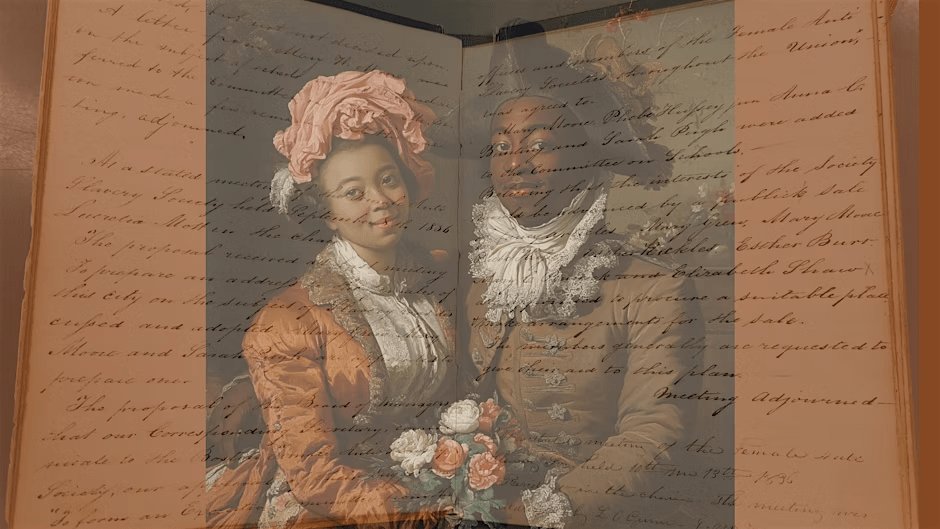
I am celebrating the work of Moses Williams who was born into slavery in Philadelphia in August 1776.

Enslaved by Charles Willson Peale, Williams was a factotum at Peale’s Museum. He participated in the first paleontological expedition in the early republic. As a skilled taxidermist, Williams was instrumental in the reconstruction of Peale’s excavated mastodon.

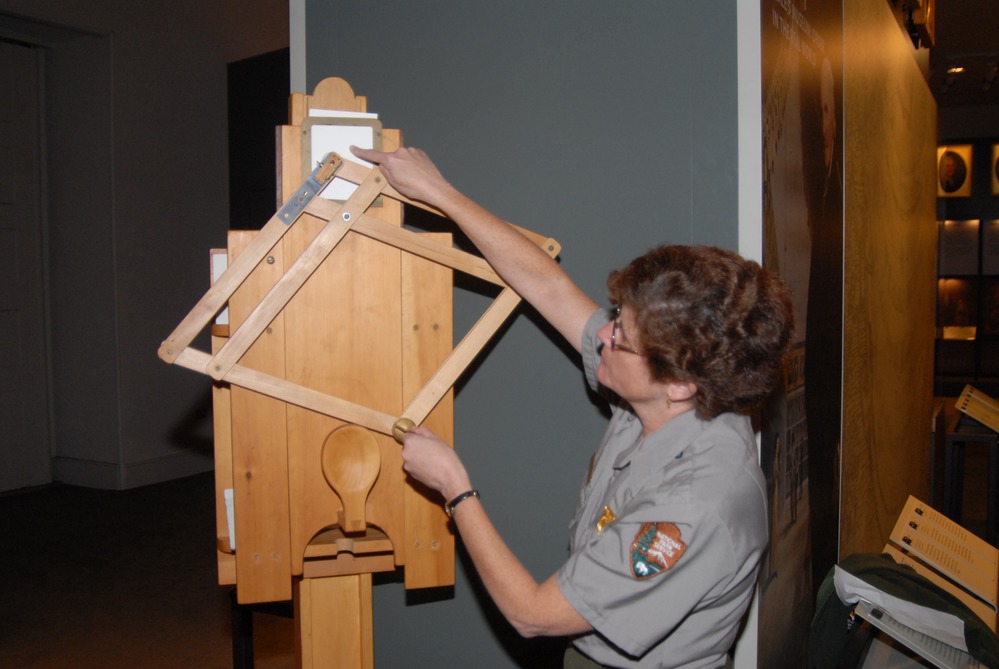
Manumitted in 1802, Williams operated a physiognotrace (face-tracing) machine “every day and evening” at Peale’s Museum.

Working in anonymity, Williams became a master silhouette artist and contributed to the success of Peale’s Museum. In Black Out: Silhouettes Then and Now, Asma Naeem observed:

Williams defied racial strictures by using his [hands] to make the portraits of hundreds of thousands of white individuals. The sight of Williams operating the physiognotrace at the Peale Museum on a daily basis, year after year, offered a consistent, if somewhat tepid, rebuke to the proslavery discourse of suppression and forcible restraining of black people – in effect, an undoing of the chained hands of the African in Josiah Wedgwood’s “Am I not a man and a brother?”… In no uncertain terms, Williams became less disenfranchised with the commercial viability of silhouettes, changing his position from being enslaved to buying his own home and marrying the white Peale family cook. … [Williams was] able to enjoy a success inextricably tied to the rising status of the silhouette as a domestic commodity and popular mode of representation.

Williams is the subject of countless scholarly articles. His silhouettes are on view at, among other places, Philadelphia Museum of Art, Portrait Gallery in the Second Bank of the United States, The Peale Museum, Yale University Art Gallery, and Thomas Jefferson’s Library at Monticello.

Williams was born one month after the signing of the Declaration of Independence. He was enslaved by “The Artist of the Revolution” Charles Willson Peale who, as a member of the Pennsylvania General Assembly, voted for the Gradual Abolition of Slavery Act of 1780.

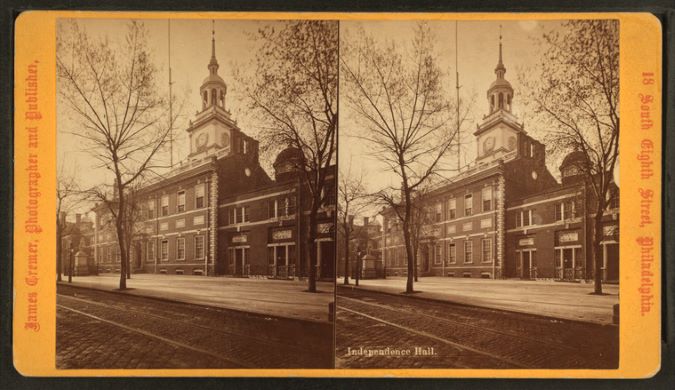
Williams was the nation’s first Black museum professional. While working on the second floor of the building now known as Independence Hall, he excelled as a “cutter of profiles” and earned a place in history.

To recognize his impact on the Revolutionary era’s visual culture, I have nominated Moses Williams for a Pennsylvania historical marker. If the nomination is approved, Williams’ marker will be dedicated in 2026, which is the 250th anniversary of both Williams’ birth and the founding of the nation.

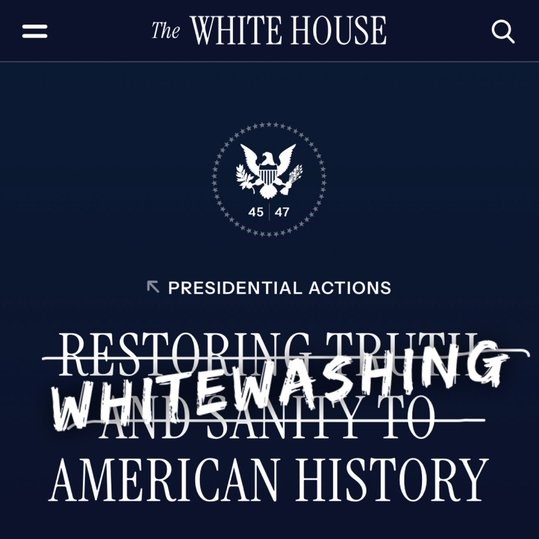
Moses Williams will not be celebrated by President Trump’s Task Force 250, but we the people will say his name.

In the meantime, I will investigate what happened to Williams’ remains.

Williams joined the ancestors on December 18, 1830. He was interred at Northwest Burial Ground on December 20, 1830.

Northwest Burial Ground was located in North Philadelphia. Between 1860 and 1875, the burial ground closed, the bodies disinterred, and the land developed for a church. So where was Williams reinterred? Is his gravesite marked?

For updates, send your name and email address to phillyjazzapp@gmail.com.

Black History Month: Ida B. Wells

Educator and investigative journalist Ida B. Wells gave no quarter to white supremacists. Born into slavery in Mississippi during the Civil War, Wells led an anti-lynching campaign and became a prominent voice against racial violence and discrimination.

Beginning in 2022, the U.S. Mint American Women Quarters Program has commemorated phenomenal women.

The 2025 honorees are Althea Gibson, Juliette Gordon Low, Stacey Park Milbern, Dr. Vera Rubin and Ida B. Wells.

The quarters give new meaning to making some coin. To secure a bag of Ida B. Wells quarters, go here.

76ers Arena Was All a Dream

Josh Harris, David Blitzer and David Adelman have moved on. 76 Place Facebook and X (Twitter) accounts, and website were scrubbed from the internet on January 16, 2025, less than a month after City Council caved in to the billionaires’ demands.

But the internet never forgets. 76 Place falsehoods, factoids and disinformation live on the Internet Archive Wayback Machine, including this pledge.

From Day One, the billionaires were all in for themselves. They pledge allegiance to the almighty dollar. More money is what they want.

Common Sense and 76ers Arena Nonsense

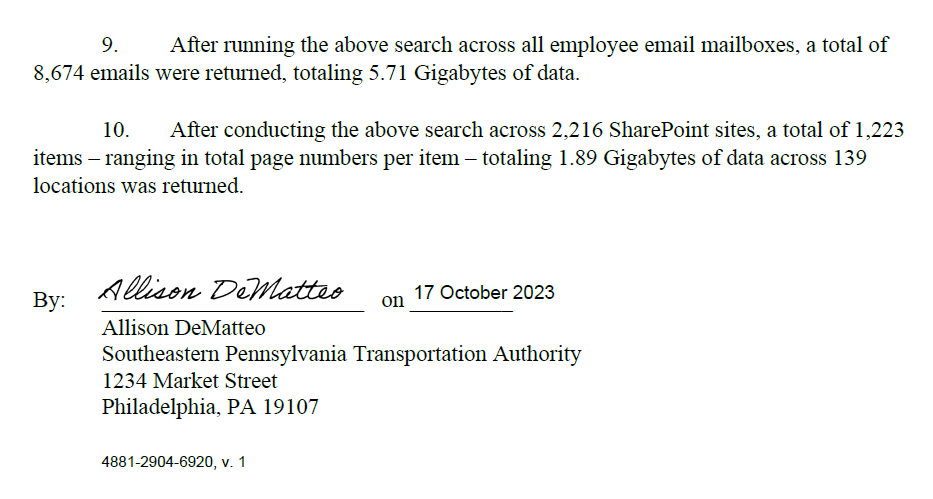
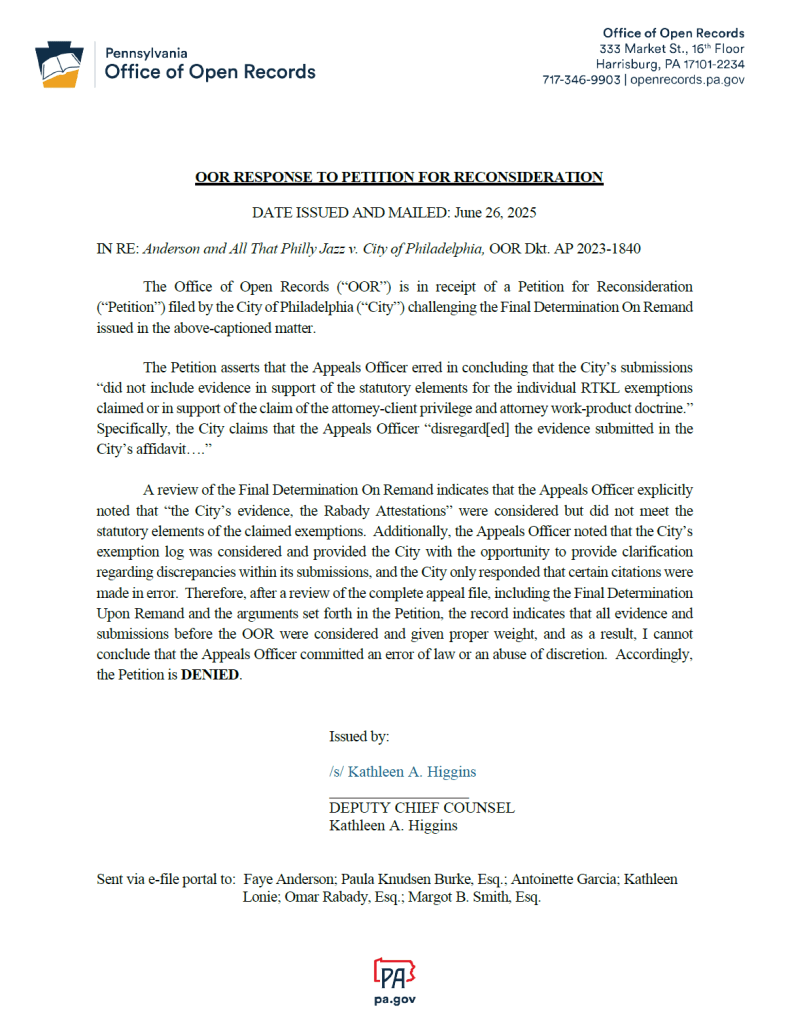
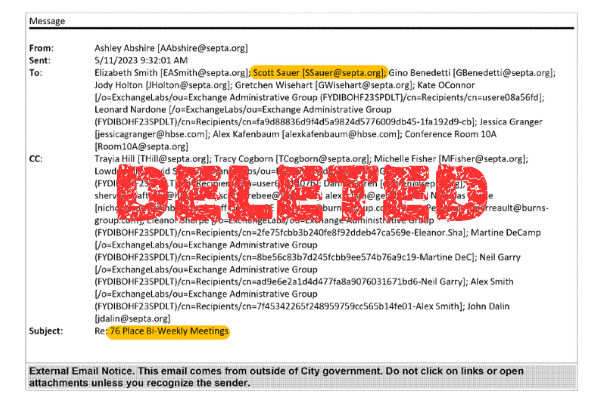
The City of Philadelphia and SEPTA are fighting release of records related to the Sixers’ proposal to build an arena atop Jefferson Station as ordered by the Pennsylvania Office of Open Records in 2023. The city and SEPTA appealed the OOR’s final determination. Their lawyers have asked whether I want to continue to pursue my records requests. If they want to end litigation, the city and SEPTA can simply stop litigating and turn over the records.

For more than two years, Philadelphia’s misleaders gaslighted the public into believing that all that was needed for the Sixers’ half-baked proposal to become “a done deal” was the approval of enabling legislation by City Council.

It is said that common sense is not so common. Neither Mayor Cherelle L. Parker nor City Council can grant the right to build on SEPTA property. Someone on Mayor Parker’s bloated staff should have had enough common sense to ask whether SEPTA was on board with the transit-oriented development.

We now know SEPTA was not on board. Then-interim General Manager Scott Sauer’s testimony before City Council’s November 19, 2024 public hearing should have ended the nonsensical notion that 76 Place would keep the transit agency from falling off the fiscal cliff:

The reality is that SEPTA simply cannot assume these new costs within the framework of its operating budget… SEPTA cannot shoulder the burden of expanded transit costs at 76 Place which would be in addition to the existing fiscal challenges.

Mayor Parker and 12 City Council members ignored the red flags. As I wrote in an opinion piece for the Philadelphia Inquirer, the Sixers’ billionaire owners knew the Federal Transit Administration was the shot caller in the 76ers arena saga:

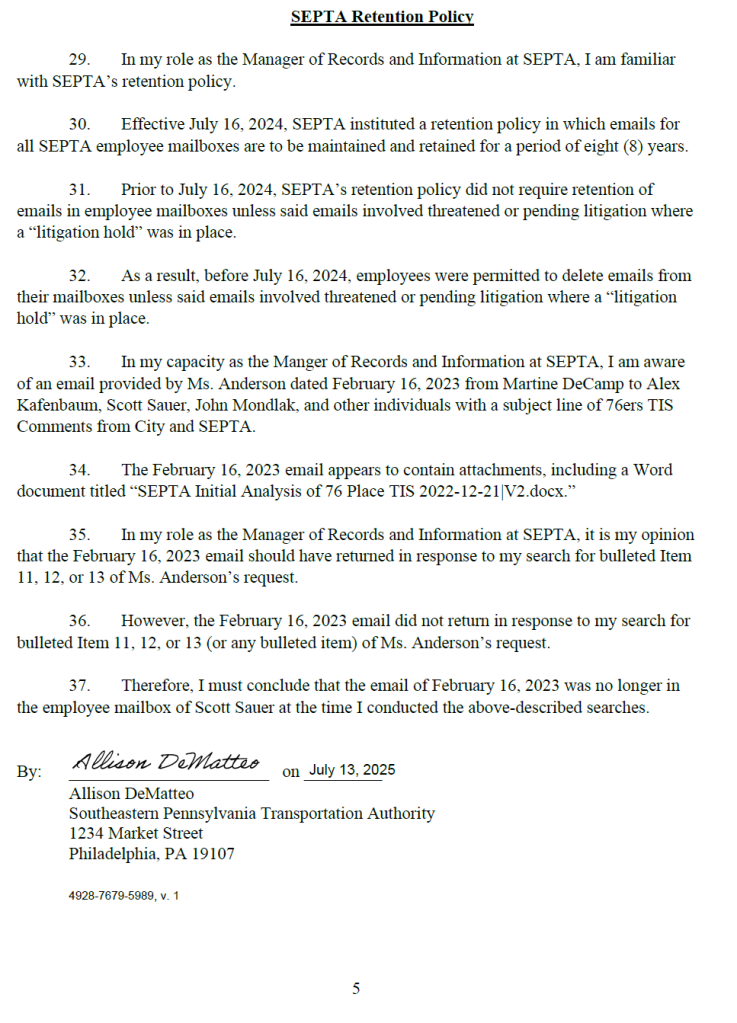
SEPTA received federal funding to make improvements to Jefferson Station. In order to protect the “federal interest,” changes to the use of the station must be approved by the Federal Transit Administration. In other words, federal officials call the shots.

Sixers co-owner David Adelman tacitly acknowledged the crucial role played by Washington in a social media post following City Council’s 12-5 vote: “We look forward to pursuing the remaining approvals to make 76Place a reality.”

Read more.

76 Place Game Is Over

The Philadelphia 76ers billionaire owners gamed Philadelphia’s “corrupt and contented” ecosystem. When building an arena atop SEPTA’s Jefferson Station no longer served their interest, it was game over. The 76ers are staying in South Philly with their landlord-turned-partner, Comcast Spectacor.

The Philadelphia Inquirer reported:

The team has struck a deal with Comcast Spectacor to remain in the South Philadelphia sports complex, after more than two years of heated debate over moving to a potential new arena on East Market Street.

[…]

The reversal is a stunning end to a saga that has dominated city politics for more than a year and a setback for Mayor Cherelle L. Parker and others who championed the $1.3 billion Center City proposal.

At a press conference, Mayor Parker said, “This is a curveball that none of us saw coming.” Well, I saw it coming. It was only a matter of time before the Sixers abandoned their public transit-oriented project.

The ballyhooed legislation City Council passed was little more than a zoning permit. Neither Mayor Parker nor City Council can give the billionaires the right to enter Jefferson Station. They need SEPTA’s and the Federal Transit Administration’s approval of the development project. The review process could take years.

So, the billionaires were negotiating a deal with Comcast Spectacor while Mayor Parker and City Council were carrying their water. Philly’s misleaders were not just played. In the immortal words of Malcolm X, they were had, took, hoodwinked and bamboozled.

My New Year’s Resolution

This year marks the 10th anniversary of PHL Watchdog. In the words of legendary gospel singer James Cleveland, “I don’t feel no ways tired.”

As a longtime advocate for transparency and accountability, every year I resolve to “comfort the afflicted and afflict the comfortable.” That includes submitting as many open records requests as necessary to shed light on what is being said and done behind closed doors.

Some agencies may want to falsely label me a “vexatious” or “repetitive” requester. As vexing as the Right-To-Know Law is for corrupt public officials, I have no “vexatious intent.” The public has the right to know whether officials are acting in the public interest or doing the bidding of special interests.

In 2025, I resolve to keep on pushing.

City Council Gives Philadelphians a Lump of Coal for Christmas

As expected, City Council gave final approval to enabling legislation that gives the Philadelphia 76ers a zoning permit to build an arena in the footprint of the Fashion District. Mayor Cherelle L. Parker said, “All of Philadelphia will benefit from this project.”

Truth be told, the 12 to 5 vote is a victory for the building trades unions and the Sixers billionaire owners. In this infamously “corrupt and contented” city, mayors and City Councilmembers genuflect to Big Labor. But neither Parker nor City Council has the authority to give the Sixers the right to enter SEPTA’s property. The billionaires now must get the approval of SEPTA and the Federal Transit Administration to enter Jefferson Station. David Adelman tacitly acknowledges this fact in a tweet sent after the vote:

We look forward to pursuing the remaining approvals to make 76Place a reality.

The enabling legislation does not include a solution to SEPTA’s recurring budget deficit of $240 million. The flex funding is a stopgap measure that bought SEPTA six months before the transit agency, again, faces a “death spiral.” SEPTA officials have already testified that the transit agency cannot be “burdened” with the operational costs of managing the demolition of the Fashion District, construction of the arena, and additional service to accommodate the 76ers’ schedule.

Stay tuned.

Bad Things Happen in Philadelphia

Philadelphia has ranked as the poorest big city in the country for decades. The high poverty rate is not a bug; it’s a feature. Philadelphia’s misleaders are not interested in reducing poverty because there’s a lot of money to be made by insiders and cronies managing poor people.

There is also a lot of money to be made by insiders and cronies with the Sixers’ proposal to build an arena atop SEPTA’s Jefferson Station. For more than two years, the billionaire owners of the Philadelphia 76ers have spent millions of dollars lobbying and spreading misinformation about the economic benefits of 76 Place.

By a vote of 12-4 on December 12, 2024, City Council gave preliminary approval to legislation enabling 76 Place to move pass the first round. Councilmembers Jamie Gauthier, Rue Landau, Nicolas O’Rourke, and Jeffery Young Jr. voted against the enabling legislation. Councilmember Kendra Brooks, a staunch opponent of the arena, was absent.

The Sixers made it pass the first round with an assist from Philadelphia’s misleaders. The enabling legislation does not give the billionaires the right to construct an arena on SEPTA’s property. They will need more than the building trades unions to get the approval of SEPTA, which is teetering on the brink of a “death spiral,” and President Donald Trump’s Federal Transit Administration.

It ain’t over.