Who Will Be the First to Say Goodbye to 76 Place?

The Philadelphia 76ers has been courting elected officials and policymakers behind closed doors for more than two years. Axios Philadelphia recaps:

The Sixers’ pitch to build a $1.5 billion arena in Center City hits its second anniversary this month with little to show beyond slick renderings and millions of dollars spent on lobbying.

Why it matters: The transformational project can potentially turn around the struggling Market East neighborhood but has divided residents and fueled concerns about quality-of-life issues and displacement.

State of play: All eyes remain on PIDC. The public-private development agency has yet to complete independent studies on the economic and community impacts of the plan, known as 76 Place.

Key legislators and officials have said they’re awaiting the completion of those studies before moving forward, including with legislation needed to kickstart the project.

The intrigue: The studies are a half-year behind schedule and span two mayoral administrations.

What they’re saying: PIDC spokesperson Kevin Lessard tells Axios there’s no timeline to finish the studies.

76 Place social media team has not posted on X/Twitter in more than six weeks.

Who will be the first to say goodbye to the billionaires’ scheme to make more money on the backs of taxpayers in the poorest big city in the country?

UPDATE: 76 Place is back posting on X/Twitter. David Adelman is regurgitating already debunked factoids.

Stop the Presses: Construction Workers Support Building New Arena

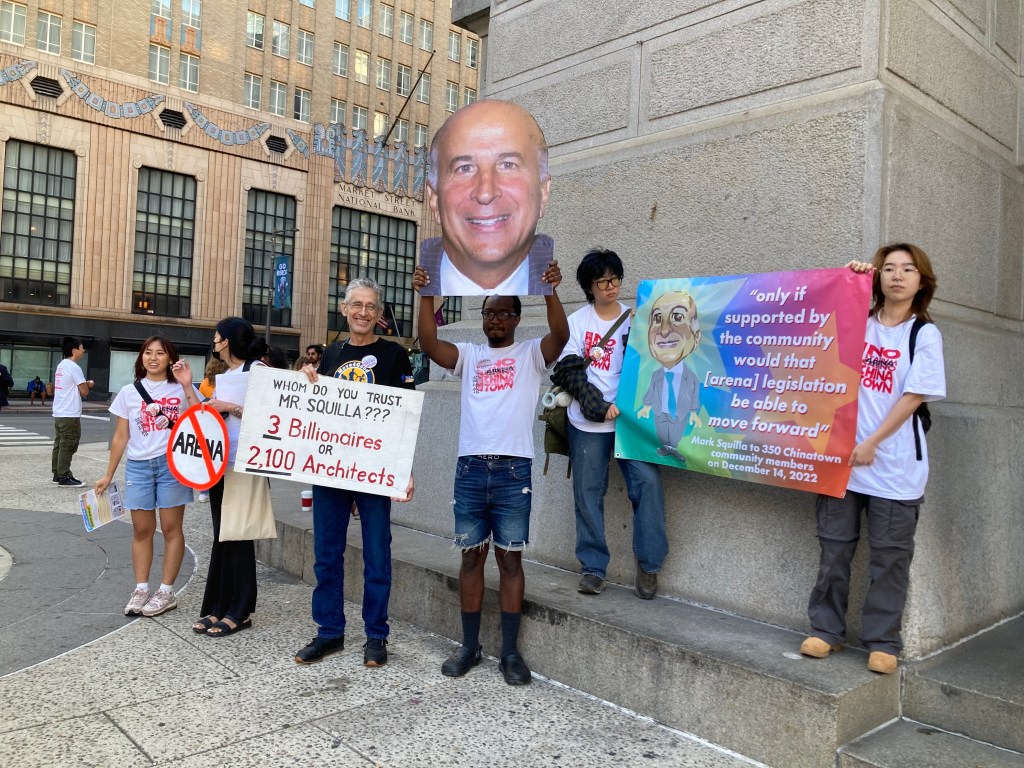
It’s baseball season and the Philadelphia 76ers are back at the top of the order. 76 Place hype man, billionaire David Adelman, held a pep rally with construction workers on April 12, 2023.


With limited support for the Sixers’ “win-win” proposal to build a basketball arena atop Jefferson Station, Adelman held a pep rally with construction workers on June 3, 2024.


Here’s the thing: Those “thousands of construction jobs” would be created whether the arena is built in Philadelphia, Camden, or wherever.

The Sixers’ have spent millions on lobbyists, newspaper, TV and social media ads, window signs, paid canvassers and billboards for their Astroturf campaign. With little self-awareness, Adelman is now whining that it has “been hard to cut through some of the manufactured noise.”

Adelman says, “We love Philly.” What’s love got to do with it? Study after study shows that the push for a new sports arena is all about more profits for billionaire team owners.

Black Music Month: Let the Sunshine In

This year marks the 45th anniversary of Black Music Month. The celebration of African American musicians and their contribution to American culture is the brainchild of music mogul and Rock and Roll Hall of Fame inductee Kenny Gamble, radio personality and media coach Dyana Williams and Cleveland DJ Ed Wright.

The first celebration was held on June 7, 1979. President Jimmy Carter and First Lady Rosalynn Carter hosted a dinner and concert on the White House’s South Lawn.


I love music. I also love transparency and accountability in government. Sunshine is said to be the best disinfectant (h/t Louis Brandeis). So Black Music Month and, indeed, every month, let the sunshine in.

Philadelphia Art Commission’s Inartful Dodge

The Philadelphia Art Commission falls under the Department of Planning and Development. When questioned by Valerie Russ of The Philadelphia Inquirer about the short notice given for the Art Commission’s May 8, 2024 meeting, Department spokesperson Bruce Bohri said, “Public notice for this Art Commission meeting is compliant with the Sunshine Act.”

Under the Sunshine Act, public agencies must provide at least three days advance notice of a regular public meeting. Art Commission staff met with Midwood Investment & Development’s art curator for over a year but the public was given the minimum notice.

Tellingly, Bohri is silent about whether Odili Donald Odita’s concept design is compliant with Section 14-702(5) of the Philadelphia Zoning Code:

The items or programs provided to earn this bonus must meet the definition of “On-site Public Art” or “On-site Cultural Programming” in Chapter 14-200 (Definitions). It is not the intention of these requirements to allow decorative, ornamental, or functional elements of the building or public space that are not designed by an artist and created specifically for the site, nor to have landscaped areas or other furnishings or elements required by this Zoning Code, to qualify as part of the public art requirement.

After 40 minutes of “deliberation,” Commissioners gave final approval to Odita’s repetitive design that has been installed on walls from Philadelphia to Venice, Italy. The only thing new about Odita’s “Newfound Forms” is the medium. This would be his first public sculpture.

To be honest, I question whether Odita ever visited the site. If he had, he would know that 12th Street is one way and the correct SEPTA bus route.


Bohri claimed the review was “consistent with longstanding Art Commission procedure.” But get this: In their submission to the Art Commission, Midwood acknowledged that “this will be the first public art erected pursuant to this zoning bonus.” The 40 minutes from presentation of the concept design to final approval by the Commissioners is without precedent.

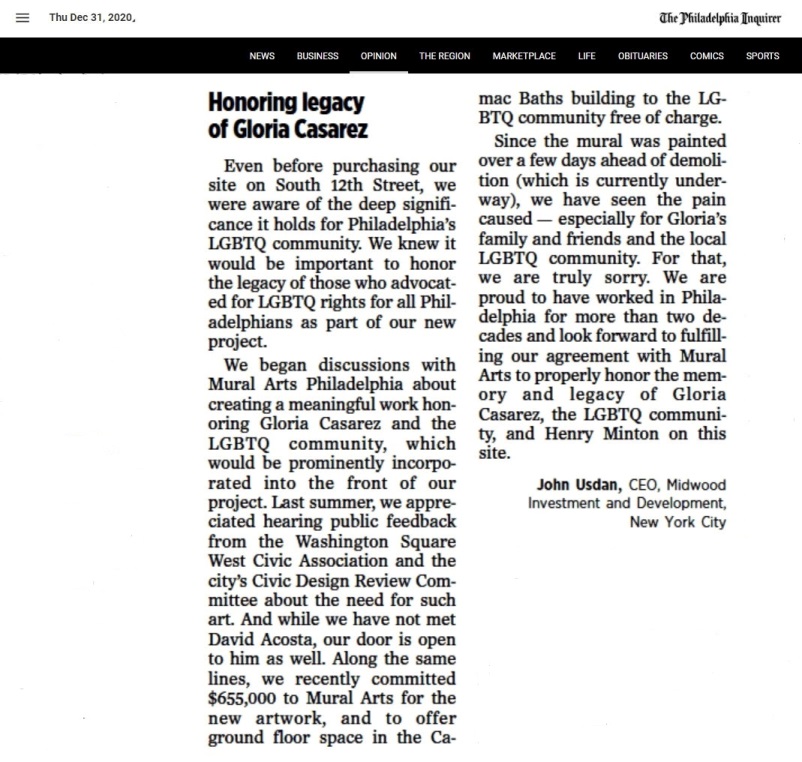
In a letter to the editor published by The Inquirer on December 31, 2020, Midwood CEO John Usdan promised “to properly honor the memory and legacy of Gloria Casarez, the LGBTQ community, and Henry Minton on this site.”


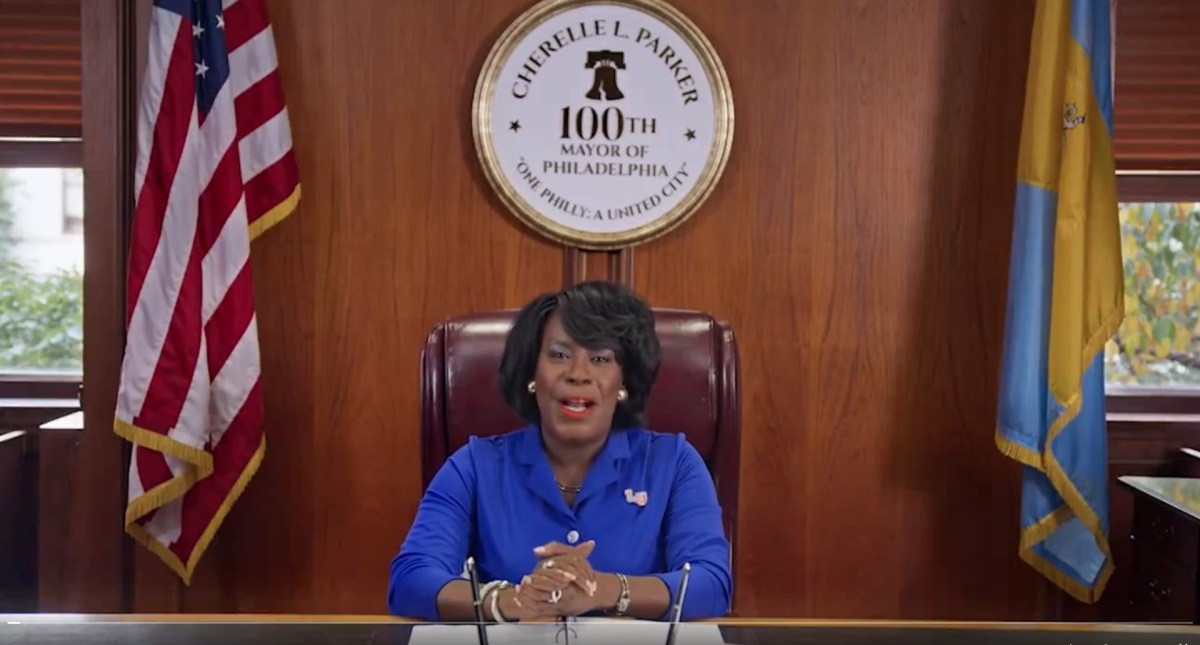
A nameless representative told The Inquirer Midwood’s offer to recreate the Gloria Casarez mural “still stands.” Will Mayor Cherelle L. Parker hold Usdan to his promise to honor Black abolitionist Henry Minton?

Public Art Matters

On the eve of Black History Month 2021, Midwood Investment & Development demolished one of the few extant buildings associated with the Underground Railroad. The New York City-based developer demolished the former home of Henry Minton, an elite caterer and abolitionist who played host to icons of American history, including John Brown, Frederick Douglass and William Still.


The Henry Minton House had been the subject of a heated discussion at the Philadelphia Historical Commission in 2019. The road to demolition was paved by the Commissioners who ignored the unanimous recommendation of the Committee on Historic Designation.

Before demolishing the Henry Minton House, Midwood had painted over a mural honoring LGBTQ+ activist Gloria Casarez which adorned a wall of the 12th Street Gym.

The whitewashing of Gloria’s mural triggered a media firestorm. Midwood CEO John Usdan promised “to properly honor the memory and legacy of Gloria Casarez, the LGBTQ community, and Henry Minton on this site.”


Demolition of the Henry Minton House and 12th Street Gym was not the end of the story. Midwood has a conditional public art density bonus that allows the developer to build more cookie-cutter apartments on the site. 210 S 12th Street is in the footprint of the Henry Minton House and 12th Street Gym. The public art zoning density bonus is site-specific and must be approved by the Philadelphia Art Commission.

Fast forward to April 24, 2024, the law firm that represented Midwood at the contentious Historical Commission meeting asked to be placed on the Art Commission’s May 8, 2024 agenda. The Commission’s response: Done.

While Art Commission Director Alex Smith met with Midwood’s art curator “over the past year,” the public was given three business days’ notice. The agenda was posted on Friday, May 3, 2024. The Art Commission meeting was held on Wednesday, May 8, 2024.

In this shamelessly “corrupt and contented” city, the Art Commission conducted a sham review of Midwood’s concept design. In less than 40 minutes, the Commissioners voted to give final approval to a concept design that erased the African American and LGBTQ+ history of the site. The Commission approved a pig in a poke, e.g., “Rendered colors indicative only – Final color selection TBD in Design Development.”


The rendered colors’ similarity to the Pride Rainbow flag is a mere coincidence. Other than the medium, there is nothing new about “Newfound Forms.” Painter Odili Donald Odita’s repetitive design was installed in Philadelphia on a now-blocked mural, Cleveland, Richmond and Venice, among other cities.

Author E.A. Bucchianeri said, “Art is in the eye of the beholder, and everyone will have their own interpretation.” Ray Charles and Stevie Wonder could see final approval of Odita’s repetitive design made a mockery of the site-specific public art density bonus.

I have submitted a Right-To-Know Law request that will shed light on the Art Commission’s perversion of the public art review process.

76 Place Masquerade

76 Place development team’s second time before the Civic Design Review committee fared no better than the first time. KYW Newsradio said the Sixers’ master plan for Market East “got another brutal bashing.”

The Philadelphia Inquirer reported:

Members of a city-appointed advisory panel panned the Sixers plan for a downtown arena on Tuesday, calling it “undercooked” and questioning whether construction would repeat harmful mistakes of the past.

“I don’t think as a city we just need to accept this as our fate,” said committee member Ashley DiCaro, a senior associate at Interface Studio urban planning. “We need to think about the real giveback here and whether we should build this thing.”

Not to be outdone, the Camden-based 76 Place communications team posted a half-baked transit map rife with errors on X/Twitter. When the map was ridiculed, the post was deleted.

Much to their chagrin, I had taken a screenshot.

AT&T Station was renamed NRG Station in 2018. There is no “Bridgeburg” station. The Bridesburg Station is located in Northeast Philadelphia, not in North Philly at the end of the Broad Street Line. How can anyone trust the design of a transit-oriented project when they cannot draw an accurate transit map?

76 Place front man David Adelman told a group of businesspeople that “five years from now people will look back and feel like this was a no brainer.”

Five years ago, the Fashion District was a “no brainer.” The state and city pumped $137 million into the project to revitalize Market East. As noted during the CDR, the Fashion District is now a dying indoor mall:

She [Ashley DiCaro] and some other members of the city’s Civic Design Review committee — which includes design and land-use experts — reached back a half-century to the building of the Gallery mall, which turned three central blocks of East Market Street into a mostly closed, inward-facing series of walls. Five years ago the site became the Fashion District, another struggling mall, where the basketball team intends to build.

Today, DiCaro said, it’s clear the Gallery was a mistake, one that wiped away the natural urbanism of the city in exchange for a promise of development.

The promised development never happened. Instead, Adelman and his development team began meeting with government officials behind closed doors in April 2022. The proposed arena would demolish a section of the publicly-subsidized Fashion District.

In a city that’s majority-minority, Adelman, a billionaire, is playing the race card to further line his pockets. One Pennsylvania Political Coordinator Nydea Graves said:

Arenas are not for the community, they are for the developers. 76 Place won’t pay any property taxes. Research shows that wages fall for black workers when arenas are built. None of this helps our people. The developers pit black folks and Asian folks against one another, keeping us busy while they profit. 76 Place is the same old exploitation dressed up in a Sixers jersey.

76 Place is a self-serving project masquerading as “a catalyst to redevelop and bring back Market East,” a decades-old dead zone for retail and hot spot for crime.

April Fool: 76 Place is ‘More than an Arena’

As the proverb goes, fool me once, shame on you; fool me twice, shame on me. Truth be told, few have been fooled by the Philadelphia 76ers’claim that their proposal to build a basketball arena atop SEPTA’s Jefferson Station is “more than an arena.”

The 76 Place development team’s X/Twitter timeline is a stream of jackleg preachers and numbers plucked out of thin air.

I asked Microsoft’s chatbot how many construction workers were involved with One World Trade Center:

During the construction of One World Trade Center, more than 10,000 workers were involved in building this iconic complex in Lower Manhattan, New York City. The scale of this project required careful coordination, and at any given time, there could be as many as 1,100 workers on-site. These dedicated individuals worked tirelessly to create a symbol of resilience and hope, and their efforts culminated in the completion of the 94-story tower that now stands as the tallest building in the Western Hemisphere.

I gave the same prompt to ChatGPT:

One World Trade Center, also known as the Freedom Tower, was constructed by thousands of construction workers over several years. The exact number of workers involved in the construction process can vary depending on the source, the phase of construction, and the specific tasks being carried out. However, it’s estimated that at its peak, there were approximately 3,500 workers on-site daily during the construction of One World Trade Center. This number includes various trades such as ironworkers, electricians, plumbers, carpenters, and many others who contributed to the building’s construction.

I pity the fool who thinks that building a big box arena on Market Street would create “12,200 construction-related jobs.”

Second Time Around for 76 Place and Civic Design Review

Back in the day, Shalamar had a hit with “The Second Time Around.” As the song goes, the second time around is “better than the first time.”

The first time that 76 Place at Market East development team presented their plan before Civic Design Review, the only people who said anything positive about the project are on the Sixers’ payroll. During the public comment period, no one spoke in support of 76 Place.

The development team will sing the same old song that 76 Place is a “win-win” for Philadelphia during their second time before CDR. However, the 106-page CDR Resubmission is no better than the one presented the first time around.

The updated plan leaves unanswered questions that have been asked for nearly two years, including who will pay for infrastructure and SEPTA upgrades? Who will pay to relocate the entrance to the Market-Frankford Line? Who will pay for the disruption in SEPTA service and ridership?

The Sixers propose using 12th and Chestnut Streets as rideshare pick-up and drop-off zones.

The narrow one-way streets are used by Routes 21 and 23, two of SEPTA’s highest ridership bus routes. Demolition, construction and game days would disrupt Route 33.

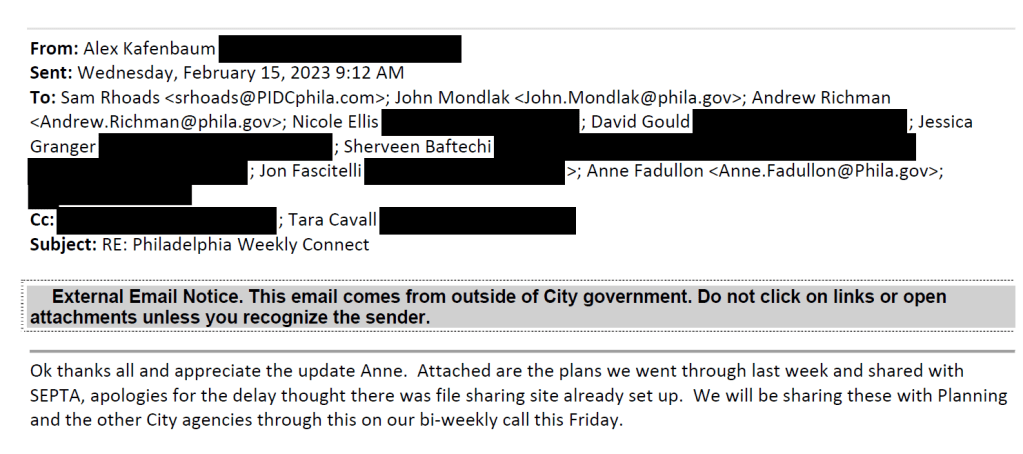
It is also the second time around for two government officials whose communications with the Sixers are the subject of my Right-To-Know Law Request: Philadelphia City Planning Commission Interim Executive Director Martine Decamp and PCPC Presenter Ian Litwin.

The Pennsylvania Office of Open Records ordered the City Planning Commission to turn over the records. Rather than comply with the OOR’s final determination, the Philadelphia Law Department filed an appeal with the Court of Common Pleas.

I have an appointment to watch paint dry so I will miss the Sixers’ dog and pony show on April 2. If you are interested in joining the Zoom meeting, you can register for the webinar here.

And The Winner Is …

I nominated SEPTA CEO and General Manager Leslie S. Richards for the Society for Professional Journalists’ 2024 Black Hole Award. The cash-strapped public transit agency has money to pay an outside law firm to fight the release of records as ordered by the Pennsylvania Office of Open Records.

In the OOR’s final determination, SEPTA was ordered to turn over records related to the Philadelphia 76ers’ proposal to build a basketball arena atop Jefferson Station. Like the transit agency she has run into the ground, Richards did not make the cut. The Black Hole Award went to the North Carolina General Assembly.

During Sunshine Week, I received notice that SEPTA submitted the Certified Record of my Right-To-Know Law Request to the Commonwealth Court of Pennsylvania. The legal maneuver is designed to delay compliance with the OOR order. Common sense suggests that if the records supported the Sixers’ claim that 76 Place is a “win-win” for SEPTA and the City of Philadelphia, they would have been released. It bears remembering what SEPTA Director of Media Relations Andrew Busch told NBC Sports Philadelphia in July 2022:

Yes, the Sixers have been in touch with SEPTA regarding their plans for the new arena. We are looking forward to continuing to work closely with the team, the city and other stakeholders moving forward.

There is still no timeline for release of the arena impact studies that were due in December 2023. Tellingly, the Sixers have not released their study that supports their factoid that 76 Place would generate $1.5 billion in new tax revenue. The Philadelphia Inquirer reported:

They have declined to share the calculations behind their tax figure. And they’ve made other bold claims, including the creation of 1,000 permanent jobs and $400 million in annual “economic output.” Meanwhile, the city-sponsored studies that are supposed to offer clarity to decision-makers are months overdue.

With an air of exasperation, City Councilmember Mark Squilla recently told CBS News Philadelphia: “By the end of this year, it will be determined whether we move forward or not.” The clock is ticking.

Sunshine Week: John Coltrane House Update

March 10-16, 2024 is Sunshine Week, a time to celebrate transparency, and the right to know what government officials are doing and saying behind closed doors. I used the Freedom of Information Act (FOIA) and Pennsylvania’s Right-To-Know Law to tell the story of the deteriorating condition of the John Coltrane House and the drama over ownership of the National Historic Landmark.

John Coltrane’s beloved “Cousin Mary,” Mary Alexander, sounded the alarm about the physical deterioration of the property as early as 1987.

From time to time I would check on the Coltrane House. Without access to the property, I reported illegal dumping and other violations visible from the public right of way. I am a cold weather person but on a hot and humid morning in August 2019, I felt an overwhelming urge to stop by the Coltrane House. I later learned that Cousin Mary joined the ancestors the same day that I was snooping around her former home. I vowed then that I would do whatever I could to preserve the historic landmark in public memory.

I successfully nominated the Coltrane House for inclusion on 2020 Pennsylvania At Risk. Designation does not bring any resources; instead, it brings renewed media attention to a historic landmark at risk of demolition by neglect.

News stories about the designation were published in February 2020. I had a conference call with Ravi Coltrane to explore next steps on March 13, 2020. I have not spoken with him since that conversation. However, news articles about the At-Risk designation were included as exhibits to the case that Ravi and Oran Coltrane filed to gain possession of the property on April 27, 2022.

Fast forward to May 2023, the parties reached an agreement in principle. The outcome was predetermined given the existence of a valid will. Under the terms of their grandmother’s will, Ravi and Oran should have gained possession of the property upon the death of Cousin Mary on August 31, 2019.

Norman Gadson is still listed as the owner on property and tax records. Last week, the New York Times reported the African American Cultural Heritage Action Fund, a program of the National Trust for Historic Preservation, “will assist in coordinating and financing the transfer of Coltrane’s home from its current owner back to his family.”

The Coltrane House is the first site selected for the new Descendants and Family Stewardship Initiative. Brent Leggs, executive director of the Action Fund, said:

Descendants and families have been doing this work for centuries on an informal basis. The initiative is about empowering descendants and families through historic preservation more formally. Our role is to give them the resources and technical expertise they need to protect and preserve the physical evidence of the past and share their profound stories with the American public.

It has taken nearly four decades, but the John Coltrane House will finally be restored. As I told Valerie Russ of the Phliladelphia Inquirer, my work is done. Mission accomplished.