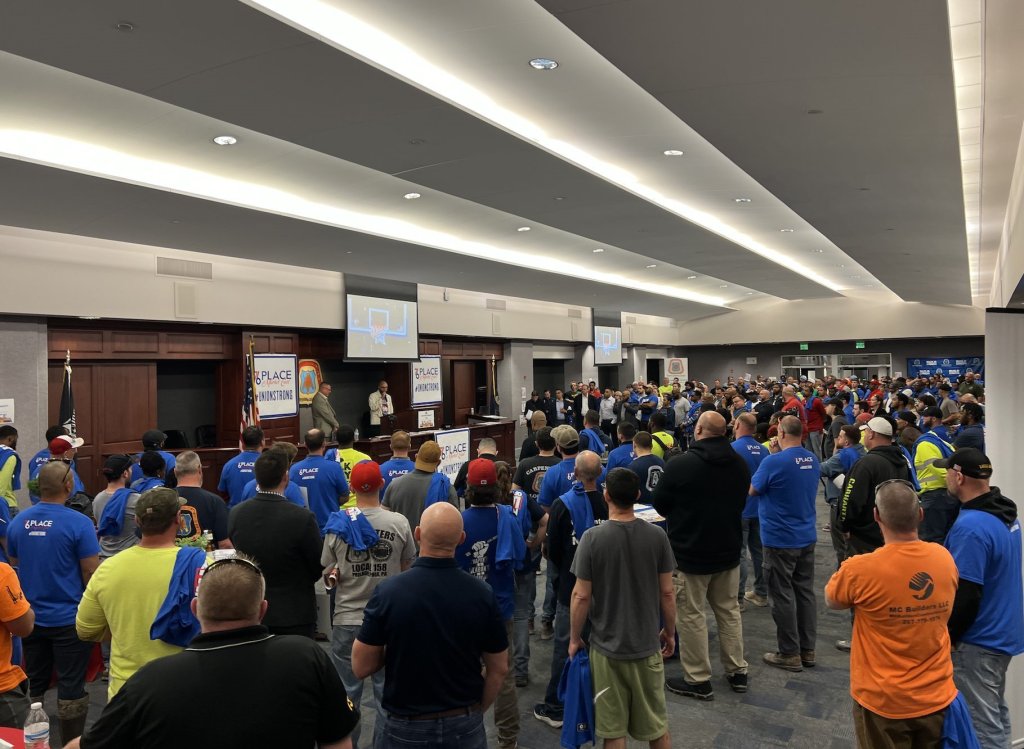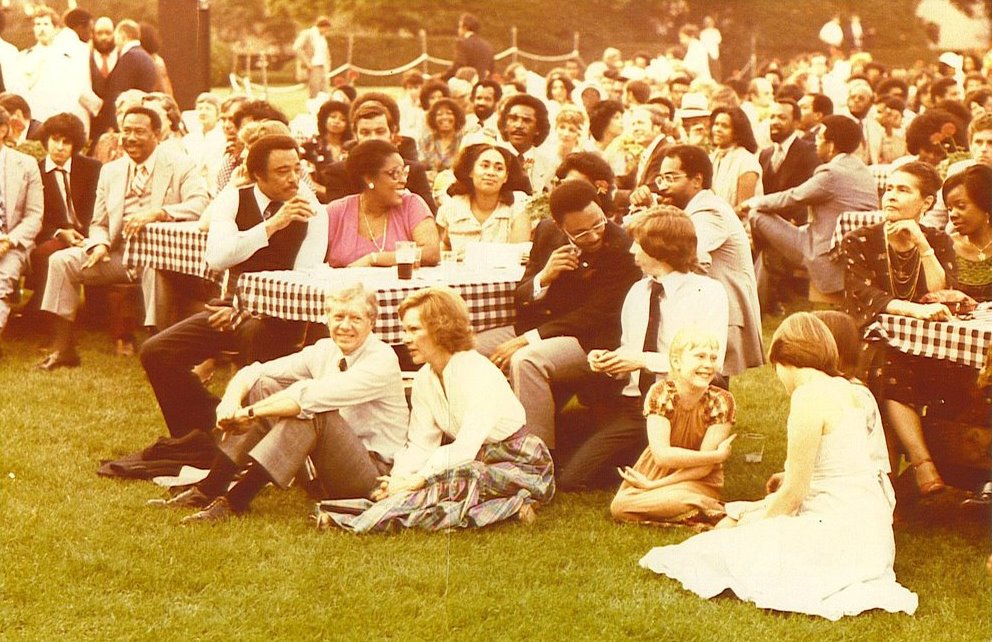
A picture is worth a thousand words. The Sixers have gone from meeting with government officials in corner offices to astroturfing in corner stores.
Axios Philadelphia reports the Sixers have spent more than $4.4 million lobbying for a basketball arena that few other than the 76ers’ billionaire owners want.
The Philadelphia 76ers publicly announced their proposal to build a basketball arena atop Jefferson Station on July 22, 2022. The billionaire owners’ “done deal” has devolved into an echo chamber of attacks and counterattacks by opponents and supporters of 76 Place. In the absence of facts, the Sixers’ communications team has filled the void with fanciful factoids like “76 Place is a slam dunk for Philly’s economy.” They claim an arena that would be closed more days than it would be open would generate $1.5 billion in new tax revenue.
Let’s break down the math.
$0 in taxpayer dollars. More than 30,000 jobs. Almost $1.5 Billion in new tax revenue – a portion of which goes directly to Philadelphia’s public schools.
A win for taxpayers. A win for small businesses. A win for our schools. A win for Philly. pic.twitter.com/EM9z8gtgN7
The Sixers’ math ain’t mathing. Study after study shows sports venues have a limited economic impact. In the most recent economic analysis, Dr. Arthur Acolin of the University of Washington found that 76 Place could cost Philadelphia and Pennsylvania more than $1 billion in lost tax revenue.
CBS News Philadelphia reports:
With zero self-awareness, Sixers’ limited partner David Adelman questions Prof. Acolin’s objectivity.
In the billionaire’s worldview, the public should be skeptical of an academic study but trust the economic analysis of a firm hired by PIDC and paid for by the Sixers. Records received in response to my Right-To-Know Law requests show then-PIDC president Sam Rhoads participated in “Philadelphia Weekly Connect” meetings with 76 Place representatives and government officials.
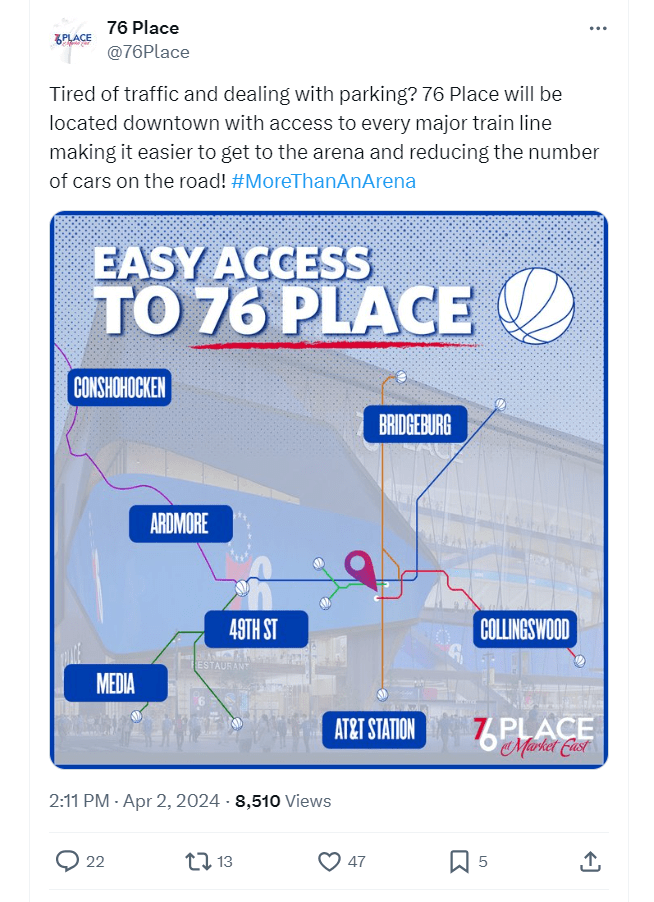
In their increasingly desperate quest for approval of their transit-oriented project in a city “without a viable transit system,” the Sixers have spent millions on lobbyists, advertising and canvassers. I recently spotted a 76 Place billboard on the Lit Brothers building. I did not take any photos because the digital images were as fleeting as the 76ers’ odds of getting past the second round of the NBA playoffs.
It has been nearly two years since the Philadelphia 76ers began meeting behind closed doors with government officials to get approval of their proposal to build a basketball arena atop Jefferson Station. Since I submitted my Right-To-Know Law requests in July 2023, lobbying expense reports show the Sixers have spent an additional $2,136,744.
Sixers’ limited partner, billionaire David Adelman, has fallen from City Hall to an event hall in Kensington, ground zero for the opioid epidemic.
Bishop Dwayne Royster, executive director of POWER Interfaith, said don’t believe the hype:
In the meanwhile, there is no timeline for release of the “independent” arena impact studies paid for by the Sixers. The studies should have been released in December 2023.
In his 2024-2025 budget address, Pennsylvania Gov. Josh Shapiro asked for an additional $161 million for SEPTA to keep the transit agency from falling off a fiscal cliff.
Today, I can report that @SEPTA has presented plans to address cleanliness and safety.
While they have work to do to make good on those plans, I'm prepared to increase our investment in SEPTA by $161 million, bringing the total state funding to $1 billion. pic.twitter.com/L3UkVeIhEr
Gov. Shapiro said SEPTA has “presented plans to address cleanliness and safety.” Just as Willie Sutton robbed banks because “that’s where the money is,” the Sixers’ proposal to build a basketball arena atop Jefferson Station would increase crime on the beleaguered system.
Christopher Herrmann, an assistant professor in the Department of Law and Police Science at CUNY’s John Jay College of Criminal Justice, recently told Gothamist:
The subway stations are typically what we call “crime generators.” Whenever you have increased people traffic, you’re going to get increased crime, and that’s because offenders want to go to places where they can have their selection of victims.
SEPTA is fighting the release of records related to their communications about the Sixers’ proposal as ordered by the Pennsylvania Office of Open Records. The records will shed light on what, if any, plan SEPTA has to address the increase in crime if the 76ers’ transit-oriented project is approved.
I shot the sheriff. But I didn’t shoot the deputy (h/t Bob Marley). You won’t read about it in the Philadelphia Inquirer or any news outlets because it didn’t happen. Nor will you read about Philadelphia Sheriff Rochelle Bilal’s “record of accomplishment during her time in office.” The Inquirer reported:
But Bilal has been telling a different story on her campaign website. It features dozens of favorable headlines attributed to local news organizations such as NBC10, CBS3, WHYY, and The Inquirer, all listing the dates of publication.
“This page,” the site proclaims, “highlights Sheriff Bilal’s record of accomplishment during her time in office.”
One snag: No one can seem to find any of the supposed news stories
For an office plagued by corruption and shady deals, spreading fake news and wasting taxpayers’ money on Deputy Sheriff Justice are “accomplishments.”
The Sheriff’s mascot gives new meaning to no justice (read: transparency and accountability), no peace from investigative journalists.
UPDATE: Philadelphia Sheriff Rochelle Bilal wasn’t tripping; ChatGPT was hallucinating. The Associated Press reports:
Sheriff Rochelle Bilal’s campaign removed more than 30 stories created by a consultant using the generative AI chatbot. The move came after a Philadelphia Inquirer story on Monday reported that local news outlets could not find the stories in their archives.
Experts say this type of misinformation can erode the public trust and threaten democracy. Bilal’s campaign said the stories were based on real events.
“Our campaign provided the outside consultant talking points which were then provided to the AI service,” the campaign said in a statement. “It is now clear that the artificial intelligence service generated fake news articles to support the initiatives that were part of the AI prompt.”
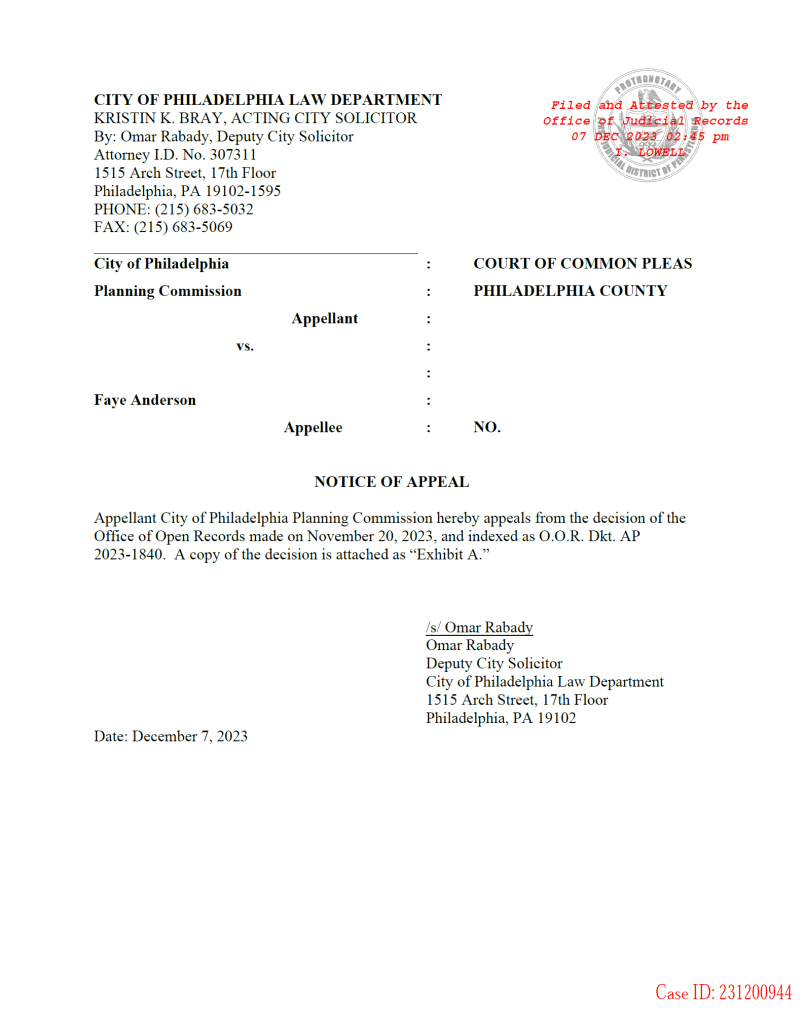
As expected, the City of Philadelphia appealed the Pennsylvania Office of Open Records’ decision. The appeal is designed to delay release of records related to the Philadelphia 76ers’ proposal to build a basketball arena atop Jefferson Station.
Sixers’ lobbyists began meeting behind closed doors with public officials about 76 Place in April 2022. Nearly two years later, a project the 76ers’ billionaire owners thought would be a slam dunk is far from over. The Philadelphia Inquirer recently reported:
The 76ers’ development team last year twice delayed its self-imposed deadline for winning Council approvals needed to build an arena on East Market Street, such as zoning changes. But it’s more likely than ever that the controversial plan will go before lawmakers before their summer recess at the end of June.
Councilmember Mark Squilla, whose 1st District includes the proposed site, will be at the center of the debate. He has said he doesn’t expect to receive drafts of the legislation until after the city completes its much-anticipated impact studies, which have been delayed and are expected to come out soon. And he has promised to give community groups 30 days to review the legislation before introducing it.
Legislation won’t be introduced until late February or later, meaning it may coincide with budget negotiations.
David Adelman has played the race card to try to stomp out opposition to the 76ers’ transit-oriented project in a city “without a viable transit system.” A self-serving group of jackleg preachers gave 76 Place their blessing.
But in the words of choir director and gospel singer Kirk Franklin, “It ain’t over.”
The Pennsylvania Office of Open Records ordered SEPTA to conduct a good faith search for records responsive to my Right-To-Know Law request for documents related to the Philadelphia 76ers’ proposal to build a basketball arena atop Jefferson Station. The records include SEPTA General Manager and CEO Leslie S. Richards’ and Chief Operating Officer Scott Sauer’s communications with City Councilmember Mark Squilla, David Adelman, and named lobbyists, lawyers and 76 Place development team. SEPTA was also ordered to turn over invoices, reports, feasibility studies, traffic impact studies, architectural designs and cost estimates.
I should have received the records no later than January 20, 2024. Instead, SEPTA filed a Petition for Review of the OOR’s decision in the Commonwealth Court of Pennsylvania at the eleventh hour on January 19, 2024.
With service cuts and fare increases looming, SEPTA is fighting to withhold from the public information about the impact of the proposed arena on its operating and capital budgets. Six years of demolition and construction would disrupt service and ridership as Jefferson Station becomes a construction zone and buses on Market Street are rerouted. Meanwhile, the public transit agency is rattling the cup in Harrisburg and Washington.
In a letter to Transportation Secretary Pete Buttigieg, members of Pennsylvania’s congressional delegation, including Senators John Fetterman and Bob Casey, and Rep. Dwight Evans, wrote:
We are at a critical juncture for transit in the Philadelphia region. Without strong, sustained support at all levels of government, Pennsylvanians risk losing access to transit and all its benefits.
[…]
SEPTA’s service is essential for the entire southeastern PA region, providing more than 700,000 daily trips throughout a five county, city and suburban territory. A high-quality transit system is essential to maintain growth and economic vitality, both downtown and throughout the region. We cannot ease congestion or reduce emissions without transit. How will we host major events in Pennsylvania, including 250th anniversary of the Declaration of Independence in two years, without a viable transit system?
In the absence of open records, the Sixers’ PR team has filled the vaccum with factoids. Fact is, 76 Place is a transit-oriented project “without a viable transit system.”
Service at Jefferson Station would be disrupted during demolition of the Fashion District shopping mall and construction of the arena. The project would require SEPTA to periodically turn off power at Jefferson Station and the 11th Street station. When that happens, riders would be told “that train don’t stop here.”
In a post on X (formerly Twitter), 76 Place hype man David Adelman floated the straw man claim of “a grand conspiracy.” Adelman said “we are talking to SEPTA about how to improve access and service at the station.”
Leslie Richards and Scott Sauer are fighting release of their communications with Adelman about the cost of improving access and service at Jefferson Station. Secretary Buttigieg should demand answers about the impact of 76 Place on the public transit agency. In the meantime, I will submit a FOIA request to the Federal Transit Administration.
The Philadelphia 76ers’ mantra is: Trust the process. Sixers’ owners Josh Harris and David Blitzer entrusted limited partner David Adelman with shepherding their proposal to build a new basketball arena through the review and approvals process. Nearly two years and millions of dollars later, 76 Place is no closer to being “a done deal.” It’s now a “saga.”
Sixers Arena Saga: Right-to-Know Appeals, Behind the Scenes "Gamesmanship," and a Question of Blacklisting https://t.co/Xb7iMsirGe
I began to draft my first Right-To-Know Law request for records related to 76 Place shortly after it was reported that a provision that would have paved the way for the Sixers to build an arena adjacent to Chinatown was slipped into an unrelated bill introduced by Councilmember Mark Squilla. Mayor Jim Kenney and Squilla pointed the finger at each other as to the source of the “immaculate” legislation.
In July, I submitted RTKL requests to then-Mayor Kenney, City Councilmembers, including Squilla, and City agencies that have jurisdiction over some aspect of the project. All of my requests were denied. The City consolidated my requests on appeal.
The Office of Open Records issued its final determination on January 9, 2024. My appeal was granted in part and denied in part. The OOR ordered the City to turn over responsive records by February 9, 2024. The records include Squilla’s communications with Adelman and PIDC, the nonprofit organization that commissioned the “independent studies” paid for by the Sixers.
The City may withhold records that contain confidential proprietary information or trade secrets. As with the earlier orders, the City is expected to appeal the OOR’s final determination to the Court of Common Pleas.
Meanwhile, the release of the “independent studies” has been delayed. Squilla appealed to the community “to wait for these studies.” In the coming weeks, we will have the spectacle of Squilla asking the public to trust a process that has been tainted from the beginning while at the same time in court fighting to withhold from the public his communications with Adelman, PIDC, and 76 Place lawyers, lobbyists and development team.
On her first day in office, Philadelphia Mayor Cherelle L. Parker released her 100-Day Action Plan. Mayor Parker promised to tackle “public safety, stubbornly high poverty, quality-of-life concerns, housing availability, burdens on local businesses, and shortcomings in our educational system.” She took aim at the Philadelphia Land Bank:
We will order a top-to-bottom review of the city’s Land Bank to better understand the challenges of developing vacant, city-owned properties—and work to significantly improve that process.
A review of the Land Bank is long overdue. Under the discredited custom of councilmanic prerogative, district Council members view City-owned land in their district as theirs to dispose as they please. So when I searched for 1517 N 33rd Street, I was not surprised the vacant lot was not in the database.
For years, Strawberry Mansion Community Development Corporation (SMCDC) has been making plans for properties that they do not own, including 1517 N 33rd Street, 1515 N 33rd Street, and 1511 N 33rd Street, the John Coltrane House .
During community events, SMCDC said it “has commitments from the City of Philadelphia and the Philadelphia Housing Authority to include two of their properties in the John Coltrane Street improvements!”
Councilmanic prerogative notwithstanding, public property cannot be disposed of with a handshake. The Philadelphia Housing Authority cannot transfer ownership of 1515 N 33rd Street without the approval of the Department of Housing and Urban Development. So I submitted a Right-To-Know Law request to PHA focusing on HUD’s disposition process as detailed in 24 CFR Part 970. PHA’s response:
There was no sale or other transfer or removal of the identified property under Section 18 of the Housing Act of 1937, CFR part 970, and PIH Notice 2021-07.
On November 30, 2023, then-City Councilmember Darrell L. Clarke introduced Resolution No. 230905 “authorizing the Philadelphia Land Bank to execute and deliver to the Philadelphia Housing Authority a deed conveying fee simple title to 1517 N. 33rd Street in the Fifth Councilmanic District of the City of Philadelphia pursuant to Section 16-706 of the Philadelphia Code.” Councilmanic prerogative ensured that no Council member would ask why the City is conveying title to a vacant lot to PHA which owns the adjacent property that has been vacant for decades. Instead, the resolution was fast-tracked for final passage on December 14, 2023.
On the day before the final vote, I submitted a RTKL request to Councilmember Clarke.
The Councilmember invoked his right to a 30-day extension so a response is not due until January 22, 2024. But my RTKL request triggered a response from Clarke: Resolution No. 230905 was among the bills and resolutions that were held from final passage. In other words, the resolution was not approved.
Philadelphia 76ers co-owner David Adelman, hype man for 76 Place, told the New York Times: “I got the chills the first time I walked by that site [11th and Market Streets]. I get it. We’re going to do this right. We’re going to honor this and respect this and find a way to enhance.” The Sixers’ billionaire owners honor the almighty dollar. They decide where to build based on how much cold hard cash they get from taxpayers.
In 2014, the Sixers received $82 million in tax credits to move their headquarters and practice facility from Philadelphia to Camden, the poorest city in New Jersey. The Sixers claimed their development project would create jobs for Camden residents. Only 11 of their 250 employees are local residents. The New Jersey Economic Development Authority found that the 76ers received a bigger tax break than they deserved and should pay back $400,000. To date, the Sixers have not repaid the money.
In 2017, Sixers billionaire owners Josh Harris and David Blitzer likely got goose bumps when Delaware dangled a tax break for a new arena for their NBA G League team, the Delaware 87ers. Harris Blitzer Sports & Entertainment received $30 million for a new arena and sports complex known as 76ers Fieldhouse. The team was renamed the Delaware Blue Coats.
The arena was renamed Chase Fieldhouse in February 2021 after JPMorgan Chase showed the billionaires a still undisclosed amount of money for naming rights.
The billionaires’ most audacious grab for taxpayers’ money happened two years before Adelman “got the chills.” Harris and Blitzer proposed a Neighborhood Improvement District that would have diverted tax revenues to them. The Philadelphia Inquirer reported:
Last week’s decision to grant Penn’s Landing development rights to a rival bidder upended the 76ers $4 billion plan to build themselves a new basketball arena at the central Philadelphia waterfront site.
[…]
Harris and Blitzer planned to seek state and local legislation granting them tax subsidies worth as much as $885 million to help pay for their proposal.
The Sixers claim their latest proposal – 76 Place – will not cost Philadelphia taxpayers a dime. Maya Angelou told us: “When someone shows you who they are, believe them the first time.” Time after time, the 76ers’ owners have shown us who they are: Billionaires who make decisions based on who shows them the money, not what gives them “the chills.”