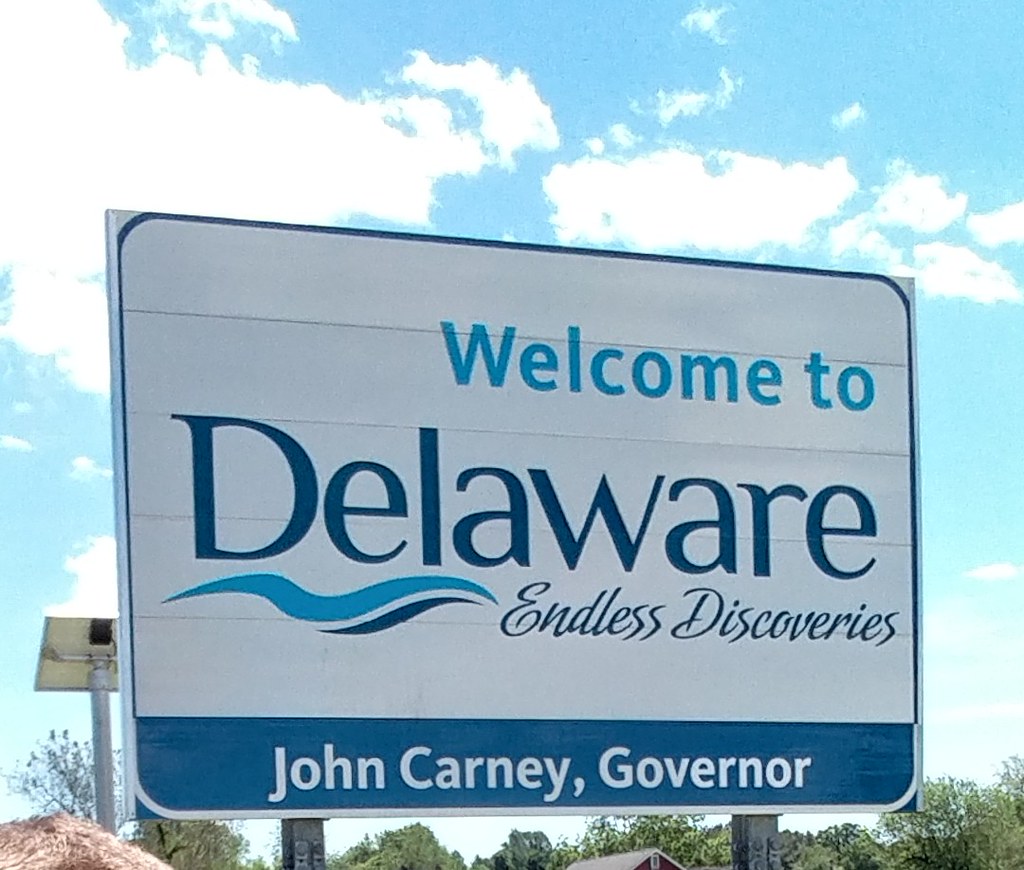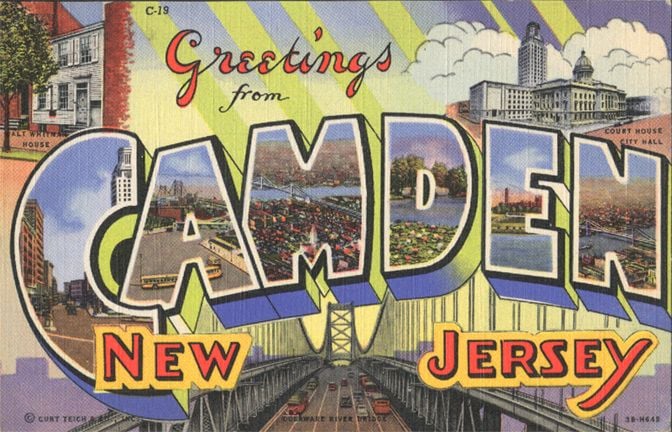
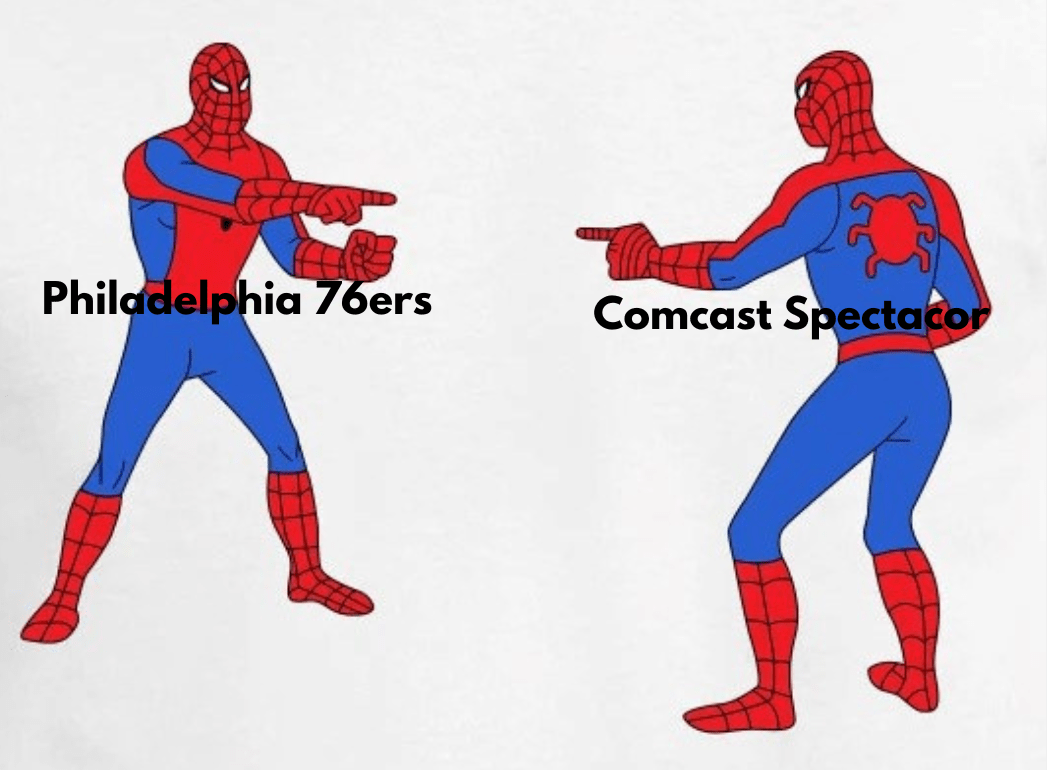
On the heels of New Jersey Gov. Phil Murphy’s invitation to the Philadelphia 76ers to move to Camden, Delaware Gov. John Carney gave it a shot. In a post on X, formerly known as Twitter, Carney told the 76ers billionaire owners: “[L]et’s build your new arena in Wilmington. We’re all in.”
Hey @sixers, if you’re looking outside of Philly, let's build your new arena in Wilmington. We’re all in.
In Delaware, you'll get: 🏀 A huge Sixers fan base 👏 No sales tax 😎 Best community around
Delaware is the self-proclaimed state of “endless discoveries.” Perhaps a move to Delaware would help the Sixers discover how to get pass the second round of the NBA playoffs. While the 76ers have not won an NBA championship since 1983, their Wilmington-based minor league team, the Delaware Blue Coats, are the 2022-23 NBA G League Champions.
Whether it is Delaware or New Jersey, take the Sixers … Please!
The billionaire owners of the Philadelphia 76ers have pushed an endless supply of factoids in their quest to win approval of their proposal to build a basketball arena in Center City. Their latest bankrolled study claims that the only thing better than having one arena in America’s poorest big city is having two arenas:
Today, 76 Place released findings from the study done by live entertainment expert CAA-ICON that confirm a second Philadelphia arena will address the unmet need for live entertainment options in the city. The newly released findings confirm what leading entertainment professionals have repeatedly said: Philadelphia not only can handle a second arena, but has been losing out on entertainment options because it doesn’t have one.
[…]
In its report examining unmet demand in Philadelphia, CAA-ICON estimated that two venues, one in South Philadelphia and a second in Center City, would each host between 125 and 150 ticketed events annually, inclusive of tenant events, Pollstar-reported events, and other ticketed events. Importantly, its estimates do not include other non-ticketed events such as community events, meetings or banquets, which will drive usage higher.
CAA-ICON also noted that major cities with just one arena are at a major disadvantage, with more limited date options because of professional sports season schedules that can eat up weekends which are key for successful tours and routing.
The billionaires’ factoids were published in PR Newswire.
Meanwhile, the region’s newspaper of record reported a second arena would “split the market.” From thePhiladelphia Inquirer:
Comcast Spectacor, concerned about the Sixers’ plan to leave the Wells Fargo Center and build a new arena downtown, hired a national real estate adviser to study the implications of having two big, competing venues in Philadelphia.
The consultant concluded the rivalry would split the market, starving both places of attendance and revenue.
There aren’t enough additional games, concerts and shows to financially support two major Philadelphia arenas of roughly the same capacity, said the report by Chicago-based Hunden Partners. It predicted taxpayers would eventually be asked to provide millions of dollars for renovations that neither arena could afford on its own.
[…]
“It’s not totally unprecedented [for a city to have two arenas],” said Dave Brooks, senior director of live music and touring at Billboard, the music-and-entertainment magazine, “but there’s only so many arena touring shows each year. Definitely Philly is a must-play city, but there’s not really any evidence that another arena is going to attract more concerts to a market. They’re probably going to be going after a lot of the same stuff.”
[…]
“Philadelphia performs below its weight class,” Hunden said, attributing that at least partially to lower household incomes in what is one of the nation’s poorest big cities.
[…]
However, the study said, the venues would roughly divide the total number of ticketed events, with 105 going to the Wells Fargo Center and 92 to the Sixers arena.
The “unmet demand in Philadelphia” is the billionaires’ pursuit of a second arena.
The billionaire owners of the Philadelphia 76ers are used to calling the shots. So they keep setting deadlines for City Council to give them what they want. First they said they wanted government approvals by June 2023. Then they said December 2023. The wannabe shot callers have set a new deadline of “early September.” A 76ers spokesperson told CBS News Philadelphia:
We remain focused on bringing a state-of-the-art arena to Philadelphia as we have been for the last four years. We are hopeful to reach an agreement with the city this summer to ensure legislation is introduced in early September, which will allow the 76ers to open our new home in time for the 2031-32 NBA season.
The billionaires don’t give a fig that the “independent studies” which they paid for have not been released. They don’t give a fig that Councilmember Mark Squilla repeatedly promised to give the public 30 days’ notice before legislation is introduced.
Squilla said he “expects a yes-or-no decision on the project by the end of the year.” As we approach the dog days of summer, the wannabe shot callers will miss yet another deadline.
A few days after setting the “early September” deadline, 76ers limited partner David Adelman told Marc Zumoff that “our timeline has always been for us to get approvals by the end of this calendar year.” For those keeping count, that’s the fourth deadline.
The Philadelphia 76ers announced their proposal to build a basketball arena atop SEPTA’s Jefferson Station on July 21, 2022. Public records show 76 Place representatives had been meeting with SEPTA and Philadelphia government officials as early as April 2022.
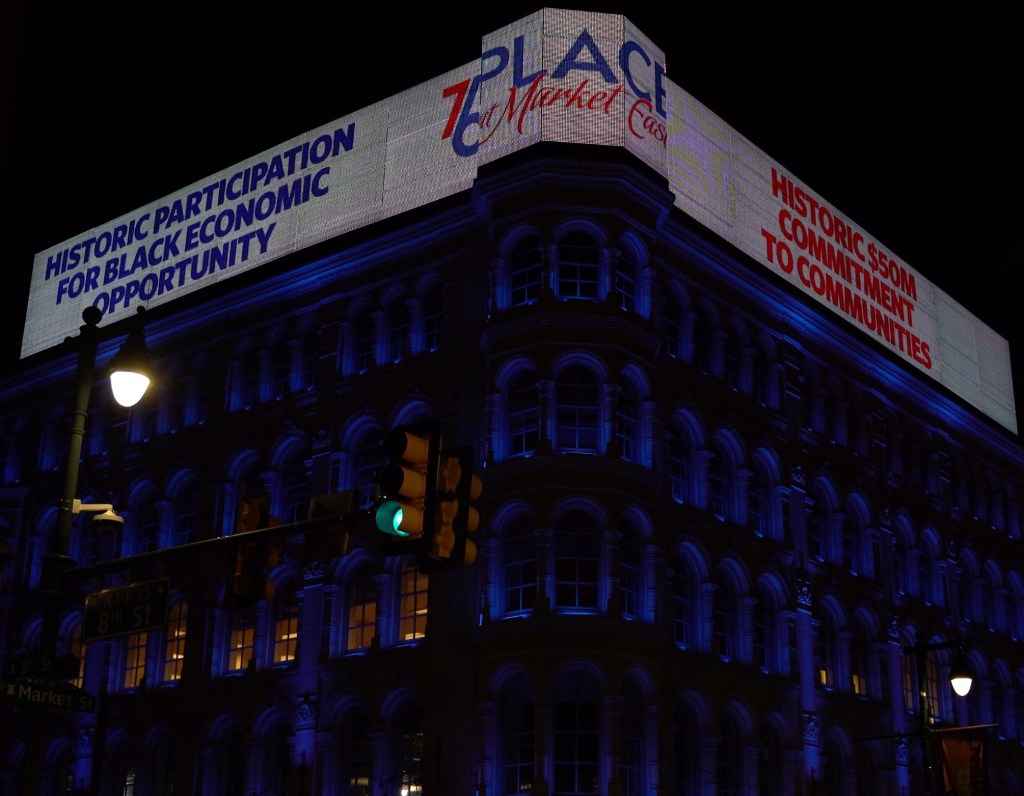
The 76ers have spent millions on unsuccessful mayoral candidate, lobbyists, lawyers, architects, traffic engineers, consultants, public relations, Astroturf community meetings, canvassing, and race-baiting billboard.
Two years later, their millions have brought the 76ers no closer to getting the approvals necessary to build an arena that would benefit no one other than the billionaire owners themselves. So like a two-year-old, the owners are throwing a tantrum. They reportedly are in negotiations to build an arena in Camden, New Jersey where their headquarters and practice facility are located. ROI-NJ reports:
The sources indicated that talks have picked up recently, in part because HBSE’s efforts to build a new arena in Center City Philadelphia have hit repeated roadblocks, despite the fact that the owners have indicated they would self-finance the $1.3 billion proposed project.
[…]
The clock appears to be ticking on 76 Place. In order to be ready for 2031-32 season, construction likely would need to begin in 2025. That means approvals from the city need to come this year.
76 Place hype man David Adelman has said there is “no Plan B.” Fact is, the 76ers proposed building an arena at Penn’s Landing in 2020 (Plan A). 76 Place is Plan B. The move to Camden would be, well, Plan C.
To mark the second anniversary of 76 Place, I will submit new FOIA and Right-To-Know Law requests to the Federal Transit Administration, Federal Railroad Administration, SEPTA and Pennsylvania Department of Transportation.
The region’s public transit agency is facing a fiscal cliff. General Manager and CEO Leslie Richards said the agency’s COVID relief funds have dried up and SEPTA is facing a $240 million deficit. The agency was counting on an additional $140 million in state funds. Instead, SEPTA will receive $53 million of the one-time transfer of $80 million to the Public Transit Trust Fund passed by the Pennsylvania legislature on July 11.
SEPTA does not have money to keep the buses, subway, trolleys and trains running, but they have money to pay outside lawyers to fight the Pennsylvania Office of Open Records’ order to produce records related to the Philadelphia 76ers’ proposal to build a basketball arena atop Jefferson Station. The public has a right to know the impact of six years of demolition and construction on SEPTA’s operations and budget.
SEPTA officials and employees have been meeting and consulting about 76 Place since April 2022. Records obtained via my Right-To-Know Law requests to local agencies show that 76 Place representatives embedded themselves in the agency’s operations. SEPTA employees frequently met about 76 Place. Richards and Chief Operating Officer Scott Sauer led SEPTA Board members on “site visits” to 76 Place. The SEPTA Board has a 76 Place subcommittee.
While SEPTA officials and employees huddle with representatives of the 76ers billionaire owners, the agency wants more taxpayers’ money. The beleaguered transit agency should get their money where their employees and officials spend their time.
UPDATE: In a report released on July 15, the Federal Transit Administration ordered SEPTA to fix the “escalating pattern” of safety incidents. The Philadelphia Inquirer reports:
Citing a “deteriorating safety record” with a higher-than-average accident rate, the Federal Transit Administration has ordered SEPTA to better protect transit operators from assaults, improve employee training, and tighten bus and rail procedures to prevent injuries and fatalities.
The regulatory agency found 16 problems that it said make the regional public transit system potentially more dangerous for riders and workers — including staffing shortages in key jobs. In all, it required 24 corrective actions in its exhaustive Safety Management Inspection of SEPTA’s bus, trolley and subway operations, according to a report released Monday.
Improvements will require new spending, especially for hiring, even as SEPTA confronts a $240 million operating deficit, Richards and other executives said. It is not yet clear how much compliance will cost.
I submitted Right-To-Know Law requests for records related to the Philadelphia 76ers’ proposal to build a basketball arena atop Jefferson Station in August 2023. The City of Philadelphia denied all of my requests so I filed an appeal with the Pennsylvania Office of Open Records (OOR).
The OOR issued its final determination on January 9, 2024. My appeal was granted in part and denied in part. The OOR ordered the City to turn over responsive records by February 9, 2024. As expected, the City appealed the OOR’s decision to the Court of Common Pleas Philadelphia County.
Paula Knudsen Burke and Mayeesha Galiba of the Reporters Committee for the Freedom of the Press represent me on appeal. With their back against the wall, the City has agreed to turn over responsive records. The City produced the first batch of records on July 1, 2024.
The Sixers’ pitch to build a $1.5 billion arena in Center City hits its second anniversary this month with little to show beyond slick renderings and millions of dollars spent on lobbying.
Why it matters: The transformational project can potentially turn around the struggling Market East neighborhood but has divided residents and fueled concerns about quality-of-life issues and displacement.
State of play: All eyes remain on PIDC. The public-private development agency has yet to complete independent studies on the economic and community impacts of the plan, known as 76 Place.
Key legislators and officials have said they’re awaiting the completion of those studies before moving forward, including with legislation needed to kickstart the project.
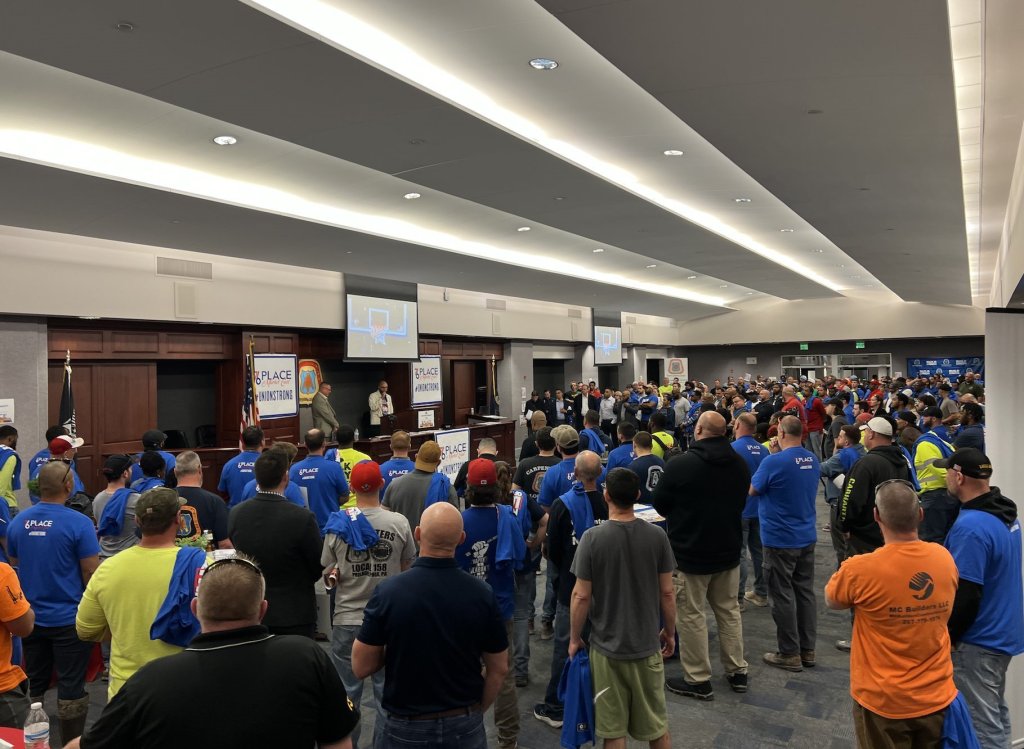
It’s baseball season and the Philadelphia 76ers are back at the top of the order. 76 Place hype man, billionaire David Adelman, held a pep rally with construction workers on April 12, 2023.
With limited support for the Sixers’ “win-win” proposal to build a basketball arena atop Jefferson Station, Adelman held a pep rally with construction workers on June 3, 2024.
Here’s the thing: Those “thousands of construction jobs” would be created whether the arena is built in Philadelphia, Camden, or wherever.
The Sixers’ have spent millions on lobbyists, newspaper, TV and social media ads, window signs, paid canvassers and billboards for their Astroturf campaign. With little self-awareness, Adelman is now whining that it has “been hard to cut through some of the manufactured noise.”
It has admittedly been hard to cut through some of the manufactured noise and shortsighted agendas about our proposal. The facts are:
1.) We love Philly and want to play a key role in the revitalization of Center City.
Adelman says, “We love Philly.” What’s love got to do with it? Study after study shows that the push for a new sports arena is all about more profits for billionaire team owners.
76 Place development team’s second time before the Civic Design Review committee fared no better than the first time. KYW Newsradio said the Sixers’ master plan for Market East “got another brutal bashing.”
Members of a city-appointed advisory panel panned the Sixers plan for a downtown arena on Tuesday, calling it “undercooked” and questioning whether construction would repeat harmful mistakes of the past.
“I don’t think as a city we just need to accept this as our fate,” said committee member Ashley DiCaro, a senior associate at Interface Studio urban planning. “We need to think about the real giveback here and whether we should build this thing.”
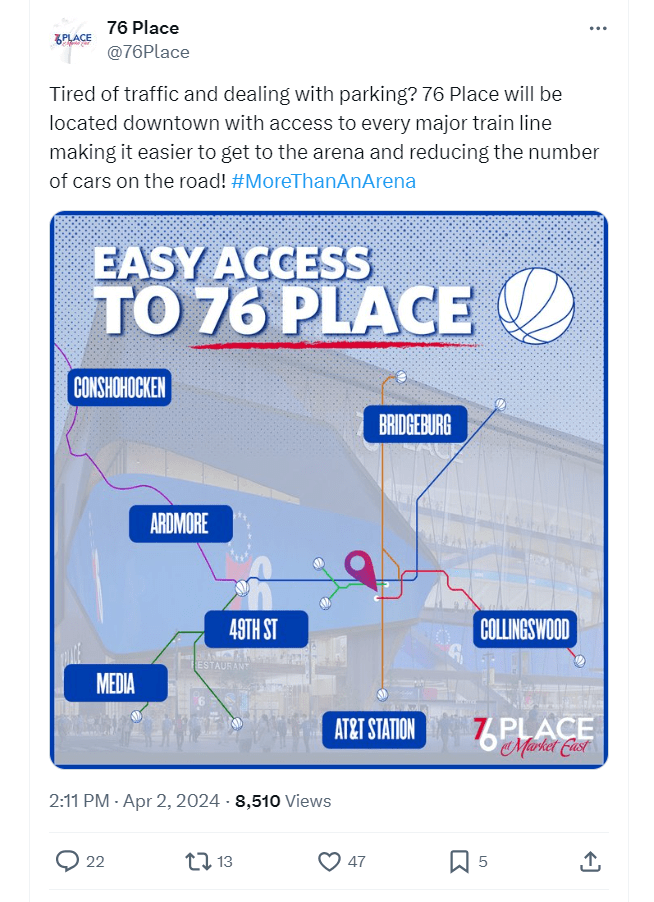
Not to be outdone, the Camden-based 76 Place communications team posted a half-baked transit map rife with errors on X/Twitter. When the map was ridiculed, the post was deleted.
Much to their chagrin, I had taken a screenshot.
AT&T Station was renamed NRG Station in 2018. There is no “Bridgeburg” station. The Bridesburg Station is located in Northeast Philadelphia, not in North Philly at the end of the Broad Street Line. How can anyone trust the design of a transit-oriented project when they cannot draw an accurate transit map?
76 Place front man David Adelman told a group of businesspeople that “five years from now people will look back and feel like this was a no brainer.”
David Adelman, the face of the 76ers Center City arena proposal, said that despite pushback the project is currently receiving, "five years from now people will look back and feel like this was a no brainer." https://t.co/A3T6a2Lr9C
— Philadelphia Business Journal (@PHLBizJournal) April 2, 2024
Five years ago, the Fashion District was a “no brainer.” The state and city pumped $137 million into the project to revitalize Market East. As noted during the CDR, the Fashion District is now a dying indoor mall:
She [Ashley DiCaro] and some other members of the city’s Civic Design Review committee — which includes design and land-use experts — reached back a half-century to the building of the Gallery mall, which turned three central blocks of East Market Street into a mostly closed, inward-facing series of walls. Five years ago the site became the Fashion District, another struggling mall, where the basketball team intends to build.
Today, DiCaro said, it’s clear the Gallery was a mistake, one that wiped away the natural urbanism of the city in exchange for a promise of development.
The promised development never happened. Instead, Adelman and his development team began meeting with government officials behind closed doors in April 2022. The proposed arena would demolish a section of the publicly-subsidized Fashion District.
In a city that’s majority-minority, Adelman, a billionaire, is playing the race card to further line his pockets. One Pennsylvania Political Coordinator Nydea Graves said:
Arenas are not for the community, they are for the developers. 76 Place won’t pay any property taxes. Research shows that wages fall for black workers when arenas are built. None of this helps our people. The developers pit black folks and Asian folks against one another, keeping us busy while they profit. 76 Place is the same old exploitation dressed up in a Sixers jersey.
76 Place is a self-serving project masquerading as “a catalyst to redevelop and bring back Market East,” a decades-old dead zone for retail and hot spot for crime.
As the proverb goes, fool me once, shame on you; fool me twice, shame on me. Truth be told, few have been fooled by the Philadelphia 76ers’claim that their proposal to build a basketball arena atop SEPTA’s Jefferson Station is “more than an arena.”
The 76 Place development team’s X/Twitter timeline is a stream of jackleg preachers and numbers plucked out of thin air.
A new arena for Philadelphia means more jobs for Philadelphians! A recent study shows that Sacramento’s downtown arena generated over $150 million in new annual income for arena and neighborhood workers. 76 Place will do even more for Philly! #MoreThanAnArenapic.twitter.com/yjK6h7n2ye
I asked Microsoft’s chatbot how many construction workers were involved with One World Trade Center:
During the construction of One World Trade Center, more than 10,000 workers were involved in building this iconic complex in Lower Manhattan, New York City. The scale of this project required careful coordination, and at any given time, there could be as many as 1,100 workers on-site. These dedicated individuals worked tirelessly to create a symbol of resilience and hope, and their efforts culminated in the completion of the 94-story tower that now stands as the tallest building in the Western Hemisphere.
I gave the same prompt to ChatGPT:
One World Trade Center, also known as the Freedom Tower, was constructed by thousands of construction workers over several years. The exact number of workers involved in the construction process can vary depending on the source, the phase of construction, and the specific tasks being carried out. However, it’s estimated that at its peak, there were approximately 3,500 workers on-site daily during the construction of One World Trade Center. This number includes various trades such as ironworkers, electricians, plumbers, carpenters, and many others who contributed to the building’s construction.
I pity the fool who thinks that building a big box arena on Market Street would create “12,200 construction-related jobs.”