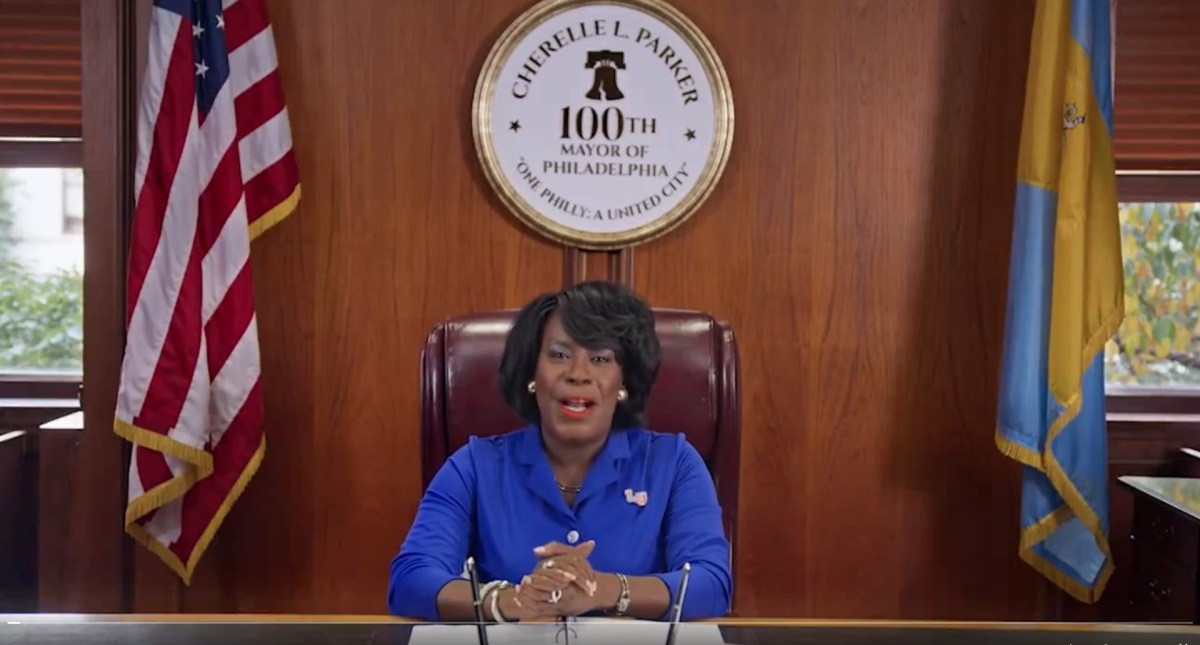
With less than 24 hours’ notice to “the People of Chinatown,” Mayor Cherelle L. Parker announced her endorsement of the Philadelphia 76ers’ proposal to build an arena that would abut against the historic neighborhood.
As your Mayor, I'm speaking from my City Hall office with a very important announcement. I am proud to share that I have made my decision, and an agreement has been reached to ensure that our Sixers are staying home.
Parker may “hear” the People of Chinatown, but she is not listening. If she were, she would know 76 Place is an existential threat to Chinatown. So, the Asian American Legal Defense and Education Fund threw down the gauntlet: See you in court!
AALDEF is disappointed that Mayor Parker took a stance in support of 76 Place arena's construction—before city council has had the opportunity to officially consider the proposal with public participation.
In the sprint to Election Day, you will be told the 2024 Election is the most consequential election since, well, the last presidential election. This election lives up to the hype. The choice is between going back or embracing hope and opportunity.
National Voter Registration Day, the country’s largest single-day voter registration drive, is September 17, 2024. Since 2012, more than five million Americans have been registered to vote on this civic holiday.
Your vote matters. If it didn’t, conservatives would not be trying every trick in the book to block access to the ballot box. You can register to vote here.
If you are already registered, confirm your status to make sure you are #VoteReady. On Election Day, be careful how you vote.
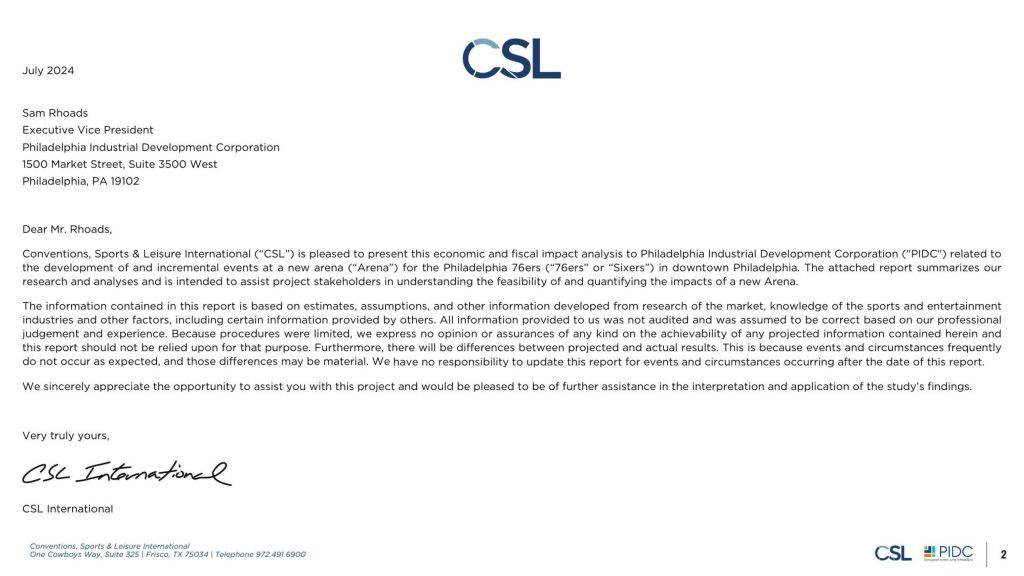
The long-awaited studies of the impact of the Philadelphia 76ers’ proposal to build an arena atop SEPTA’s Jefferson Station landed with a thud at City Hall. I am still wading through the 400 pages. This disclaimer from CSL International about the economic impact of a second arena speaks volumes about the credibility of their report.
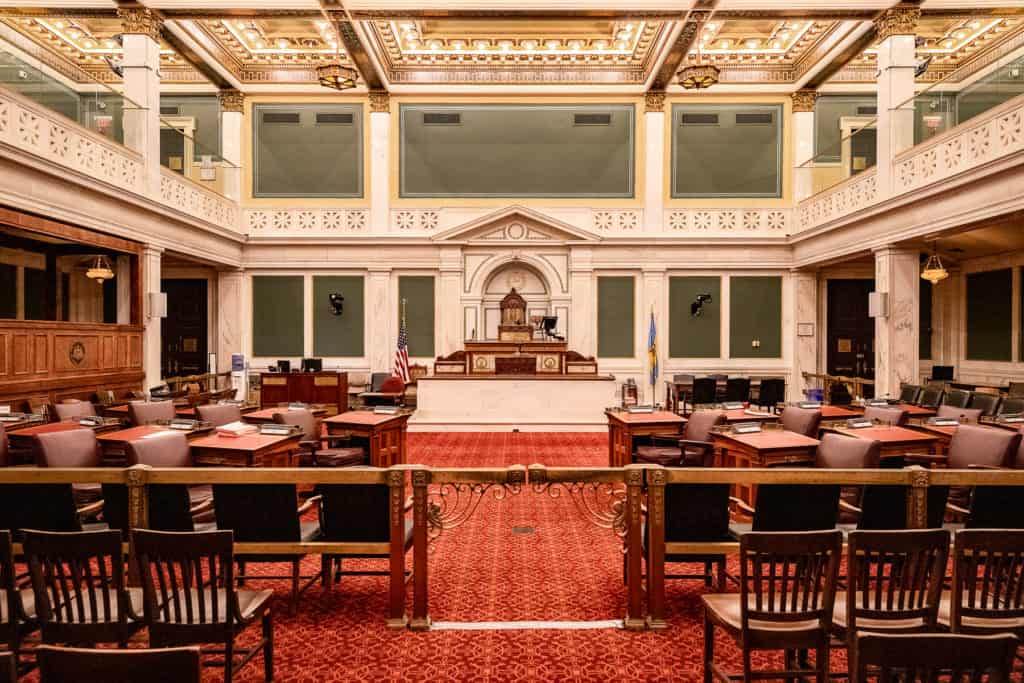
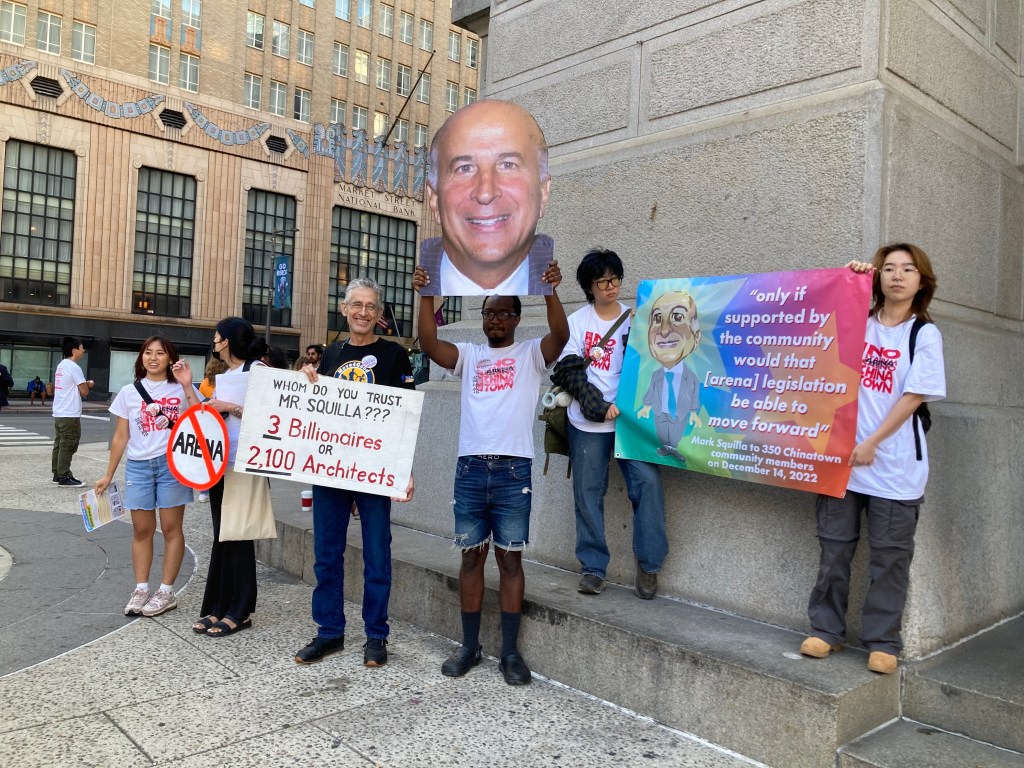
City Council will be back in session on September 5 and so will opponents of 76 Place. No Arena in Chinatown Solidarity will hold a press conference before they head up to the fourth floor of City Hall for their weekly City Council Watch.
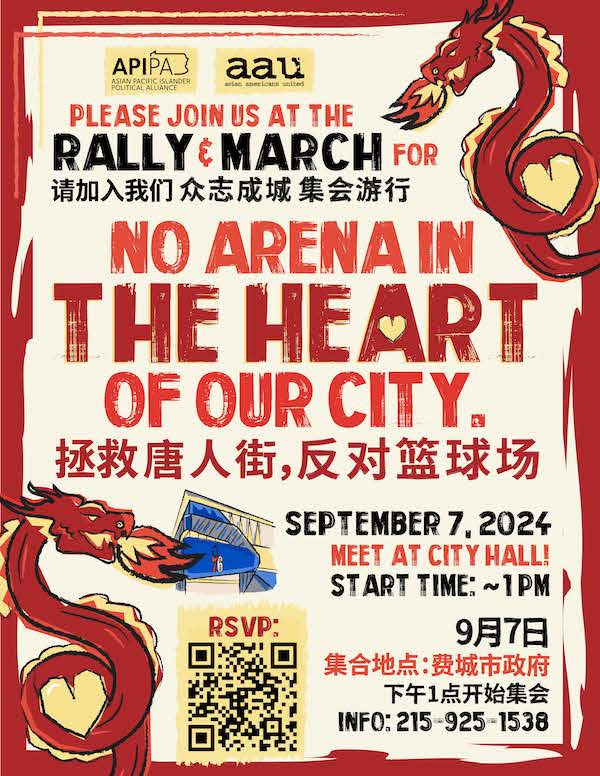
The Asian Pacific Islander Political Alliance and Asian Americans United will bring the fire on Saturday, September 7 at a rally and march. In an Instagram post, Asian Americans United wrote:
We’ll rally with voices from diverse Philly neighborhoods then march into Chinatown with the power of the people!
Chinatown, South Philly, West Philly, North Philly, Northwest and Northeast, let’s all come together and tell the developers: MOVE ON! Stop pushing the arena onto communities that don’t want it.
Teachers, doctors, nurses, small business owners, union members, people of faith, students, we all don’t want it! Philadelphia needs a government that spends its time on what the people need, not what billionaires want!
The rally and march will kick off on Saturday, September 7 at 1 p.m.
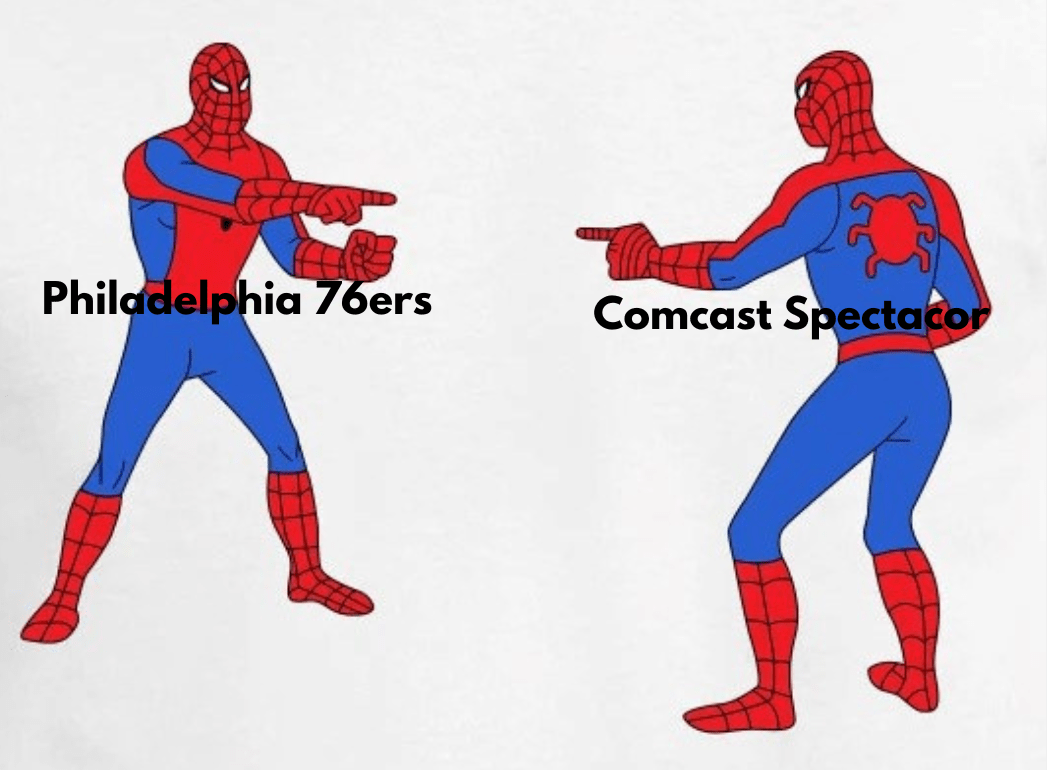
Nature abhors a vacuum. The so-called “independent studies” of the impact of the Sixers’ proposal to build a basketball arena atop Jefferson Station are months overdue. So in recent weeks, the Philadelphia 76ers and their landlord, Comcast Spectacor, have released studies touting the economic benefits – or lack thereof – of a new arena.
Now the main stakeholders in the decision are getting antsy. Over the past several weeks, two consultant-led studies have dropped, yielding radically different potential economic and commercial real estate outcomes to building a second major arena.
Who should CRE believe? Neither, several economists told Bisnow, adding that the impact of two stadiums on the industry would be more nuanced. But the most likely result is that instead of doubling opportunity, hosting two major stadiums would merely redistribute where activity is happening, spreading a finite number of dollars over a wider canvas.
“All they need to do is convince some people that this number is objective when it’s not,” Dennis Coates, a professor of economics at the University of Maryland, Baltimore, said of rival reports from the 76ers organization and Comcast Spectacor, whose Wells Fargo Center in South Philly would compete with a new arena.
One promises boom times ahead for city coffers, schools and real estate developers operating in and around a new 76ers arena. The other claims dueling arenas would split the market, draining potential attendance and revenue from both.
Economists say such studies are built upon different benchmarks that serve a specific purpose, and they aren’t a good guide for local developers, politicians or other stakeholders to use for decision-making, especially this year or at any prebuilding stage.
Coates said the real estate players poised to benefit from arena development are naturally those in close proximity that could see “greater demand, charge my tenant higher or even sell the land,” especially when a stadium first opens, he said.
But those near venues that lose a regular team, even to a stadium a few miles away, are set up for a corresponding amount of business going out the door, he said.
The billionaire owners of the Philadelphia 76ers have pushed an endless supply of factoids in their quest to win approval of their proposal to build a basketball arena in Center City. Their latest bankrolled study claims that the only thing better than having one arena in America’s poorest big city is having two arenas:
Today, 76 Place released findings from the study done by live entertainment expert CAA-ICON that confirm a second Philadelphia arena will address the unmet need for live entertainment options in the city. The newly released findings confirm what leading entertainment professionals have repeatedly said: Philadelphia not only can handle a second arena, but has been losing out on entertainment options because it doesn’t have one.
[…]
In its report examining unmet demand in Philadelphia, CAA-ICON estimated that two venues, one in South Philadelphia and a second in Center City, would each host between 125 and 150 ticketed events annually, inclusive of tenant events, Pollstar-reported events, and other ticketed events. Importantly, its estimates do not include other non-ticketed events such as community events, meetings or banquets, which will drive usage higher.
CAA-ICON also noted that major cities with just one arena are at a major disadvantage, with more limited date options because of professional sports season schedules that can eat up weekends which are key for successful tours and routing.
The billionaires’ factoids were published in PR Newswire.
Meanwhile, the region’s newspaper of record reported a second arena would “split the market.” From thePhiladelphia Inquirer:
Comcast Spectacor, concerned about the Sixers’ plan to leave the Wells Fargo Center and build a new arena downtown, hired a national real estate adviser to study the implications of having two big, competing venues in Philadelphia.
The consultant concluded the rivalry would split the market, starving both places of attendance and revenue.
There aren’t enough additional games, concerts and shows to financially support two major Philadelphia arenas of roughly the same capacity, said the report by Chicago-based Hunden Partners. It predicted taxpayers would eventually be asked to provide millions of dollars for renovations that neither arena could afford on its own.
[…]
“It’s not totally unprecedented [for a city to have two arenas],” said Dave Brooks, senior director of live music and touring at Billboard, the music-and-entertainment magazine, “but there’s only so many arena touring shows each year. Definitely Philly is a must-play city, but there’s not really any evidence that another arena is going to attract more concerts to a market. They’re probably going to be going after a lot of the same stuff.”
[…]
“Philadelphia performs below its weight class,” Hunden said, attributing that at least partially to lower household incomes in what is one of the nation’s poorest big cities.
[…]
However, the study said, the venues would roughly divide the total number of ticketed events, with 105 going to the Wells Fargo Center and 92 to the Sixers arena.
The “unmet demand in Philadelphia” is the billionaires’ pursuit of a second arena.
The region’s public transit agency is facing a fiscal cliff. General Manager and CEO Leslie Richards said the agency’s COVID relief funds have dried up and SEPTA is facing a $240 million deficit. The agency was counting on an additional $140 million in state funds. Instead, SEPTA will receive $53 million of the one-time transfer of $80 million to the Public Transit Trust Fund passed by the Pennsylvania legislature on July 11.
SEPTA does not have money to keep the buses, subway, trolleys and trains running, but they have money to pay outside lawyers to fight the Pennsylvania Office of Open Records’ order to produce records related to the Philadelphia 76ers’ proposal to build a basketball arena atop Jefferson Station. The public has a right to know the impact of six years of demolition and construction on SEPTA’s operations and budget.
SEPTA officials and employees have been meeting and consulting about 76 Place since April 2022. Records obtained via my Right-To-Know Law requests to local agencies show that 76 Place representatives embedded themselves in the agency’s operations. SEPTA employees frequently met about 76 Place. Richards and Chief Operating Officer Scott Sauer led SEPTA Board members on “site visits” to 76 Place. The SEPTA Board has a 76 Place subcommittee.
While SEPTA officials and employees huddle with representatives of the 76ers billionaire owners, the agency wants more taxpayers’ money. The beleaguered transit agency should get their money where their employees and officials spend their time.
UPDATE: In a report released on July 15, the Federal Transit Administration ordered SEPTA to fix the “escalating pattern” of safety incidents. The Philadelphia Inquirer reports:
Citing a “deteriorating safety record” with a higher-than-average accident rate, the Federal Transit Administration has ordered SEPTA to better protect transit operators from assaults, improve employee training, and tighten bus and rail procedures to prevent injuries and fatalities.
The regulatory agency found 16 problems that it said make the regional public transit system potentially more dangerous for riders and workers — including staffing shortages in key jobs. In all, it required 24 corrective actions in its exhaustive Safety Management Inspection of SEPTA’s bus, trolley and subway operations, according to a report released Monday.
Improvements will require new spending, especially for hiring, even as SEPTA confronts a $240 million operating deficit, Richards and other executives said. It is not yet clear how much compliance will cost.
I submitted Right-To-Know Law requests for records related to the Philadelphia 76ers’ proposal to build a basketball arena atop Jefferson Station in August 2023. The City of Philadelphia denied all of my requests so I filed an appeal with the Pennsylvania Office of Open Records (OOR).
The OOR issued its final determination on January 9, 2024. My appeal was granted in part and denied in part. The OOR ordered the City to turn over responsive records by February 9, 2024. As expected, the City appealed the OOR’s decision to the Court of Common Pleas Philadelphia County.
Paula Knudsen Burke and Mayeesha Galiba of the Reporters Committee for the Freedom of the Press represent me on appeal. With their back against the wall, the City has agreed to turn over responsive records. The City produced the first batch of records on July 1, 2024.
The Sixers’ pitch to build a $1.5 billion arena in Center City hits its second anniversary this month with little to show beyond slick renderings and millions of dollars spent on lobbying.
Why it matters: The transformational project can potentially turn around the struggling Market East neighborhood but has divided residents and fueled concerns about quality-of-life issues and displacement.
State of play: All eyes remain on PIDC. The public-private development agency has yet to complete independent studies on the economic and community impacts of the plan, known as 76 Place.
Key legislators and officials have said they’re awaiting the completion of those studies before moving forward, including with legislation needed to kickstart the project.
This year marks the 45th anniversary of Black Music Month. The celebration of African American musicians and their contribution to American culture is the brainchild of music mogul and Rock and Roll Hall of Fame inductee Kenny Gamble, radio personality and media coach Dyana Williams and Cleveland DJ Ed Wright.
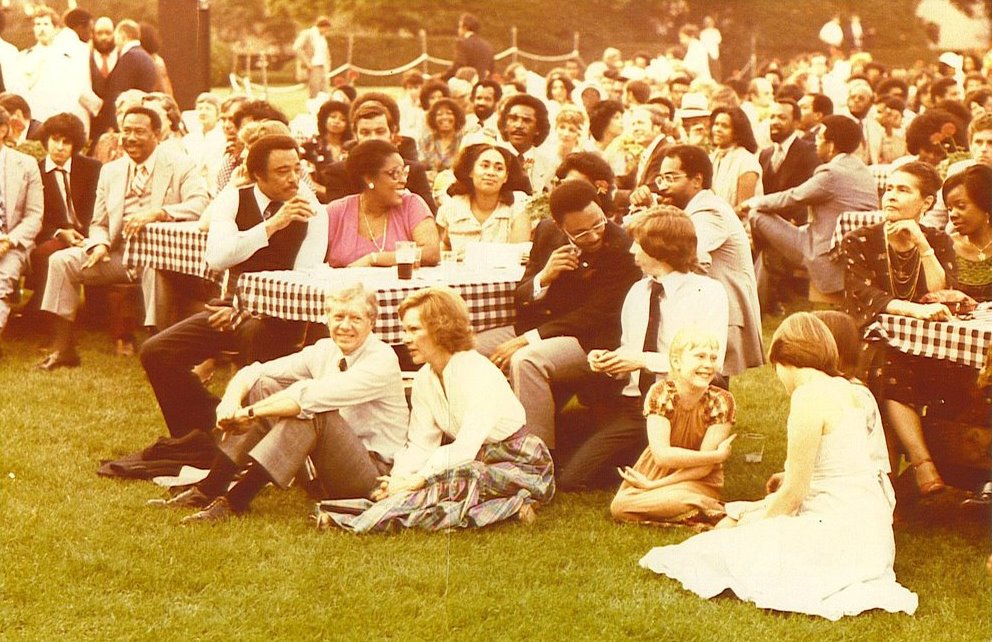
The first celebration was held on June 7, 1979. President Jimmy Carter and First Lady Rosalynn Carter hosted a dinner and concert on the White House’s South Lawn.
I love music. I also love transparency and accountability in government. Sunshine is said to be the best disinfectant (h/t Louis Brandeis). So Black Music Month and, indeed, every month, let the sunshine in.
The Philadelphia Art Commission falls under the Department of Planning and Development. When questioned by Valerie Russ of The Philadelphia Inquirer about the short notice given for the Art Commission’s May 8, 2024 meeting, Department spokesperson Bruce Bohri said, “Public notice for this Art Commission meeting is compliant with the Sunshine Act.”
Under the Sunshine Act, public agencies must provide at least three days advance notice of a regular public meeting. Art Commission staff met with Midwood Investment & Development’s art curator for over a year but the public was given the minimum notice.
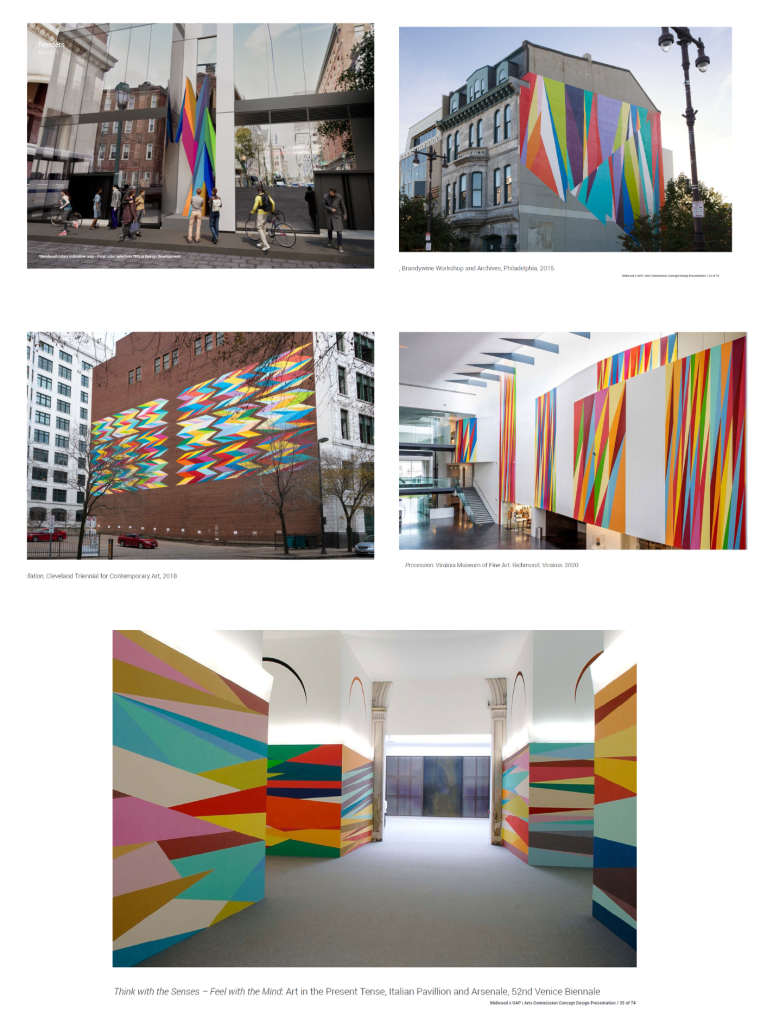
Tellingly, Bohri is silent about whether Odili Donald Odita’s concept design is compliant with Section 14-702(5) of the Philadelphia Zoning Code:
The items or programs provided to earn this bonus must meet the definition of “On-site Public Art” or “On-site Cultural Programming” in Chapter 14-200 (Definitions). It is not the intention of these requirements to allow decorative, ornamental, or functional elements of the building or public space that are not designed by an artist and created specifically for the site, nor to have landscaped areas or other furnishings or elements required by this Zoning Code, to qualify as part of the public art requirement.
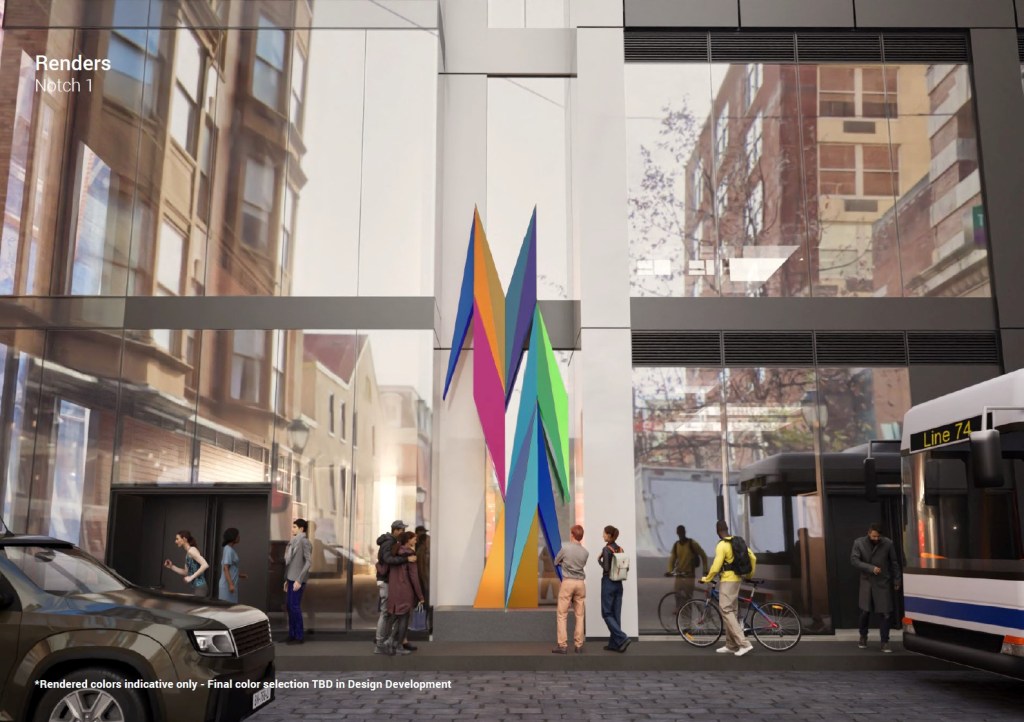
After 40 minutes of “deliberation,” Commissioners gave final approval to Odita’s repetitive design that has been installed on walls from Philadelphia to Venice, Italy. The only thing new about Odita’s “Newfound Forms” is the medium. This would be his first public sculpture.
To be honest, I question whether Odita ever visited the site. If he had, he would know that 12th Street is one way and the correct SEPTA bus route.
Bohri claimed the review was “consistent with longstanding Art Commission procedure.” But get this: In their submission to the Art Commission, Midwood acknowledged that “this will be the first public art erected pursuant to this zoning bonus.” The 40 minutes from presentation of the concept design to final approval by the Commissioners is without precedent.
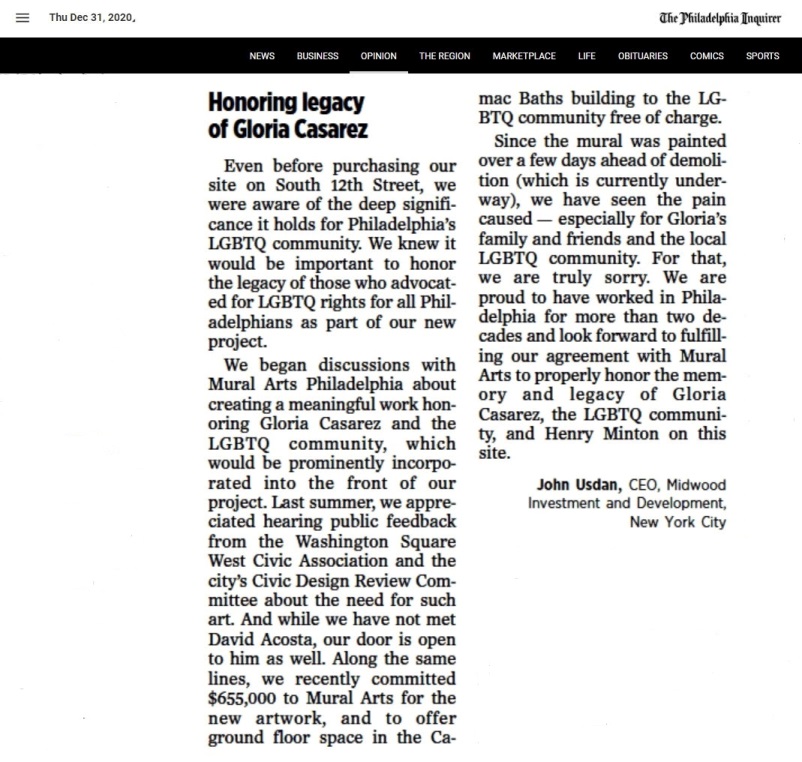
In a letter to the editor published by The Inquirer on December 31, 2020, Midwood CEO John Usdan promised “to properly honor the memory and legacy of Gloria Casarez, the LGBTQ community, and Henry Minton on this site.”
A nameless representative told The Inquirer Midwood’s offer to recreate the Gloria Casarez mural “still stands.” Will Mayor Cherelle L. Parker hold Usdan to his promise to honor Black abolitionist Henry Minton?



 PHL Watchdog