This is Sunshine Week, a time to celebrate transparency, and the public’s right to know what government officials are doing and saying behind closed doors. PHL Watchdog is a Sunshine Week partner. It is serendipitous that I will be at City Hall in Courtroom 275 during Sunshine Week.
For more than two years, the City of Philadelphia has fought release of records related to the Philadelphia 76ers’ now abandoned proposal to build an arena atop SEPTA’s Jefferson Station. Perhaps the City thought I would give up. But giving up is not in my DNA. And an awesome team of lawyers, led by Paula Knudsen Burke of the Reporters Committee for Freedom of the Press and Temple University Law Professor Mary E. Levy, has my back.
The City appealed the Office of Open Records’ final determination to turn over responsive records to the Court of Common Pleas Philadelphia County on June 27, 2025. Judge Christopher Hall will hear oral arguments on March 18, 2026.
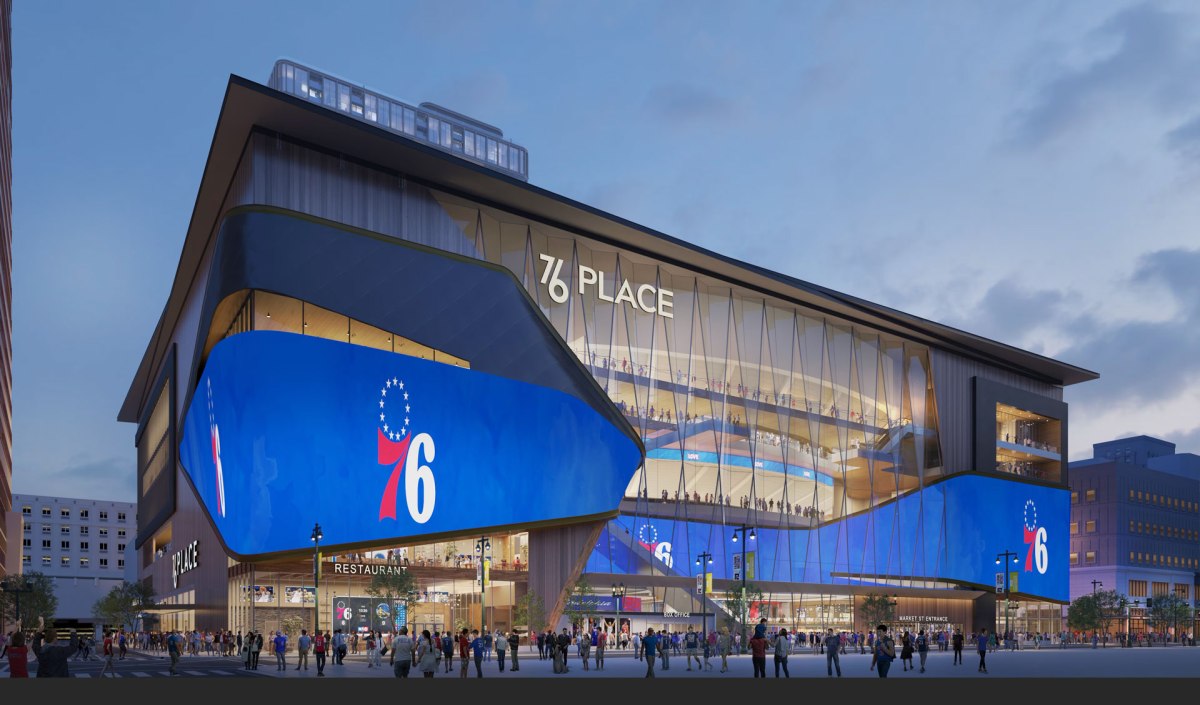
While 76 Place is as dead as the 76ers’ chances of winning an NBA championship, the public has the right to know how unaccountable and self-serving billionaires hijacked city planning. The latest Market East fiasco shows that the City has learned nothing from the arena debacle.
It is imperative that public officials are held accountable. Transparency must undergird future development projects. So, let the sun shine in.
One year ago this week, the billionaire owners of the Philadelphia 76ers pulled the rug out from under Mayor Cherelle L. Parker and City Council. Their proposal to construct a basketball arena atop SEPTA’s Jefferson Station was a dream for the billionaires and a nightmare for everyone else.
A year later, we don’t have answers about this debacle. The City is still fighting release of documents that I requested from the previous administration.
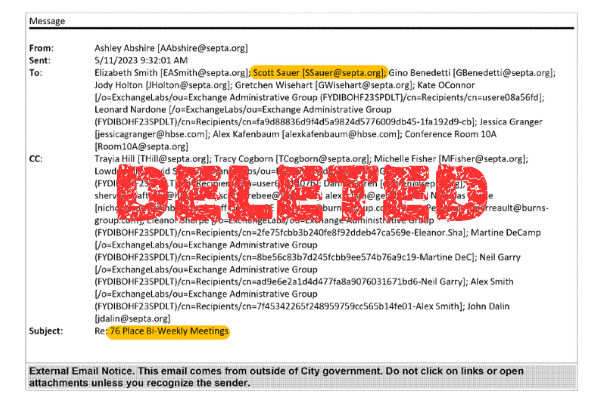
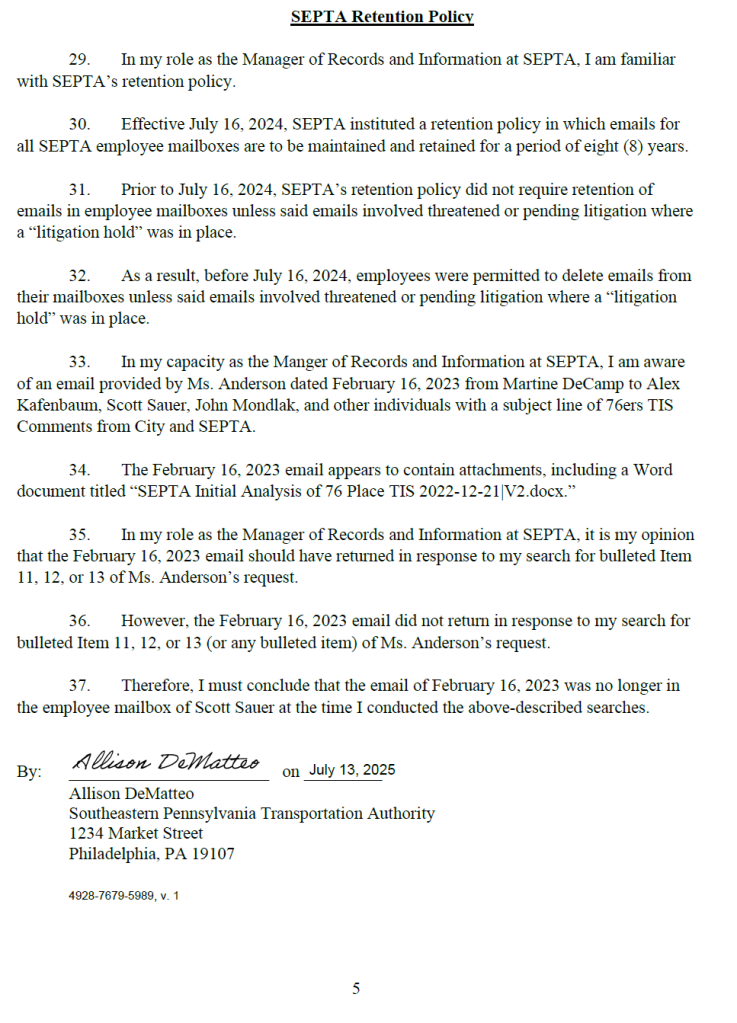
SEPTA was twice ordered to turn over records. Rather than comply with the orders, the cash-strapped agency continued to pay outside counsel to fight disclosure. With their back against the wall, SEPTA claimed the records were deleted.
In this new year, I will submit new RTKL requests for 76 Place records for the period of January 1, 2024 to January 14, 2025. I will keep on pushing until we get answers to how the billionaires hijacked the public policymaking process.
Although SEPTA is in a transit death spiral, the agency is wasting money on outside counsel fighting release of records related to the Philadelphia 76ers’ proposal to build an arena atop Jefferson Station.
I submitted a Right-To-Know Law request on August 1, 2023 for records related to 76 Place for the timeframe of April 1, 2022 to July 31, 2023. After losing before the Office of Open Records and the Commonwealth Court of Pennsylvania, SEPTA now claims more than seven gigabytes of data were deleted. Former CEO Leslie Richards and current CEO Scott Sauer deleted records related to the most controversial proposal in the transit agency’s history.
Richards left the cash-strapped agency in November 2024 but she’s still collecting a check from SEPTA.
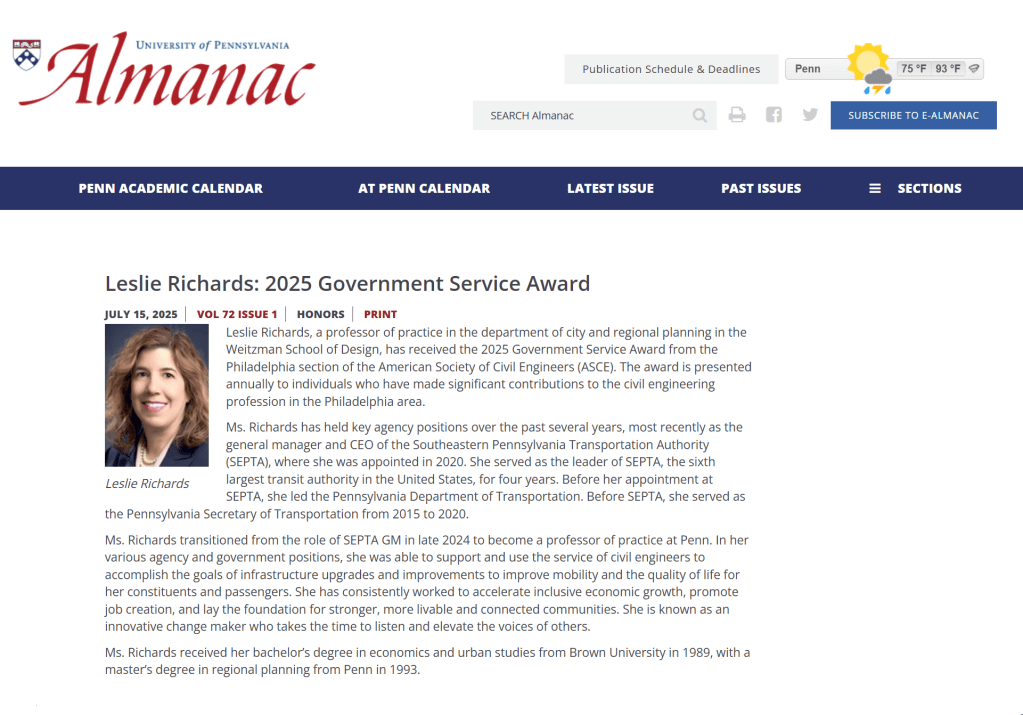
It is said that those who can, do; those who can’t, teach. Fittingly, Richards is now teaching at the University of Pennsylvania. Penn recently announced that Richards received the 2025 Government Service Award from the Philadelphia chapter of the American Society of Civil Engineers.
In deleting 76 Place records, Richards did a disservice to the public. We have the right to know how SEPTA could have been stuck paying tens of millions of dollars for the Sixers billionaire owners’ now-abandoned vanity project.
SEPTA is Exhibit 1 as to why the Pennsylvania House of Representatives should pass Senate Bill 686, sponsored by Pennsylvania Senate State Government Committee Chairman Sen. Cris Dush. The legislation makes the intentional destruction or alteration of Right-To-Know Law records a third-degree felony.
I find it deeply troubling that Pennsylvania’s long-standing RTK law mentions no criminal offense for destroying or altering records subject to a RTK request. Not surprisingly, the rule of law is entirely thwarted whenever government officials or their staff intentionally dispose or suppress records that have been requested under RTK provisions, and which the public has every right to examine.
Those who cannot handle the truth should not get away with criminally suppressing the truth. In short, the punishment for violating our Commonwealth’s RTK law must fit the crime. It’s well past time in Pennsylvania to balance the scales of justice against this preposterous ‘get-out-of-jail-free-card’ for the flagrant destruction of RTK records with a maximum third-degree felony conviction.
It is deeply troubling officials destroyed records knowing that if SEPTA approved 76 Place, lawsuits would fly.
The Philadelphia 76ers abandoned their plan to build an arena atop SEPTA’s Jefferson Station. But SEPTA is still playing games to block disclosure of communications with the Sixers’ billionaire owners and their representatives.
SEPTA lost their appeal of the Office of Open Records’ Final Determination to the Commonwealth Court of Pennsylvania. The beleaguered transit agency was directed to conduct a good faith search for records responsive to my Right-To-Know Law request for, among other things, invoices, reports, feasibility studies, traffic impact studies, architectural designs and cost estimates.
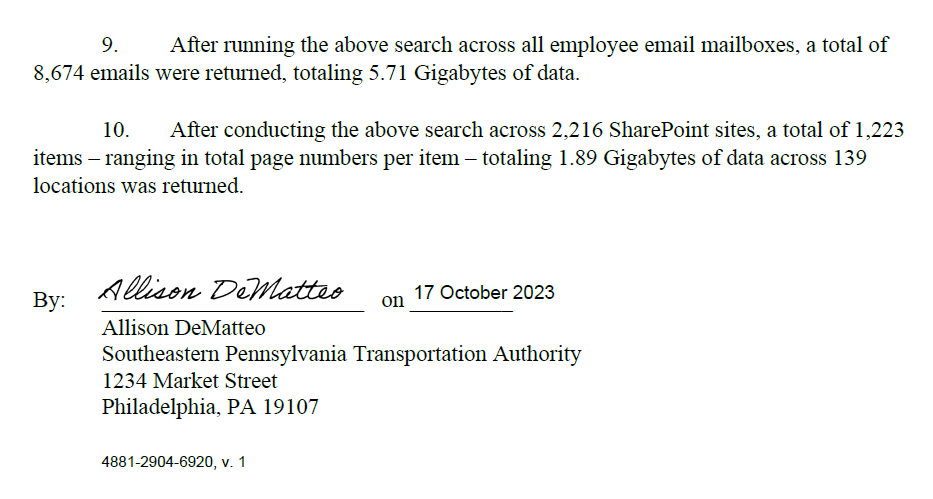
In a sworn statement, Allison DeMatteo, SEPTA’s Manager of Records and Information, claimed her search using the keywords “76 Place” and “76 Devcorp” returned 7.60 gigabytes of data, including 5.71 gigabytes of email.
According to ChatGPT, one gigabyte of email data is roughly 100,000 pages. As of this writing, SEPTA has produced 30 records.
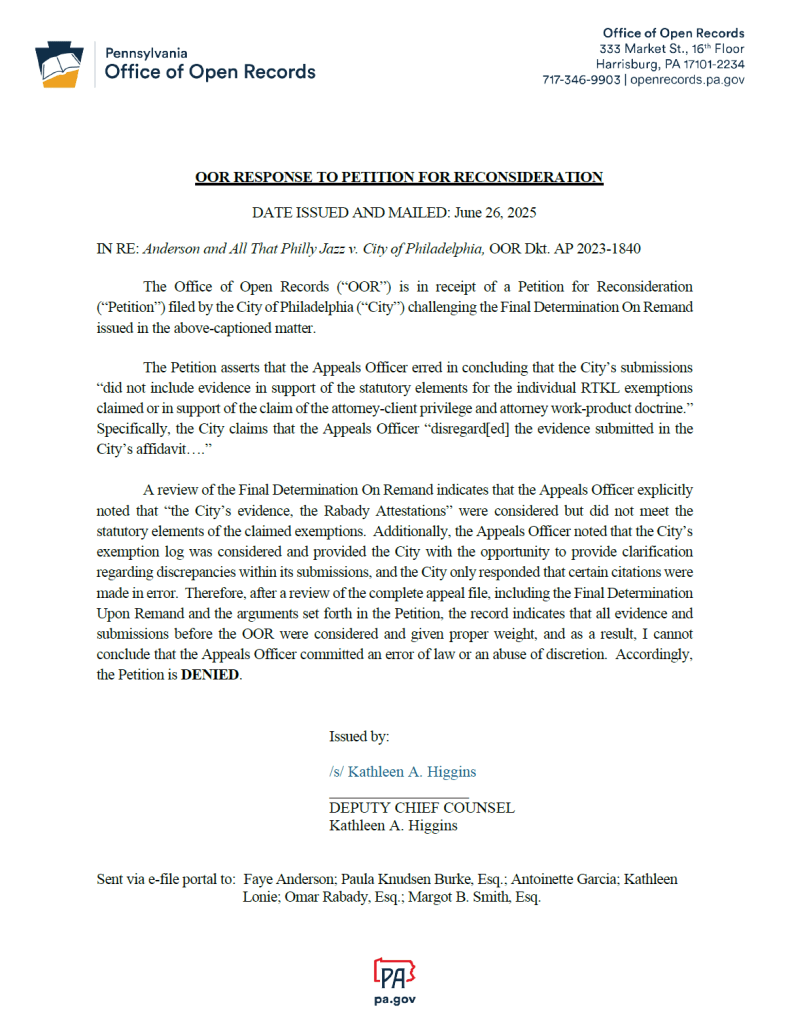
Meanwhile, the City of Philadelphia has petitioned the OOR to reconsider its final determination, dated May 30, 2025. The OOR should tell the City: We said what we said. “[T]he appeal is granted in part and denied in part, and the City is required to provide unredacted responsive records, as designated in this Final Determination, to the Requester within thirty days.”
UPDATE: Office of Open Records Deputy Chief Counsel Kathleen A. Higgins to the City of Philadelphia: The Petition is DENIED:
Therefore, after a review of the complete appeal file, including the Final Determination Upon Remand and the arguments set forth in the Petition, the record indicates that all evidence and submissions before the OOR were considered and given proper weight, and as a result, I cannot conclude that the Appeals Officer committed an error of law or an abuse of discretion. Accordingly, the Petition is DENIED.
In other words, the City of Philadelphia got to give it up.
On August 1, 2023, I filed a Right-To-Know Law request for records related to the Sixers’ now-abandoned proposal to build a basketball arena atop Jefferson Station. SEPTA denied the request, claiming the entirety of my Request was “insufficiently specific.”
I appealed the denial to the Pennsylvania Office of Open Records. The OOR determined that several Items were sufficiently specific and ordered SEPTA to conduct a good faith search for the records on December 20, 2023.
Rather than comply with the OOR’s final determination, the cash-strapped public transit agency paid outside counsel to appeal the order to the Commonwealth Court of Pennsylvania.
On May 1, 2025, the Commonwealth Court affirmed the OOR’s findings, stating that my Request was sufficiently specific, in part. SEPTA was, again, directed to conduct a good faith search for records responsive to my Request for, among other things, invoices, reports, feasibility studies, traffic impact studies, architectural designs and cost estimates.
The Commonwealth Court effectively said game over. Like the 76ers playing in the second round of the NBA playoffs, SEPTA blew its chance to assert any exemptions from disclosure. SEPTA must give up 76 Place records.
March 16-22, 2025 is Sunshine Week, a time to celebrate transparency, and the public’s right to know what government officials are doing and saying behind closed doors. PHL Watchdog is a Sunshine Week partner.
For more than a year, the City of Philadelphia and SEPTA have fought release of communications with the Philadelphia 76ers related to their now abandoned plan to build an arena atop Jefferson Station. While the Save Chinatown Coalition has given up the fight to obtain records from SEPTA, giving up is not in my DNA. The City and SEPTA eventually will have to give it up and produce the records.
On March 17, the Pennsylvania Office of Open Records will host a panel discussion, Getting to Know Pennsylvania’s Transparency Laws, moderated by Paula Knudsen Burke, senior supervising attorney with the Reporters Committee for Freedom of the Press. Knudsen Burke represents me on the City’s and SEPTA’s appeals. The event is free and open to the public. Go here to register to attend in person or virtually.
A list of Sunshine Week activities is available here.
The Association for the Study of African American Life and History has proclaimed African Americans and Labor as the theme for this year’s celebration of Black History Month:
The 2025 Black History Month theme, African Americans and Labor, focuses on the various and profound ways that work and working of all kinds – free and unfree, skilled, and unskilled, vocational and voluntary – intersect with the collective experiences of Black people. Indeed, work is at the very center of much of Black history and culture. Be it the traditional agricultural labor of enslaved Africans that fed Low Country colonies, debates among Black educators on the importance of vocational training, self-help strategies and entrepreneurship in Black communities, or organized labor’s role in fighting both economic and social injustice, Black people’s work has been transformational throughout the U.S., Africa, and the Diaspora. The 2025 Black History Month theme, “African Americans and Labor,” sets out to highlight and celebrate the potent impact of this work.
I am celebrating the work of Moses Williams who was born into slavery in Philadelphia in August 1776.
Enslaved by Charles Willson Peale, Williams was a factotum at Peale’s Museum. He participated in the first paleontological expedition in the early republic. As a skilled taxidermist, Williams was instrumental in the reconstruction of Peale’s excavated mastodon.
Manumitted in 1802, Williams operated a physiognotrace (face-tracing) machine “every day and evening” at Peale’s Museum.
Working in anonymity, Williams became a master silhouette artist and contributed to the success of Peale’s Museum. In Black Out: Silhouettes Then and Now, Asma Naeem observed:
Williams defied racial strictures by using his [hands] to make the portraits of hundreds of thousands of white individuals. The sight of Williams operating the physiognotrace at the Peale Museum on a daily basis, year after year, offered a consistent, if somewhat tepid, rebuke to the proslavery discourse of suppression and forcible restraining of black people – in effect, an undoing of the chained hands of the African in Josiah Wedgwood’s “Am I not a man and a brother?”… In no uncertain terms, Williams became less disenfranchised with the commercial viability of silhouettes, changing his position from being enslaved to buying his own home and marrying the white Peale family cook. … [Williams was] able to enjoy a success inextricably tied to the rising status of the silhouette as a domestic commodity and popular mode of representation.
Williams is the subject of countless scholarly articles. His silhouettes are on view at, among other places, Philadelphia Museum of Art, Portrait Gallery in the Second Bank of the United States, The Peale Museum, Yale University Art Gallery, and Thomas Jefferson’s Library at Monticello.
Williams was born one month after the signing of the Declaration of Independence. He was enslaved by “The Artist of the Revolution” Charles Willson Peale who, as a member of the Pennsylvania General Assembly, voted for the Gradual Abolition of Slavery Act of 1780.
Williams was the nation’s first Black museum professional. While working on the second floor of the building now known as Independence Hall, he excelled as a “cutter of profiles” and earned a place in history.
To recognize his impact on the Revolutionary era’s visual culture, I have nominated Moses Williams for a Pennsylvania historical marker. If the nomination is approved, Williams’ marker will be dedicated in 2026, which is the 250th anniversary of both Williams’ birth and the founding of the nation.
Moses Williams will not be celebrated by President Trump’s Task Force 250, but we the people will say his name.
In the meantime, I will investigate what happened to Williams’ remains.
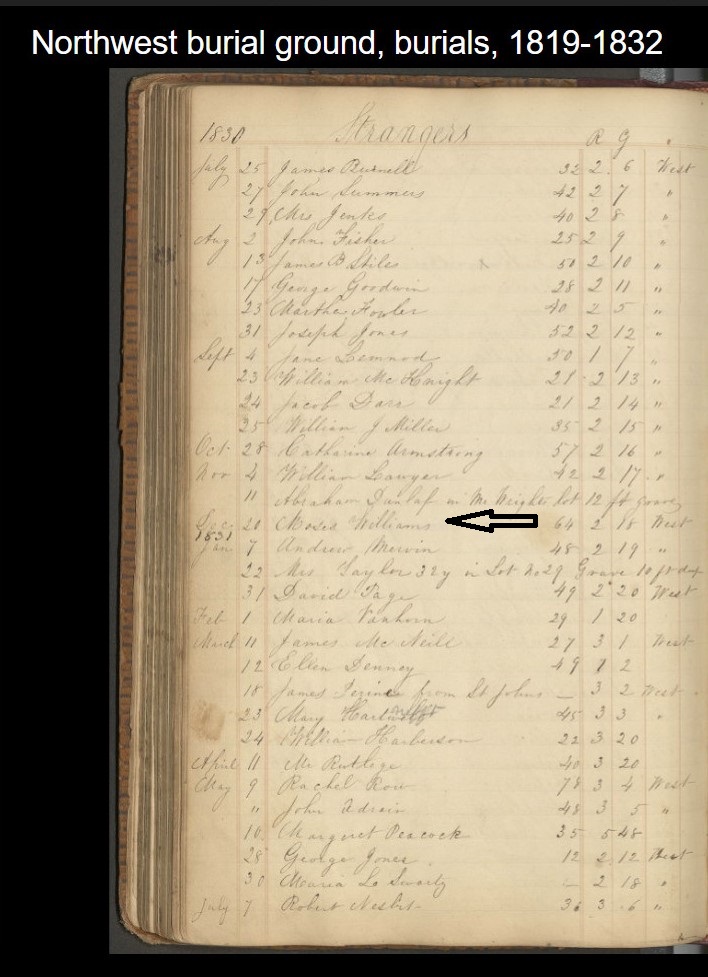
Williams joined the ancestors on December 18, 1830. He was interred at Northwest Burial Ground on December 20, 1830.
Northwest Burial Ground was located in North Philadelphia. Between 1860 and 1875, the burial ground closed, the bodies disinterred, and the land developed for a church. So where was Williams reinterred? Is his gravesite marked?
For updates, send your name and email address to phillyjazzapp@gmail.com.
The City of Philadelphia and SEPTA are fighting release of records related to the Sixers’ proposal to build an arena atop Jefferson Station as ordered by the Pennsylvania Office of Open Records in 2023. The city and SEPTA appealed the OOR’s final determination. Their lawyers have asked whether I want to continue to pursue my records requests. If they want to end litigation, the city and SEPTA can simply stop litigating and turn over the records.
For more than two years, Philadelphia’s misleaders gaslighted the public into believing that all that was needed for the Sixers’ half-baked proposal to become “a done deal” was the approval of enabling legislation by City Council.
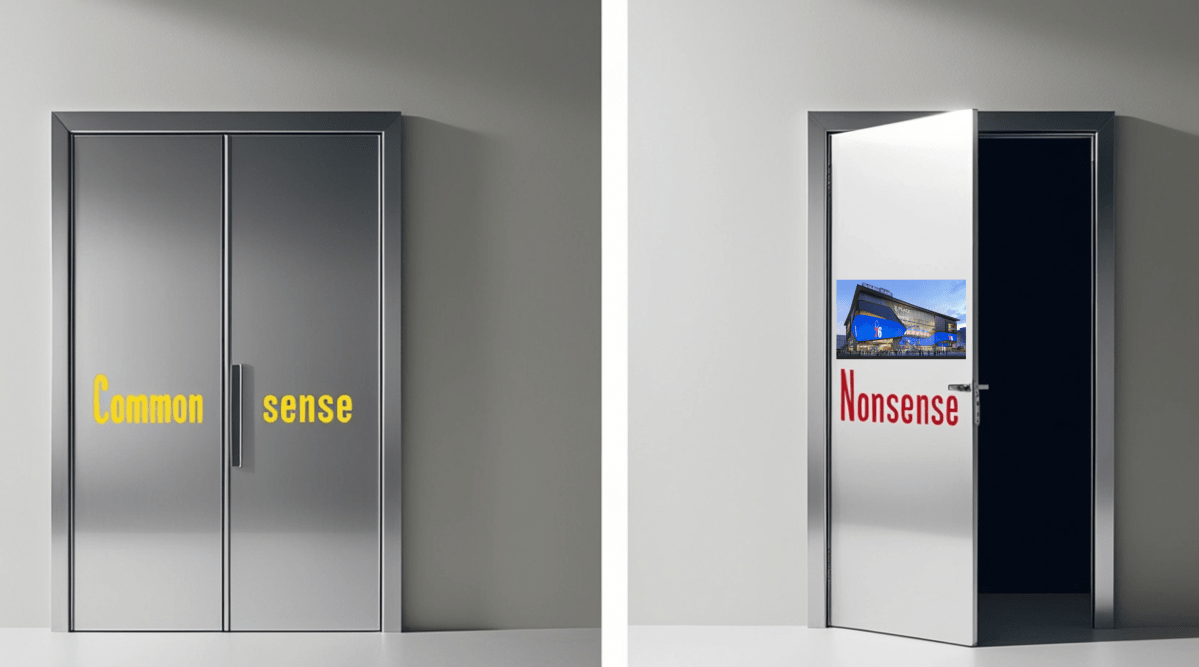
It is said that common sense is not so common. Neither Mayor Cherelle L. Parker nor City Council can grant the right to build on SEPTA property. Someone on Mayor Parker’s bloated staff should have had enough common sense to ask whether SEPTA was on board with the transit-oriented development.
We now know SEPTA was not on board. Then-interim General Manager Scott Sauer’s testimony before City Council’s November 19, 2024 public hearing should have ended the nonsensical notion that 76 Place would keep the transit agency from falling off the fiscal cliff:
The reality is that SEPTA simply cannot assume these new costs within the framework of its operating budget… SEPTA cannot shoulder the burden of expanded transit costs at 76 Place which would be in addition to the existing fiscal challenges.
Mayor Parker and 12 City Council members ignored the red flags. As I wrote in an opinion piece for the Philadelphia Inquirer, the Sixers’ billionaire owners knew the Federal Transit Administration was the shot caller in the 76ers arena saga:
SEPTA received federal funding to make improvements to Jefferson Station. In order to protect the “federal interest,” changes to the use of the station must be approved by the Federal Transit Administration. In other words, federal officials call the shots.
Sixers co-owner David Adelman tacitly acknowledged the crucial role played by Washington in a social media post following City Council’s 12-5 vote: “We look forward to pursuing the remaining approvals to make 76Place a reality.”
This year marks the 10th anniversary of PHL Watchdog. In the words of legendary gospel singer James Cleveland, “I don’t feel no ways tired.”
As a longtime advocate for transparency and accountability, every year I resolve to “comfort the afflicted and afflict the comfortable.” That includes submitting as many open records requests as necessary to shed light on what is being said and done behind closed doors.
Some agencies may want to falsely label me a “vexatious” or “repetitive” requester. As vexing as the Right-To-Know Law is for corrupt public officials, I have no “vexatious intent.” The public has the right to know whether officials are acting in the public interest or doing the bidding of special interests.
Philadelphia has ranked as the poorest big city in the country for decades. The high poverty rate is not a bug; it’s a feature. Philadelphia’s misleaders are not interested in reducing poverty because there’s a lot of money to be made by insiders and cronies managing poor people.
There is also a lot of money to be made by insiders and cronies with the Sixers’ proposal to build an arena atop SEPTA’s Jefferson Station. For more than two years, the billionaire owners of the Philadelphia 76ers have spent millions of dollars lobbying and spreading misinformation about the economic benefits of 76 Place.
By a vote of 12-4 on December 12, 2024, City Council gave preliminary approval to legislation enabling 76 Place to move pass the first round. Councilmembers Jamie Gauthier, Rue Landau, Nicolas O’Rourke, and Jeffery Young Jr. voted against the enabling legislation. Councilmember Kendra Brooks, a staunch opponent of the arena, was absent.
The Sixers made it pass the first round with an assist from Philadelphia’s misleaders. The enabling legislation does not give the billionaires the right to construct an arena on SEPTA’s property. They will need more than the building trades unions to get the approval of SEPTA, which is teetering on the brink of a “death spiral,” and President Donald Trump’s Federal Transit Administration.








 PHL Watchdog