In his 2024-2025 budget address, Pennsylvania Gov. Josh Shapiro asked for an additional $161 million for SEPTA to keep the transit agency from falling off a fiscal cliff.
Today, I can report that @SEPTA has presented plans to address cleanliness and safety.
While they have work to do to make good on those plans, I'm prepared to increase our investment in SEPTA by $161 million, bringing the total state funding to $1 billion. pic.twitter.com/L3UkVeIhEr
Gov. Shapiro said SEPTA has “presented plans to address cleanliness and safety.” Just as Willie Sutton robbed banks because “that’s where the money is,” the Sixers’ proposal to build a basketball arena atop Jefferson Station would increase crime on the beleaguered system.
Christopher Herrmann, an assistant professor in the Department of Law and Police Science at CUNY’s John Jay College of Criminal Justice, recently told Gothamist:
The subway stations are typically what we call “crime generators.” Whenever you have increased people traffic, you’re going to get increased crime, and that’s because offenders want to go to places where they can have their selection of victims.
SEPTA is fighting the release of records related to their communications about the Sixers’ proposal as ordered by the Pennsylvania Office of Open Records. The records will shed light on what, if any, plan SEPTA has to address the increase in crime if the 76ers’ transit-oriented project is approved.
As expected, the City of Philadelphia appealed the Pennsylvania Office of Open Records’ decision. The appeal is designed to delay release of records related to the Philadelphia 76ers’ proposal to build a basketball arena atop Jefferson Station.
Sixers’ lobbyists began meeting behind closed doors with public officials about 76 Place in April 2022. Nearly two years later, a project the 76ers’ billionaire owners thought would be a slam dunk is far from over. The Philadelphia Inquirer recently reported:
The 76ers’ development team last year twice delayed its self-imposed deadline for winning Council approvals needed to build an arena on East Market Street, such as zoning changes. But it’s more likely than ever that the controversial plan will go before lawmakers before their summer recess at the end of June.
Councilmember Mark Squilla, whose 1st District includes the proposed site, will be at the center of the debate. He has said he doesn’t expect to receive drafts of the legislation until after the city completes its much-anticipated impact studies, which have been delayed and are expected to come out soon. And he has promised to give community groups 30 days to review the legislation before introducing it.
Legislation won’t be introduced until late February or later, meaning it may coincide with budget negotiations.
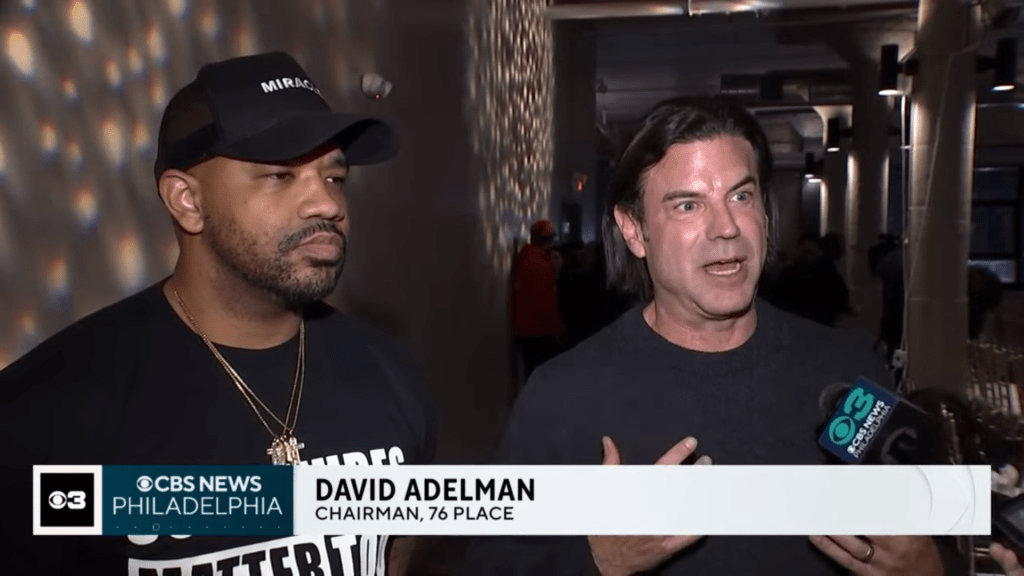
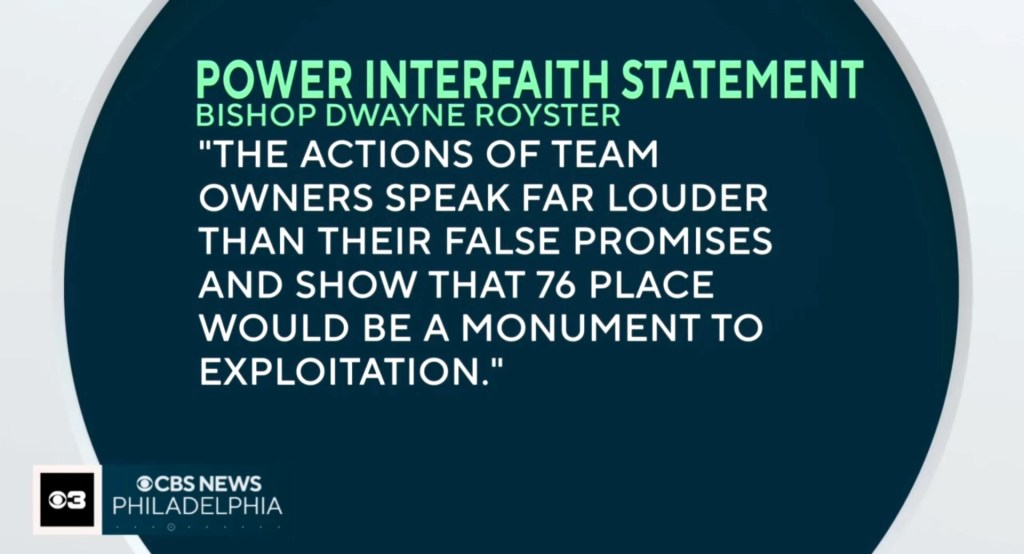
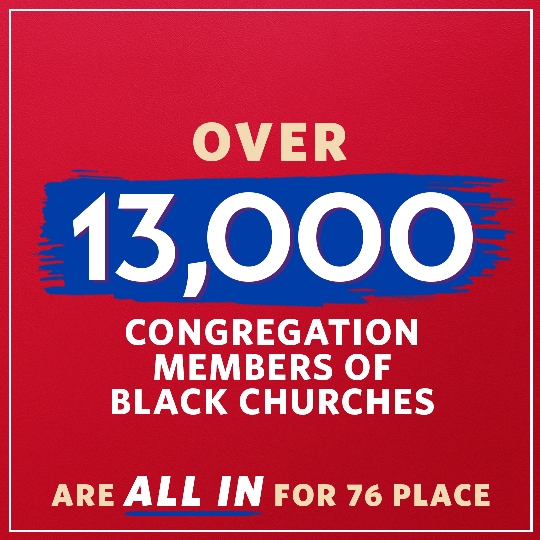
David Adelman has played the race card to try to stomp out opposition to the 76ers’ transit-oriented project in a city “without a viable transit system.” A self-serving group of jackleg preachers gave 76 Place their blessing.
But in the words of choir director and gospel singer Kirk Franklin, “It ain’t over.”
The Pennsylvania Office of Open Records ordered SEPTA to conduct a good faith search for records responsive to my Right-To-Know Law request for documents related to the Philadelphia 76ers’ proposal to build a basketball arena atop Jefferson Station. The records include SEPTA General Manager and CEO Leslie S. Richards’ and Chief Operating Officer Scott Sauer’s communications with City Councilmember Mark Squilla, David Adelman, and named lobbyists, lawyers and 76 Place development team. SEPTA was also ordered to turn over invoices, reports, feasibility studies, traffic impact studies, architectural designs and cost estimates.
I should have received the records no later than January 20, 2024. Instead, SEPTA filed a Petition for Review of the OOR’s decision in the Commonwealth Court of Pennsylvania at the eleventh hour on January 19, 2024.
With service cuts and fare increases looming, SEPTA is fighting to withhold from the public information about the impact of the proposed arena on its operating and capital budgets. Six years of demolition and construction would disrupt service and ridership as Jefferson Station becomes a construction zone and buses on Market Street are rerouted. Meanwhile, the public transit agency is rattling the cup in Harrisburg and Washington.
In a letter to Transportation Secretary Pete Buttigieg, members of Pennsylvania’s congressional delegation, including Senators John Fetterman and Bob Casey, and Rep. Dwight Evans, wrote:
We are at a critical juncture for transit in the Philadelphia region. Without strong, sustained support at all levels of government, Pennsylvanians risk losing access to transit and all its benefits.
[…]
SEPTA’s service is essential for the entire southeastern PA region, providing more than 700,000 daily trips throughout a five county, city and suburban territory. A high-quality transit system is essential to maintain growth and economic vitality, both downtown and throughout the region. We cannot ease congestion or reduce emissions without transit. How will we host major events in Pennsylvania, including 250th anniversary of the Declaration of Independence in two years, without a viable transit system?
In the absence of open records, the Sixers’ PR team has filled the vaccum with factoids. Fact is, 76 Place is a transit-oriented project “without a viable transit system.”
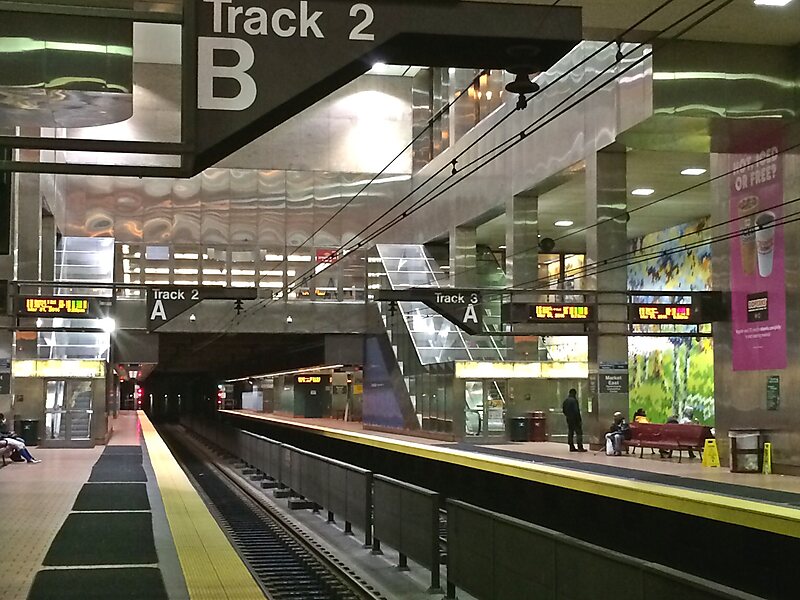
Service at Jefferson Station would be disrupted during demolition of the Fashion District shopping mall and construction of the arena. The project would require SEPTA to periodically turn off power at Jefferson Station and the 11th Street station. When that happens, riders would be told “that train don’t stop here.”
In a post on X (formerly Twitter), 76 Place hype man David Adelman floated the straw man claim of “a grand conspiracy.” Adelman said “we are talking to SEPTA about how to improve access and service at the station.”
Leslie Richards and Scott Sauer are fighting release of their communications with Adelman about the cost of improving access and service at Jefferson Station. Secretary Buttigieg should demand answers about the impact of 76 Place on the public transit agency. In the meantime, I will submit a FOIA request to the Federal Transit Administration.
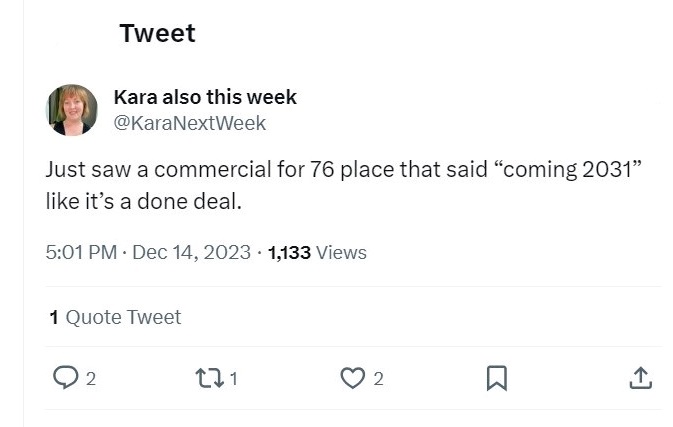
The Philadelphia 76ers’ mantra is: Trust the process. Sixers’ owners Josh Harris and David Blitzer entrusted limited partner David Adelman with shepherding their proposal to build a new basketball arena through the review and approvals process. Nearly two years and millions of dollars later, 76 Place is no closer to being “a done deal.” It’s now a “saga.”
Sixers Arena Saga: Right-to-Know Appeals, Behind the Scenes "Gamesmanship," and a Question of Blacklisting https://t.co/Xb7iMsirGe
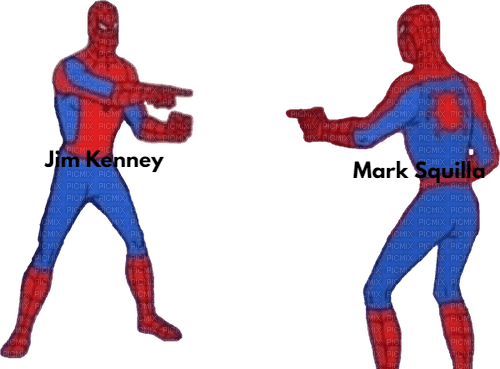
I began to draft my first Right-To-Know Law request for records related to 76 Place shortly after it was reported that a provision that would have paved the way for the Sixers to build an arena adjacent to Chinatown was slipped into an unrelated bill introduced by Councilmember Mark Squilla. Mayor Jim Kenney and Squilla pointed the finger at each other as to the source of the “immaculate” legislation.
In July, I submitted RTKL requests to then-Mayor Kenney, City Councilmembers, including Squilla, and City agencies that have jurisdiction over some aspect of the project. All of my requests were denied. The City consolidated my requests on appeal.
The Office of Open Records issued its final determination on January 9, 2024. My appeal was granted in part and denied in part. The OOR ordered the City to turn over responsive records by February 9, 2024. The records include Squilla’s communications with Adelman and PIDC, the nonprofit organization that commissioned the “independent studies” paid for by the Sixers.
The City may withhold records that contain confidential proprietary information or trade secrets. As with the earlier orders, the City is expected to appeal the OOR’s final determination to the Court of Common Pleas.
Meanwhile, the release of the “independent studies” has been delayed. Squilla appealed to the community “to wait for these studies.” In the coming weeks, we will have the spectacle of Squilla asking the public to trust a process that has been tainted from the beginning while at the same time in court fighting to withhold from the public his communications with Adelman, PIDC, and 76 Place lawyers, lobbyists and development team.
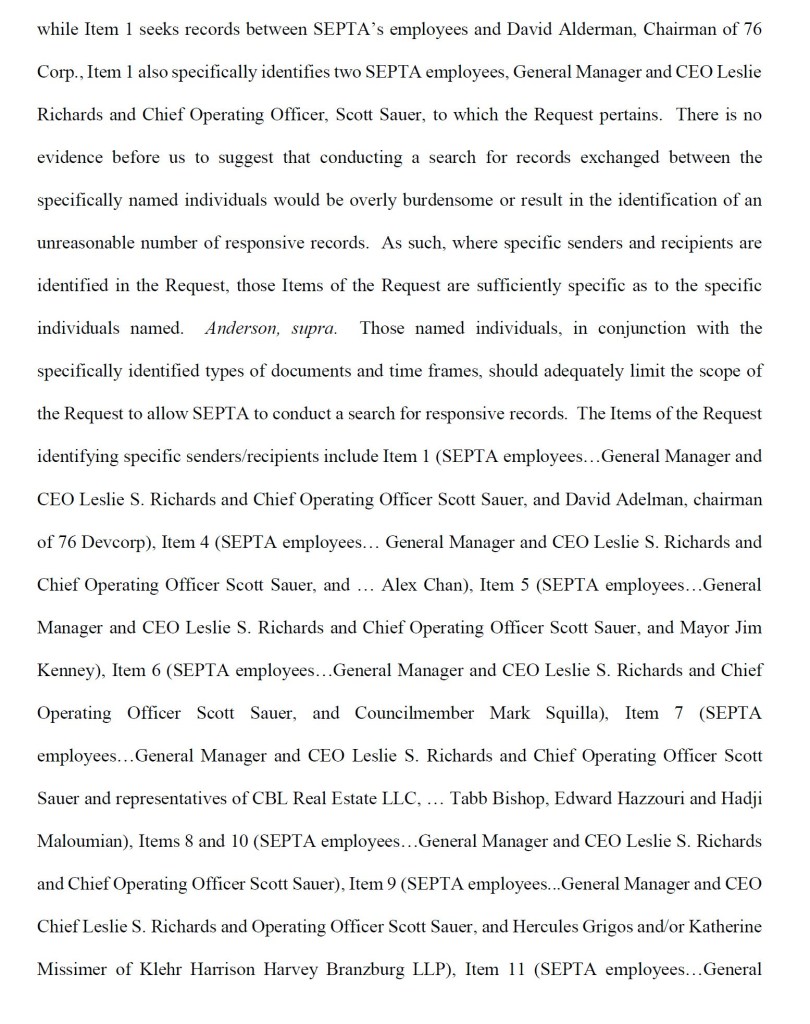
Christmas came early for me. The Pennsylvania Office of Open Records (OOR) issued its final determination in my appeal of SEPTA’s denial of my Right-To-Know Law request for records of SEPTA officials’ communications related to the Philadelphia 76ers’ proposal to build a new arena atop Jefferson Station, aka #76Place. The public transit agency denied my request claiming that it was insufficiently specific and “burdensome.”
The OOR found that the request was partially specific and named names, including billionaire David Adelman, Sixers co-owner and 76 Place hype man, and City Councilmember Mark Squilla.
SEPTA was ordered to conduct a good faith search and turn over responsive records to me by January 20, 2024.
All three of my appeals have been granted in part. Pennsylvania’s Right-To-Know Law sure has been good to me. Merry Christmas, baby.
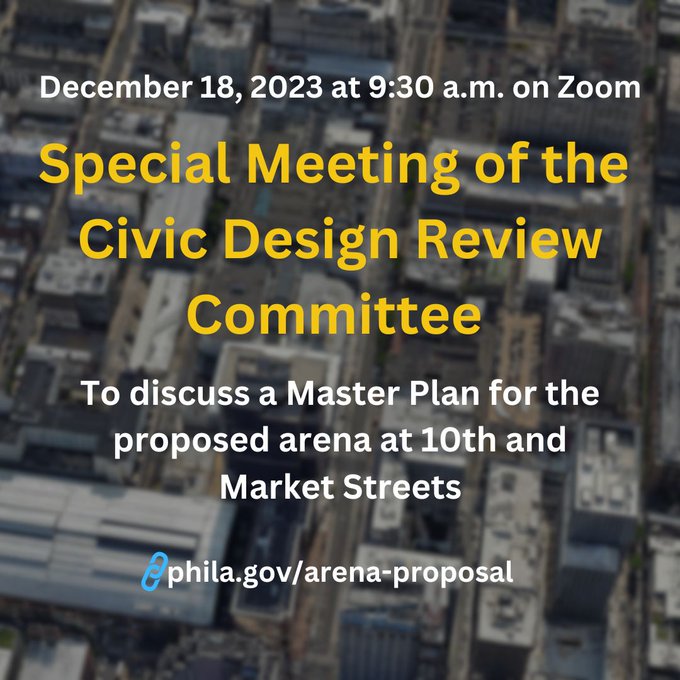
Civic Design Review (CDR), a committee of the Philadelphia Planning Commission, is holding a special meeting to evaluate the Philadelphia 76ers’ proposal to build an arena adjacent to Chinatown. CDR is triggered by building projects of a certain size and/or location as outlined in the Philadelphia Code.
The Planning Commission is an agency within the Department of Planning and Development (DPD). Eleanor Sharpe, DPD interim director, said in a press release:
Whenever a major private development project is proposed, the City looks closely at the proposal to understand the complications, challenges, and potential positive and negative impacts. It is the City’s responsibility to make sure that the people of Philadelphia will benefit as much as possible if the project—in this case, an arena—becomes a reality. Figuring this out is what we mean by “due diligence.”
The public forum was preceded by 15 months of closed door meetings between Planning Commission officials and representatives of the Sixers – the same people who will appear before the CDR Committee.
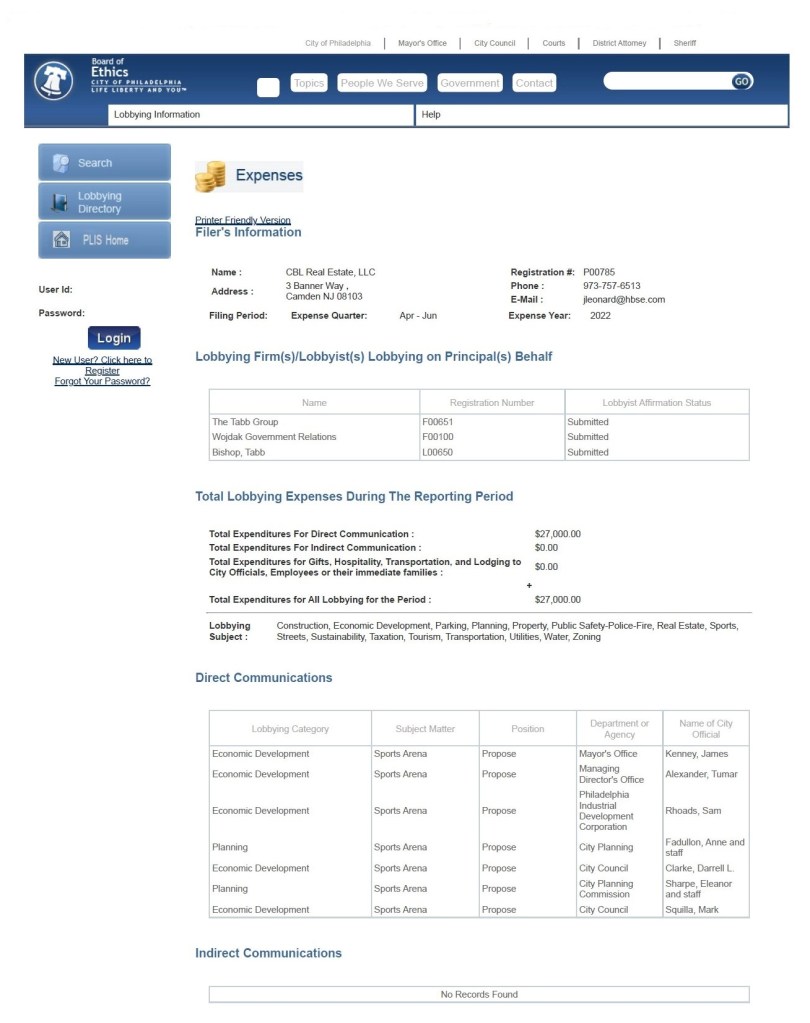
An investigation by the Philadelphia Board of Ethics found that Sharpe, then-director of the Planning Commission, diligently met with Sixers’ lobbyists beginning in April 2022 – three months before the public announcement of 76 Place.
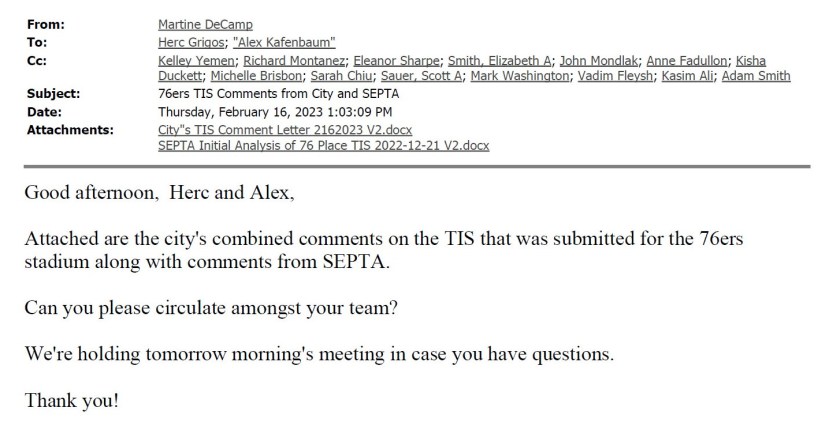
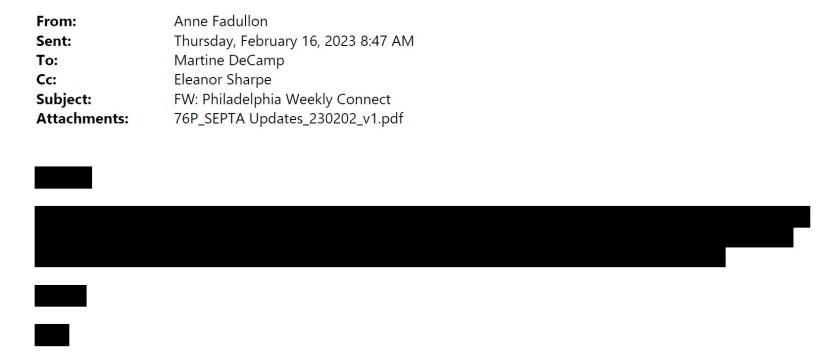
Records obtained in response to my Right-To-Know Law (RTKL) request show that Sharpe and Martine Decamp regularly communicated about 76 Place. Decamp, interim director of the Planning Commission, is a member of the CDR Committee.
After the Board of Ethics released its report, I submitted a new RTKL request to the Planning Commission, specifically requesting records related to Sharpe’s and Decamp’s communications about the proposed arena. The agency did not respond so I filed an appeal with the Office of Open Records (OOR).
The OOR issued its final determination on November 20, 2023. My appeal was granted in part and denied in part. The OOR found that portions of my request are sufficiently specific, and that the request is not disruptive or repetitive. The OOR ordered the City to search for responsive records and turn them over to me by December 20, 2023. Instead, the City appealed the OOR’s decision to the Philadelphia County Court of Common Pleas to block release of the records.
Paula Knudsen Burke, the Reporters Committee for Freedom of the Press Local Legal Initiative attorney for Pennsylvania, is representing me in this matter.
Journalist @andersonatlarge, represented by @rcfp’s @Paula_RCFP, is seeking to obtain records related to the Philadelphia 76ers’ plan to build a new arena. But the city is now taking her to court to keep the records hidden from the public. https://t.co/pRKW6lGYDZ
— Reporters Committee for Freedom of the Press (@rcfp) December 16, 2023
Knudsen Burke’s due diligence will eventually disclose what Sharpe, Decamp and other Planning Commission officials said behind closed doors.
What’s done behind closed doors can be undone with transparency. The Philadelphia Housing Authority’s plan to transfer ownership of 2125 Ridge Avenue to an undercapitalized, political insider was undone after I asked questions and filed a complaint with the Pennsylvania Office of State Inspector General.
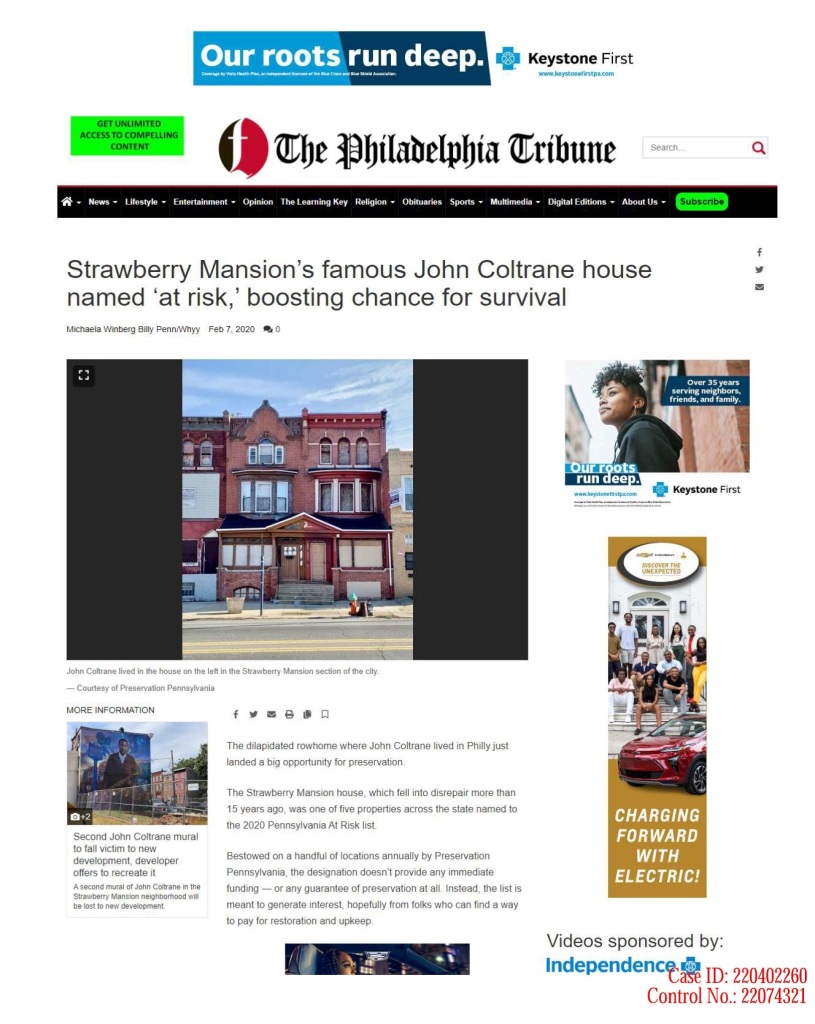
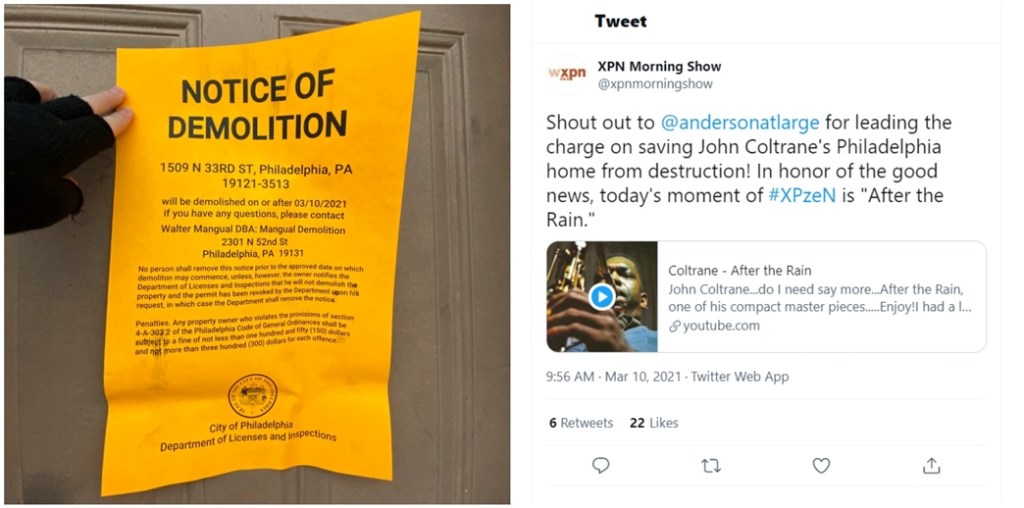
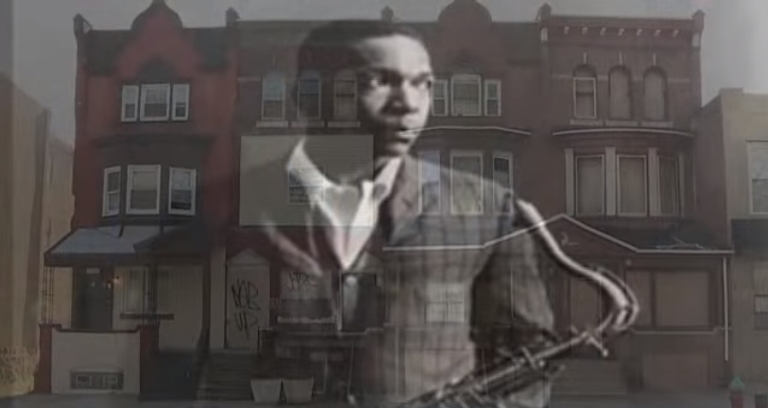
A developer’s plan to demolish the building with which the John Coltrane House shares a party wall was undone after I sounded the alarm.
The Philadelphia Historical Commission did the “Philly Shrug.” They said they did not have the authority to require the owner to stabilize or brace the historic landmark. A fly-by-night LLC that is here today and gone tomorrow could have whacked away at the John Coltrane House and let the bricks fall where they may. City Council amended the Philadelphia Building Construction and Occupancy Code and provided safeguards for “work impacting historic structures.” Mayor Jim Kenney signed the bill on July 15, 2021.
Mayor Kenney and the Office of Arts, Culture and the Creative Economy (OACCE) said their decision to award a $500,000 no-bid commission for a permanent Harriet Tubman statue was made after four million people “positively reacted” to the temporary statue that was installed at City Hall for three months during the dead of winter. Philadelphia’s population is 1.5 million.
Records obtained in response to my Right-To-Know Law request show OACCE was negotiating a no-bid contract with the artist within days of the unveiling of the temporary statue. The City took a “new direction” and issued an Open Call for Artists.
From the day the Philadelphia 76ers announced their proposal to build a basketball arena on the site of the bankrupt Fashion District, the team’s billionaire owners have tried to present the project as “a done deal.”
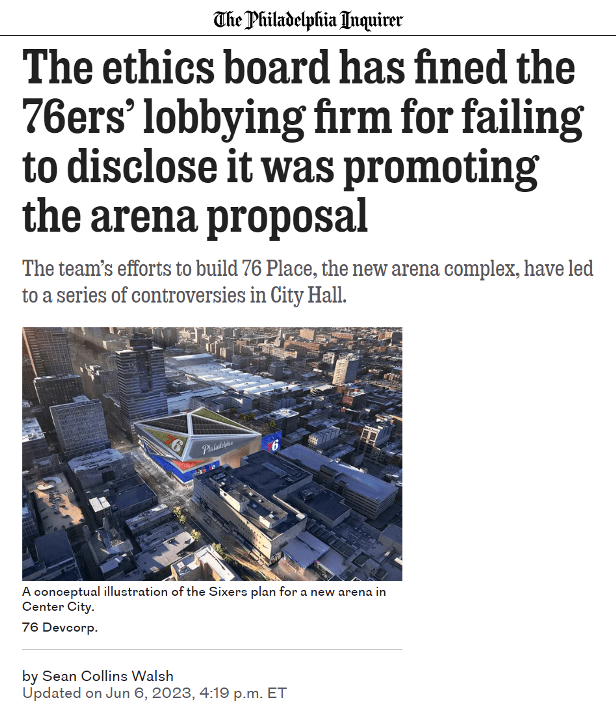
An investigation by the Philadelphia Board of Ethics found that Sixers’ lobbyists met with Mayor Kenney and other City officials as early as April 2022 – three months before the public announcement.
The proposed arena is one of the most controversial and consequential issues facing Philadelphia, the poorest big city in the country. I submitted open records requests to city and state agencies that have jurisdiction over the project, commonly known as 76 Place. The Transportation Impact Study that I obtained via a RTKL request to the Pennsylvania Department of Transportation is the only substantive document disclosed to date.
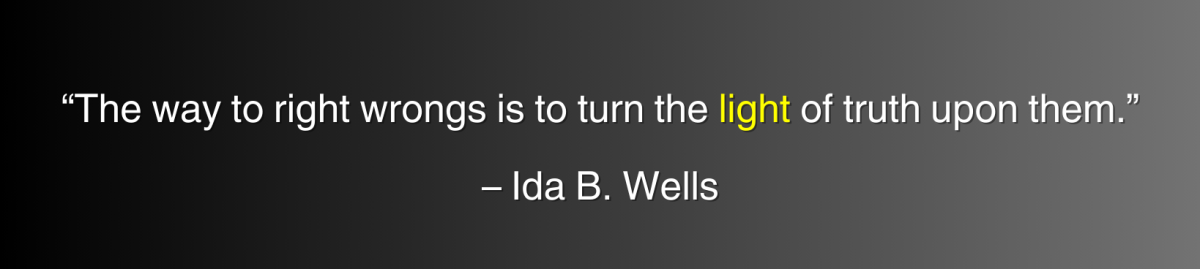
I appealed the denial of my RTKL requests to City agencies and SEPTA for records related to 76 Place. Let the sunshine in.