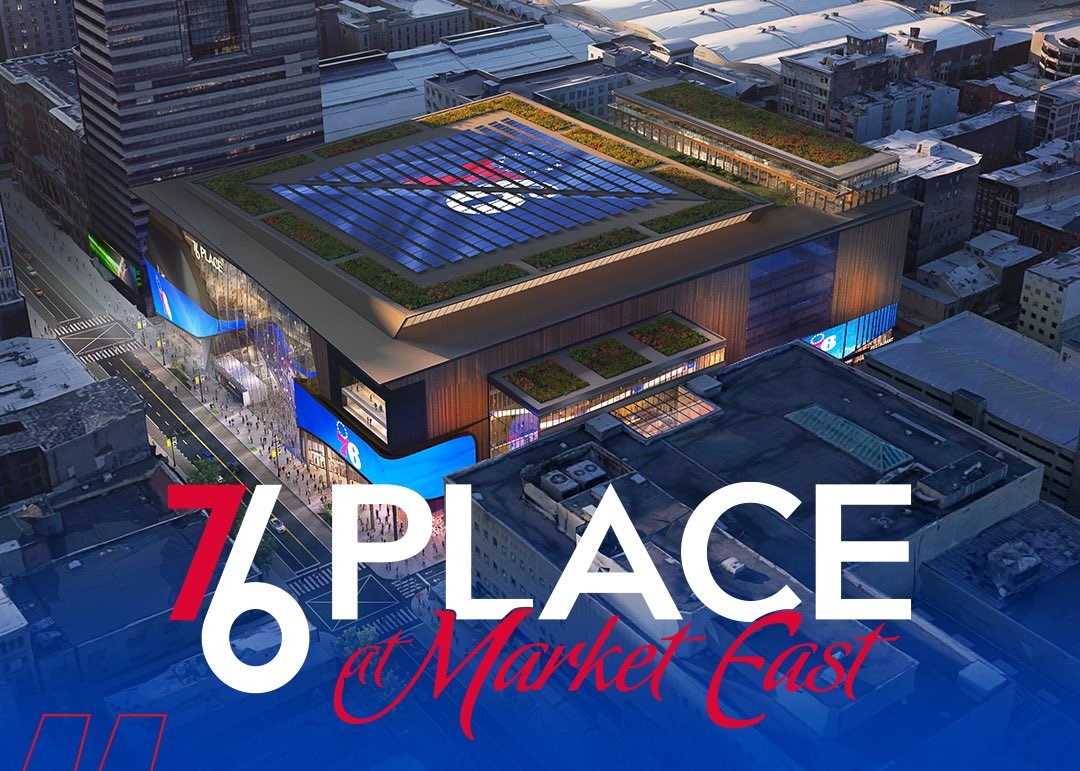
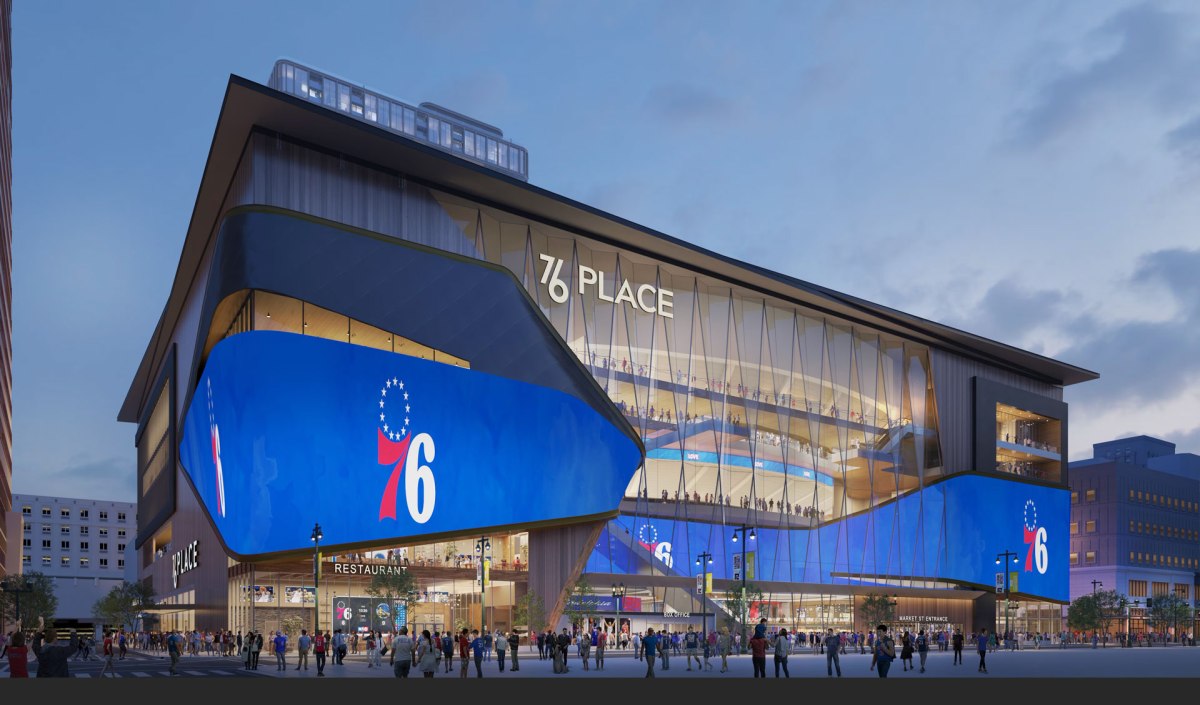
One year ago this week, the billionaire owners of the Philadelphia 76ers pulled the rug out from under Mayor Cherelle L. Parker and City Council. Their proposal to construct a basketball arena atop SEPTA’s Jefferson Station was a dream for the billionaires and a nightmare for everyone else.
A year later, we don’t have answers about this debacle. The City is still fighting release of documents that I requested from the previous administration.
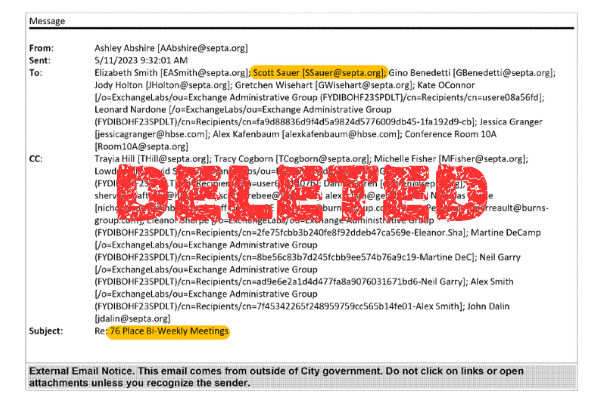
SEPTA was twice ordered to turn over records. Rather than comply with the orders, the cash-strapped agency continued to pay outside counsel to fight disclosure. With their back against the wall, SEPTA claimed the records were deleted.
In this new year, I will submit new RTKL requests for 76 Place records for the period of January 1, 2024 to January 14, 2025. I will keep on pushing until we get answers to how the billionaires hijacked the public policymaking process.
This time last year, the billionaire owners of the Sixers were going hard for a new basketball arena on East Market Street. 76 Place was a public transit-oriented project hitched to a beleaguered public transit agency. Then as now, SEPTA is facing a fiscal cliff. U.S. Transportation Secretary Sean Duffy is threatening to push the mismanaged agency over the cliff.
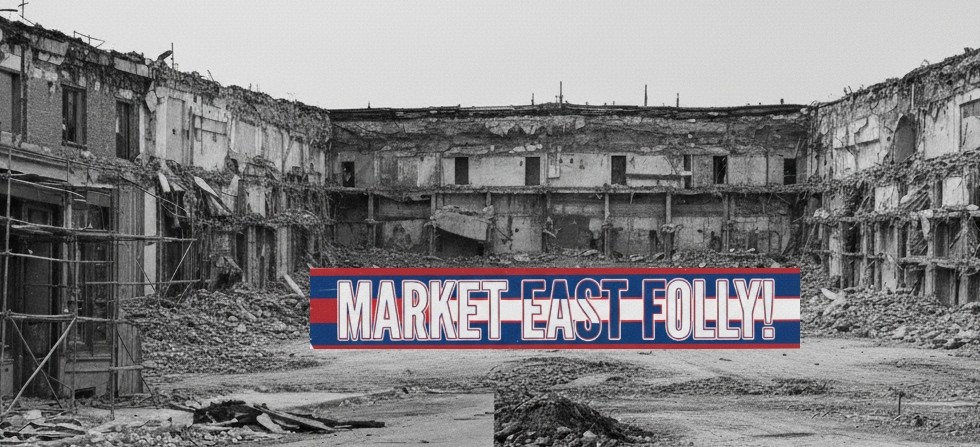
Market East has been in decline for decades. Empty storefronts line the once thriving shopping district. The Sixers and their new bestie, Comcast, plan to demolish buildings and build, well, nothing. The Philadelphia Inquirer reported:
The companies that own the 76ers and Flyers earlier this year made a high-profile commitment to help transform the long-distressed East Market Street corridor.
The first development to come out of that promise? Perhaps a mini-soccer pitch. Or a pop-up beer garden.
The teams recently hired a contractor to demolish buildings they own on the 1000-block of the beleaguered thoroughfare with the goal of eventually erecting a major development that could help revitalize the area.
But, until then, City Councilmember Mark Squilla said Friday the teams and city leaders hope to “activate” the lots slated for demolition with “pop-up” opportunities related to the FIFA World Cup and the nation’s 250th birthday being hosted in Philadelphia next summer.
The Sixers and Comcast’s development plan to shoot first and aim later was shot down by the Design Advocacy Group:
In the meantime, the sports teams that now own many buildings on the 900 and 1000 blocks of Market Street are already planning to begin tearing them down with nothing more in mind than a “pop up” beer garden or miniature soccer field.
If popups are wanted by FIFA and the 250th, Market Street already has large demolition sites—the surface parking lot at 13th and Market and the gigantic “Disney Hole” at 8th and Market. Not far away is the gaping void on Jewelers Row, a cautionary tale about premature demolition. These places remind us of past failures where rushed demolition yielded no replacement.
Of course, Market Street needs dressing up in time for the flood of visitors we look forward to in 2026. And pop-ups on existing empty sites should be part of that. But it makes no sense to stage such impulsive demolition on Market Street to create spaces we don’t need now for the not yet planned projects that may come next.
UPDATE: The Philadelphia Inquirer Architecture Critic Inga Saffron doesn’t trust the Sixers and Comcast’s process:
The long-awaited effort to reinvent Market East began in the same bombshell manner as the Sixers’ arena proposal did three years ago — with no transparency and no planning.
First, the two new BFFs of the Philadelphia sports world — the Sixers and Comcast — blindsided Mayor Cherelle L. Parker (and the rest of us) by announcing that they intended to raze several buildings on the 1000 block of Market Street, an area covering half the block. As for what they would put in their place, well, they’ll get back to us on that.
This has to be the worst idea for fixing Market Street’s woes since the last bad idea: the Sixers basketball arena.
Although SEPTA is in a transit death spiral, the agency is wasting money on outside counsel fighting release of records related to the Philadelphia 76ers’ proposal to build an arena atop Jefferson Station.
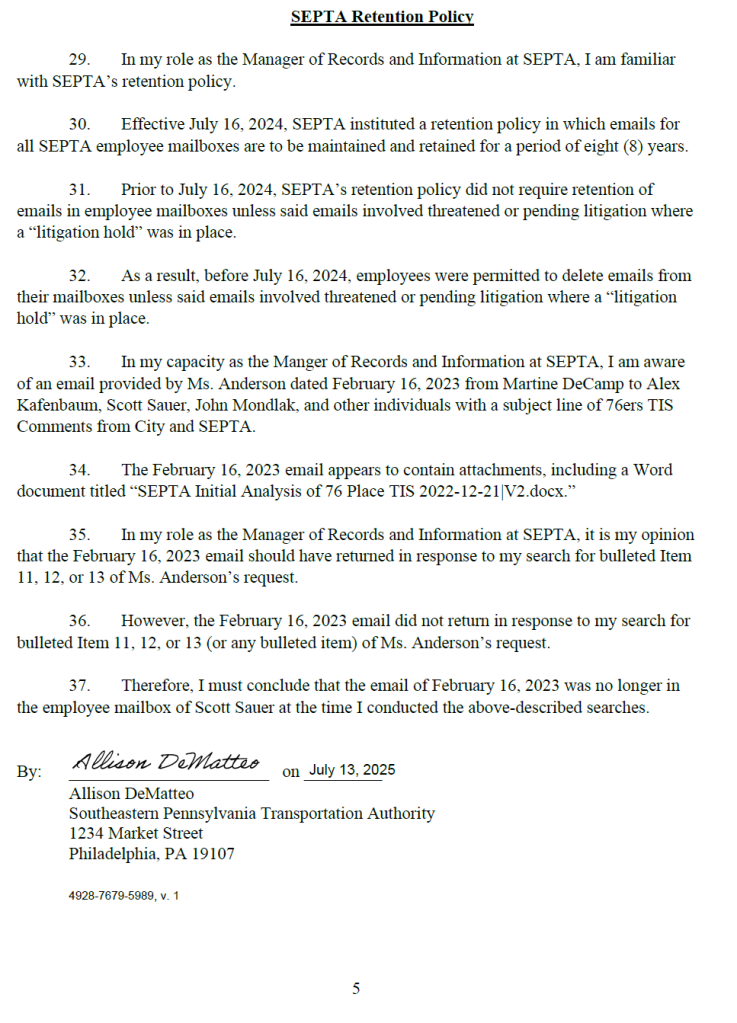
I submitted a Right-To-Know Law request on August 1, 2023 for records related to 76 Place for the timeframe of April 1, 2022 to July 31, 2023. After losing before the Office of Open Records and the Commonwealth Court of Pennsylvania, SEPTA now claims more than seven gigabytes of data were deleted. Former CEO Leslie Richards and current CEO Scott Sauer deleted records related to the most controversial proposal in the transit agency’s history.
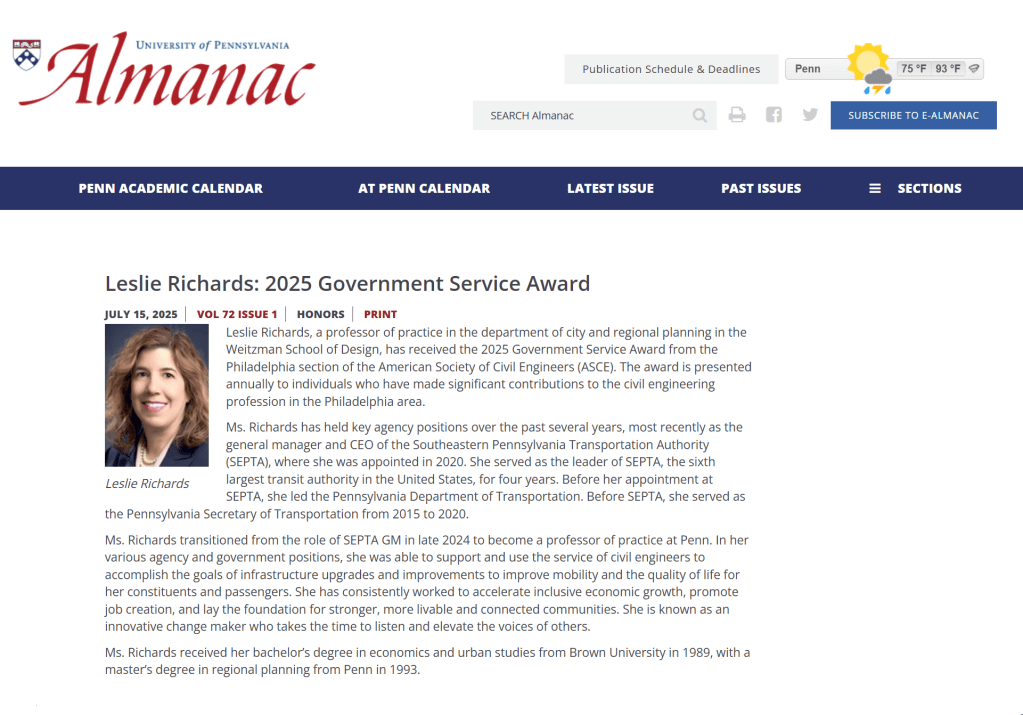
Richards left the cash-strapped agency in November 2024 but she’s still collecting a check from SEPTA.
It is said that those who can, do; those who can’t, teach. Fittingly, Richards is now teaching at the University of Pennsylvania. Penn recently announced that Richards received the 2025 Government Service Award from the Philadelphia chapter of the American Society of Civil Engineers.
In deleting 76 Place records, Richards did a disservice to the public. We have the right to know how SEPTA could have been stuck paying tens of millions of dollars for the Sixers billionaire owners’ now-abandoned vanity project.
SEPTA is Exhibit 1 as to why the Pennsylvania House of Representatives should pass Senate Bill 686, sponsored by Pennsylvania Senate State Government Committee Chairman Sen. Cris Dush. The legislation makes the intentional destruction or alteration of Right-To-Know Law records a third-degree felony.
I find it deeply troubling that Pennsylvania’s long-standing RTK law mentions no criminal offense for destroying or altering records subject to a RTK request. Not surprisingly, the rule of law is entirely thwarted whenever government officials or their staff intentionally dispose or suppress records that have been requested under RTK provisions, and which the public has every right to examine.
Those who cannot handle the truth should not get away with criminally suppressing the truth. In short, the punishment for violating our Commonwealth’s RTK law must fit the crime. It’s well past time in Pennsylvania to balance the scales of justice against this preposterous ‘get-out-of-jail-free-card’ for the flagrant destruction of RTK records with a maximum third-degree felony conviction.
It is deeply troubling officials destroyed records knowing that if SEPTA approved 76 Place, lawsuits would fly.
The Philadelphia 76ers abandoned their plan to build an arena atop SEPTA’s Jefferson Station. But SEPTA is still playing games to block disclosure of communications with the Sixers’ billionaire owners and their representatives.
SEPTA lost their appeal of the Office of Open Records’ Final Determination to the Commonwealth Court of Pennsylvania. The beleaguered transit agency was directed to conduct a good faith search for records responsive to my Right-To-Know Law request for, among other things, invoices, reports, feasibility studies, traffic impact studies, architectural designs and cost estimates.
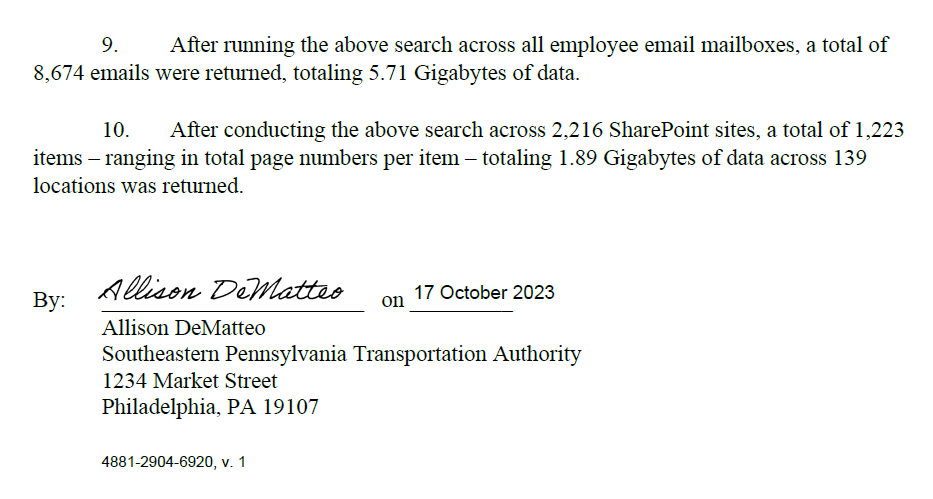
In a sworn statement, Allison DeMatteo, SEPTA’s Manager of Records and Information, claimed her search using the keywords “76 Place” and “76 Devcorp” returned 7.60 gigabytes of data, including 5.71 gigabytes of email.
According to ChatGPT, one gigabyte of email data is roughly 100,000 pages. As of this writing, SEPTA has produced 30 records.
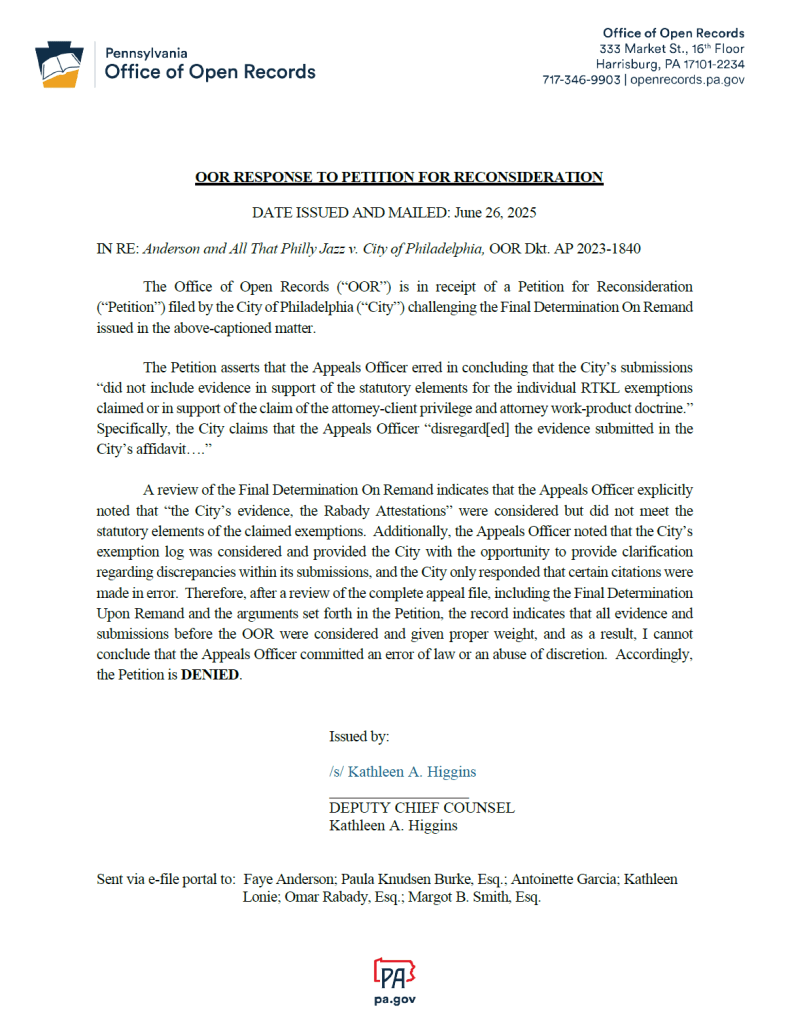
Meanwhile, the City of Philadelphia has petitioned the OOR to reconsider its final determination, dated May 30, 2025. The OOR should tell the City: We said what we said. “[T]he appeal is granted in part and denied in part, and the City is required to provide unredacted responsive records, as designated in this Final Determination, to the Requester within thirty days.”
UPDATE: Office of Open Records Deputy Chief Counsel Kathleen A. Higgins to the City of Philadelphia: The Petition is DENIED:
Therefore, after a review of the complete appeal file, including the Final Determination Upon Remand and the arguments set forth in the Petition, the record indicates that all evidence and submissions before the OOR were considered and given proper weight, and as a result, I cannot conclude that the Appeals Officer committed an error of law or an abuse of discretion. Accordingly, the Petition is DENIED.
In other words, the City of Philadelphia got to give it up.
On August 1, 2023, I filed a Right-To-Know Law request for records related to the Sixers’ now-abandoned proposal to build a basketball arena atop Jefferson Station. SEPTA denied the request, claiming the entirety of my Request was “insufficiently specific.”
I appealed the denial to the Pennsylvania Office of Open Records. The OOR determined that several Items were sufficiently specific and ordered SEPTA to conduct a good faith search for the records on December 20, 2023.
Rather than comply with the OOR’s final determination, the cash-strapped public transit agency paid outside counsel to appeal the order to the Commonwealth Court of Pennsylvania.
On May 1, 2025, the Commonwealth Court affirmed the OOR’s findings, stating that my Request was sufficiently specific, in part. SEPTA was, again, directed to conduct a good faith search for records responsive to my Request for, among other things, invoices, reports, feasibility studies, traffic impact studies, architectural designs and cost estimates.
The Commonwealth Court effectively said game over. Like the 76ers playing in the second round of the NBA playoffs, SEPTA blew its chance to assert any exemptions from disclosure. SEPTA must give up 76 Place records.
The City of Philadelphia and SEPTA are fighting release of records related to the Sixers’ proposal to build an arena atop Jefferson Station as ordered by the Pennsylvania Office of Open Records in 2023. The city and SEPTA appealed the OOR’s final determination. Their lawyers have asked whether I want to continue to pursue my records requests. If they want to end litigation, the city and SEPTA can simply stop litigating and turn over the records.
For more than two years, Philadelphia’s misleaders gaslighted the public into believing that all that was needed for the Sixers’ half-baked proposal to become “a done deal” was the approval of enabling legislation by City Council.
It is said that common sense is not so common. Neither Mayor Cherelle L. Parker nor City Council can grant the right to build on SEPTA property. Someone on Mayor Parker’s bloated staff should have had enough common sense to ask whether SEPTA was on board with the transit-oriented development.
We now know SEPTA was not on board. Then-interim General Manager Scott Sauer’s testimony before City Council’s November 19, 2024 public hearing should have ended the nonsensical notion that 76 Place would keep the transit agency from falling off the fiscal cliff:
The reality is that SEPTA simply cannot assume these new costs within the framework of its operating budget… SEPTA cannot shoulder the burden of expanded transit costs at 76 Place which would be in addition to the existing fiscal challenges.
Mayor Parker and 12 City Council members ignored the red flags. As I wrote in an opinion piece for the Philadelphia Inquirer, the Sixers’ billionaire owners knew the Federal Transit Administration was the shot caller in the 76ers arena saga:
SEPTA received federal funding to make improvements to Jefferson Station. In order to protect the “federal interest,” changes to the use of the station must be approved by the Federal Transit Administration. In other words, federal officials call the shots.
Sixers co-owner David Adelman tacitly acknowledged the crucial role played by Washington in a social media post following City Council’s 12-5 vote: “We look forward to pursuing the remaining approvals to make 76Place a reality.”
The Philadelphia 76ers billionaire owners gamed Philadelphia’s “corrupt and contented” ecosystem. When building an arena atop SEPTA’s Jefferson Station no longer served their interest, it was game over. The 76ers are staying in South Philly with their landlord-turned-partner, Comcast Spectacor.
The team has struck a deal with Comcast Spectacor to remain in the South Philadelphia sports complex, after more than two years of heated debate over moving to a potential new arena on East Market Street.
[…]
The reversal is a stunning end to a saga that has dominated city politics for more than a year and a setback for Mayor Cherelle L. Parker and others who championed the $1.3 billion Center City proposal.
At a press conference, Mayor Parker said, “This is a curveball that none of us saw coming.” Well, I saw it coming. It was only a matter of time before the Sixers abandoned their public transit-oriented project.
The ballyhooed legislation City Council passed was little more than a zoning permit. Neither Mayor Parker nor City Council can give the billionaires the right to enter Jefferson Station. They need SEPTA’s and the Federal Transit Administration’s approval of the development project. The review process could take years.
So, the billionaires were negotiating a deal with Comcast Spectacor while Mayor Parker and City Council were carrying their water. Philly’s misleaders were not just played. In the immortal words of Malcolm X, they were had, took, hoodwinked and bamboozled.
As expected, City Council gave final approval to enabling legislation that gives the Philadelphia 76ers a zoning permit to build an arena in the footprint of the Fashion District. Mayor Cherelle L. Parker said, “All of Philadelphia will benefit from this project.”
Truth be told, the 12 to 5 vote is a victory for the building trades unions and the Sixers billionaire owners. In this infamously “corrupt and contented” city, mayors and City Councilmembers genuflect to Big Labor. But neither Parker nor City Council has the authority to give the Sixers the right to enter SEPTA’s property. The billionaires now must get the approval of SEPTA and the Federal Transit Administration to enter Jefferson Station. David Adelman tacitly acknowledges this fact in a tweet sent after the vote:
We look forward to pursuing the remaining approvals to make 76Place a reality.
The enabling legislation does not include a solution to SEPTA’s recurring budget deficit of $240 million. The flex funding is a stopgap measure that bought SEPTA six months before the transit agency, again, faces a “death spiral.” SEPTA officials have already testified that the transit agency cannot be “burdened” with the operational costs of managing the demolition of the Fashion District, construction of the arena, and additional service to accommodate the 76ers’ schedule.
Philadelphia has ranked as the poorest big city in the country for decades. The high poverty rate is not a bug; it’s a feature. Philadelphia’s misleaders are not interested in reducing poverty because there’s a lot of money to be made by insiders and cronies managing poor people.
There is also a lot of money to be made by insiders and cronies with the Sixers’ proposal to build an arena atop SEPTA’s Jefferson Station. For more than two years, the billionaire owners of the Philadelphia 76ers have spent millions of dollars lobbying and spreading misinformation about the economic benefits of 76 Place.
By a vote of 12-4 on December 12, 2024, City Council gave preliminary approval to legislation enabling 76 Place to move pass the first round. Councilmembers Jamie Gauthier, Rue Landau, Nicolas O’Rourke, and Jeffery Young Jr. voted against the enabling legislation. Councilmember Kendra Brooks, a staunch opponent of the arena, was absent.
The Sixers made it pass the first round with an assist from Philadelphia’s misleaders. The enabling legislation does not give the billionaires the right to construct an arena on SEPTA’s property. They will need more than the building trades unions to get the approval of SEPTA, which is teetering on the brink of a “death spiral,” and President Donald Trump’s Federal Transit Administration.
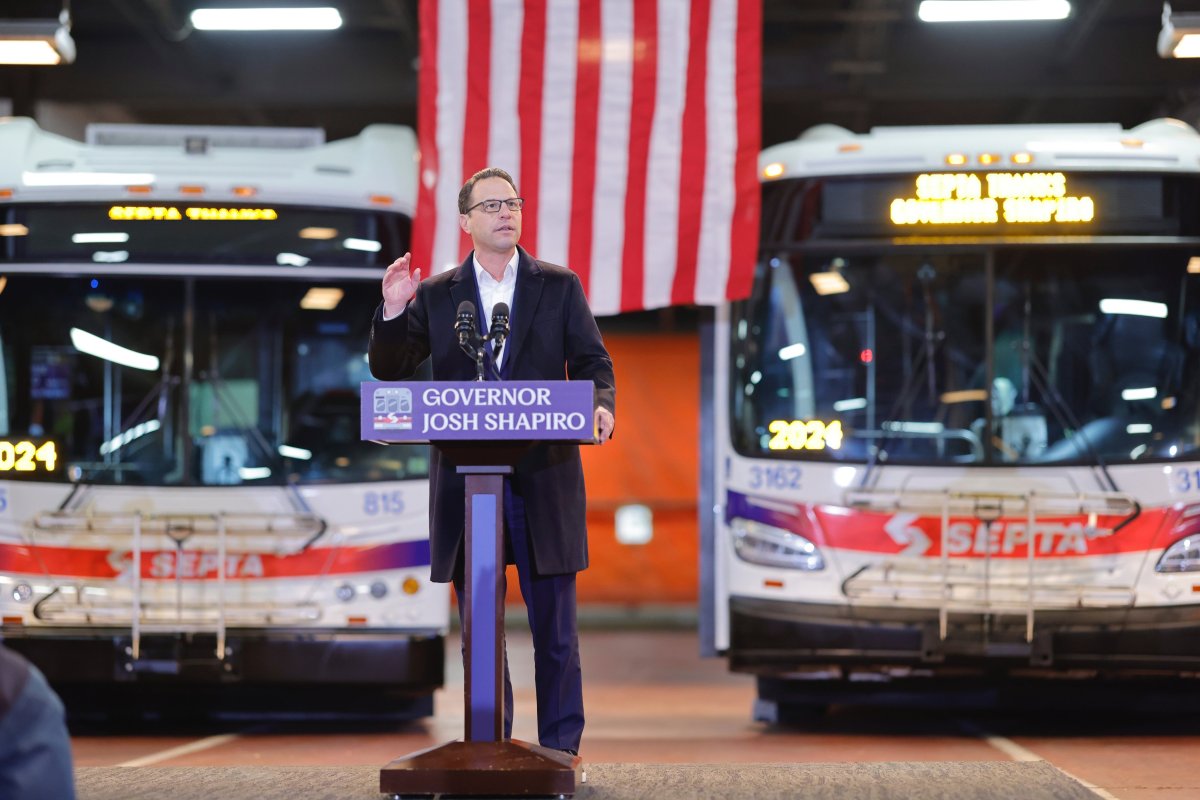
With no light at the end of the tunnel, Gov. Josh Shapiro stepped in and temporarily stopped SEPTA from going into a “death spiral.” Shapiro announced that he is transferring $153 million in federal highway capital funds to the beleaguered public transit agency. The one-time infusion of cash will cover this year’s operating budget deficit, and delay dramatic fare increases and service cuts.
Also last week, SEPTA released a draft report about the impact of the Philadelphia 76ers’ proposal to build an arena atop Jefferson Station. The Econsult Solutions Inc. report is the only impact study not paid for by the Sixers. The report debunks the claim that 76 Place would boost SEPTA’s bottom line:
Construction of 76 Place will cause significant disruption and cost SEPTA $22 million – $50 million during construction;
Additional service to achieve arena’s 40 percent transit share will cost SEPTA $20 million – $25 million annually.
The ESI study and SEPTA officials’ testimony at the arena public hearing should signal the end of the 76 Place saga. But this is Philadelphia where as President-elect Donald Trump infamously said, “bad things happen.” So, City Council could ignore the writing on the wall and pass enabling legislation for the proposed arena. Meanwhile, Mayor Cherelle Parker continues to hold “community meetings” about the project.
Fact is, neither City Council nor Parker will have the last word. 76 Place must be approved by Trump’s Federal Transit Administration. The ESI impact study notes drily: “It is not clear that the FTA will approve the station design as currently proposed.”






 PHL Watchdog