


The Philadelphia 76ers abandoned their plan to build an arena atop SEPTA’s Jefferson Station. But SEPTA is still playing games to block disclosure of communications with the Sixers’ billionaire owners and their representatives.
SEPTA lost their appeal of the Office of Open Records’ Final Determination to the Commonwealth Court of Pennsylvania. The beleaguered transit agency was directed to conduct a good faith search for records responsive to my Right-To-Know Law request for, among other things, invoices, reports, feasibility studies, traffic impact studies, architectural designs and cost estimates.
In a sworn statement, Allison DeMatteo, SEPTA’s Manager of Records and Information, claimed her search using the keywords “76 Place” and “76 Devcorp” returned 7.60 gigabytes of data, including 5.71 gigabytes of email.
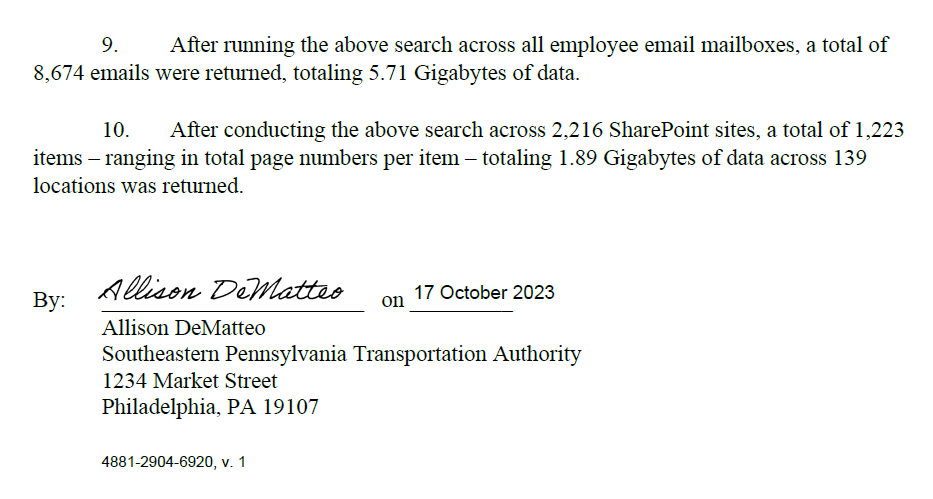
According to ChatGPT, one gigabyte of email data is roughly 100,000 pages. As of this writing, SEPTA has produced 30 records.
Meanwhile, the City of Philadelphia has petitioned the OOR to reconsider its final determination, dated May 30, 2025. The OOR should tell the City: We said what we said. “[T]he appeal is granted in part and denied in part, and the City is required to provide unredacted responsive records, as designated in this Final Determination, to the Requester within thirty days.”
UPDATE: Office of Open Records Deputy Chief Counsel Kathleen A. Higgins to the City of Philadelphia: The Petition is DENIED:
Therefore, after a review of the complete appeal file, including the Final Determination Upon Remand and the arguments set forth in the Petition, the record indicates that all evidence and submissions before the OOR were considered and given proper weight, and as a result, I cannot conclude that the Appeals Officer committed an error of law or an abuse of discretion. Accordingly, the Petition is DENIED.
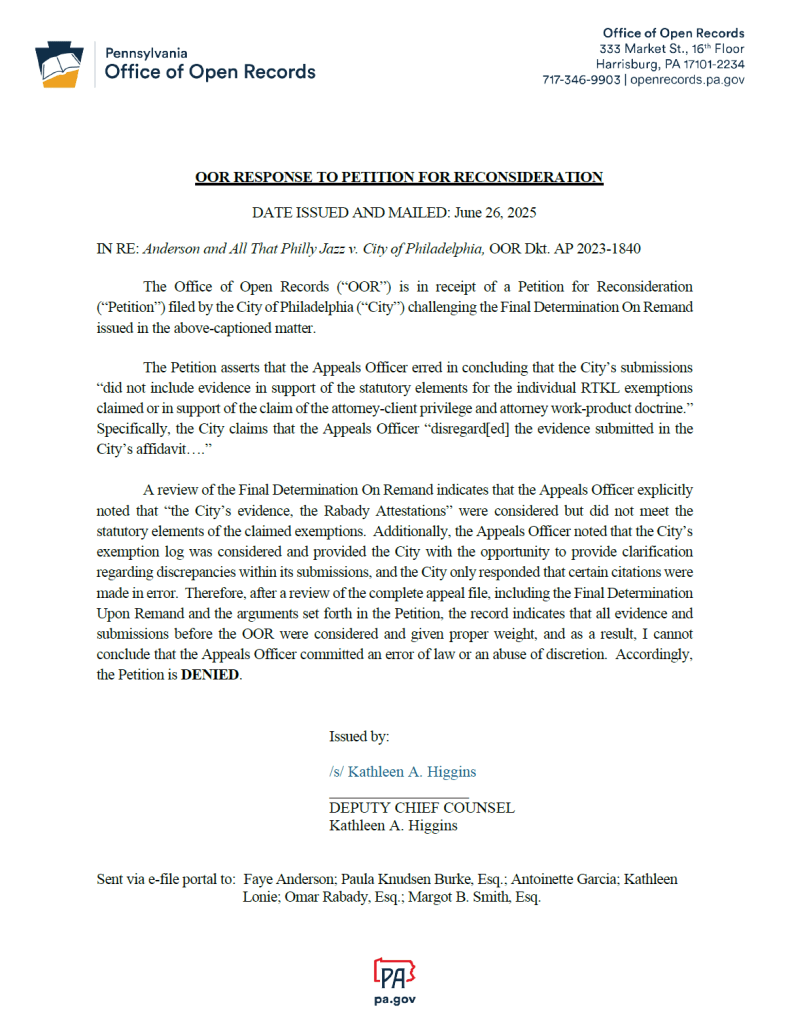
In other words, the City of Philadelphia got to give it up.














 PHL Watchdog