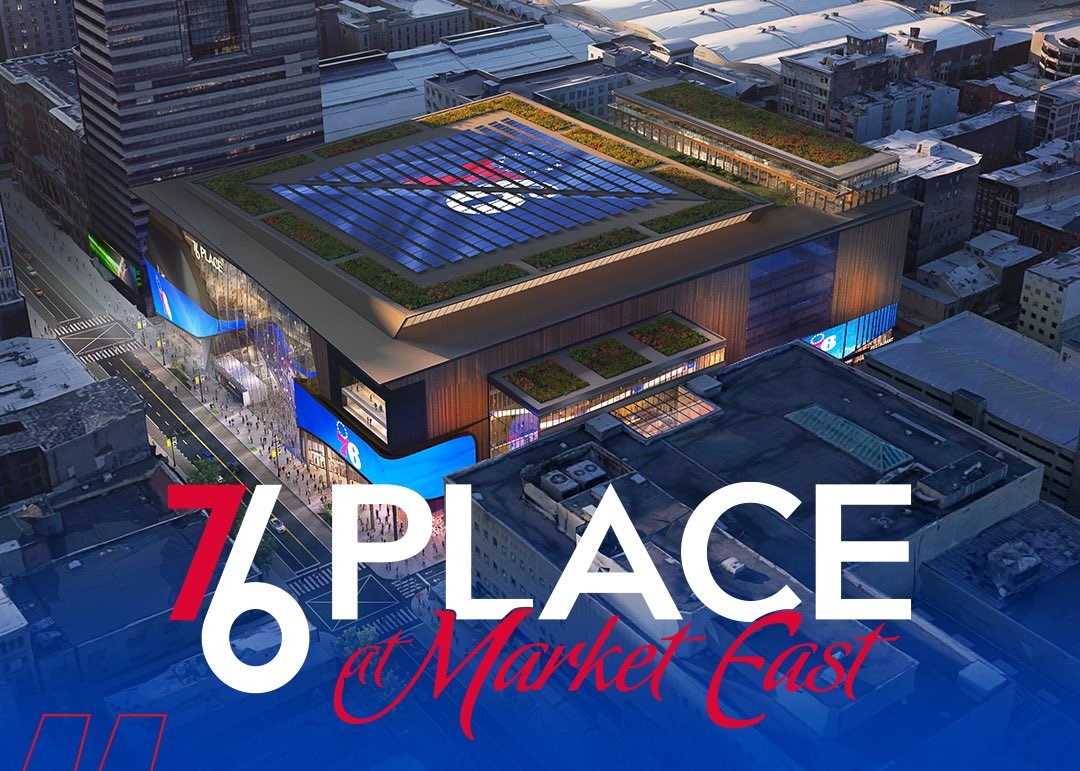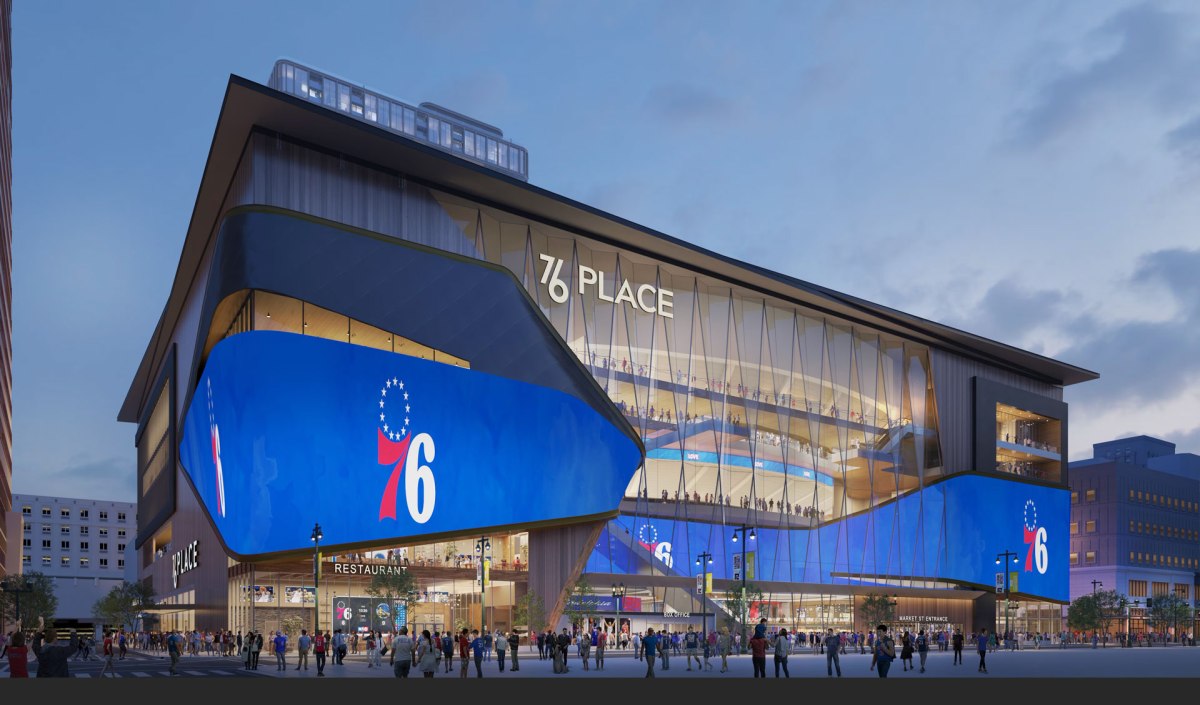
As expected, City Council gave final approval to enabling legislation that gives the Philadelphia 76ers a zoning permit to build an arena in the footprint of the Fashion District. Mayor Cherelle L. Parker said, “All of Philadelphia will benefit from this project.”
Truth be told, the 12 to 5 vote is a victory for the building trades unions and the Sixers billionaire owners. In this infamously “corrupt and contented” city, mayors and City Councilmembers genuflect to Big Labor. But neither Parker nor City Council has the authority to give the Sixers the right to enter SEPTA’s property. The billionaires now must get the approval of SEPTA and the Federal Transit Administration to enter Jefferson Station. David Adelman tacitly acknowledges this fact in a tweet sent after the vote:
We look forward to pursuing the remaining approvals to make 76Place a reality.
The enabling legislation does not include a solution to SEPTA’s recurring budget deficit of $240 million. The flex funding is a stopgap measure that bought SEPTA six months before the transit agency, again, faces a “death spiral.” SEPTA officials have already testified that the transit agency cannot be “burdened” with the operational costs of managing the demolition of the Fashion District, construction of the arena, and additional service to accommodate the 76ers’ schedule.
Philadelphia has ranked as the poorest big city in the country for decades. The high poverty rate is not a bug; it’s a feature. Philadelphia’s misleaders are not interested in reducing poverty because there’s a lot of money to be made by insiders and cronies managing poor people.
There is also a lot of money to be made by insiders and cronies with the Sixers’ proposal to build an arena atop SEPTA’s Jefferson Station. For more than two years, the billionaire owners of the Philadelphia 76ers have spent millions of dollars lobbying and spreading misinformation about the economic benefits of 76 Place.
By a vote of 12-4 on December 12, 2024, City Council gave preliminary approval to legislation enabling 76 Place to move pass the first round. Councilmembers Jamie Gauthier, Rue Landau, Nicolas O’Rourke, and Jeffery Young Jr. voted against the enabling legislation. Councilmember Kendra Brooks, a staunch opponent of the arena, was absent.
The Sixers made it pass the first round with an assist from Philadelphia’s misleaders. The enabling legislation does not give the billionaires the right to construct an arena on SEPTA’s property. They will need more than the building trades unions to get the approval of SEPTA, which is teetering on the brink of a “death spiral,” and President Donald Trump’s Federal Transit Administration.
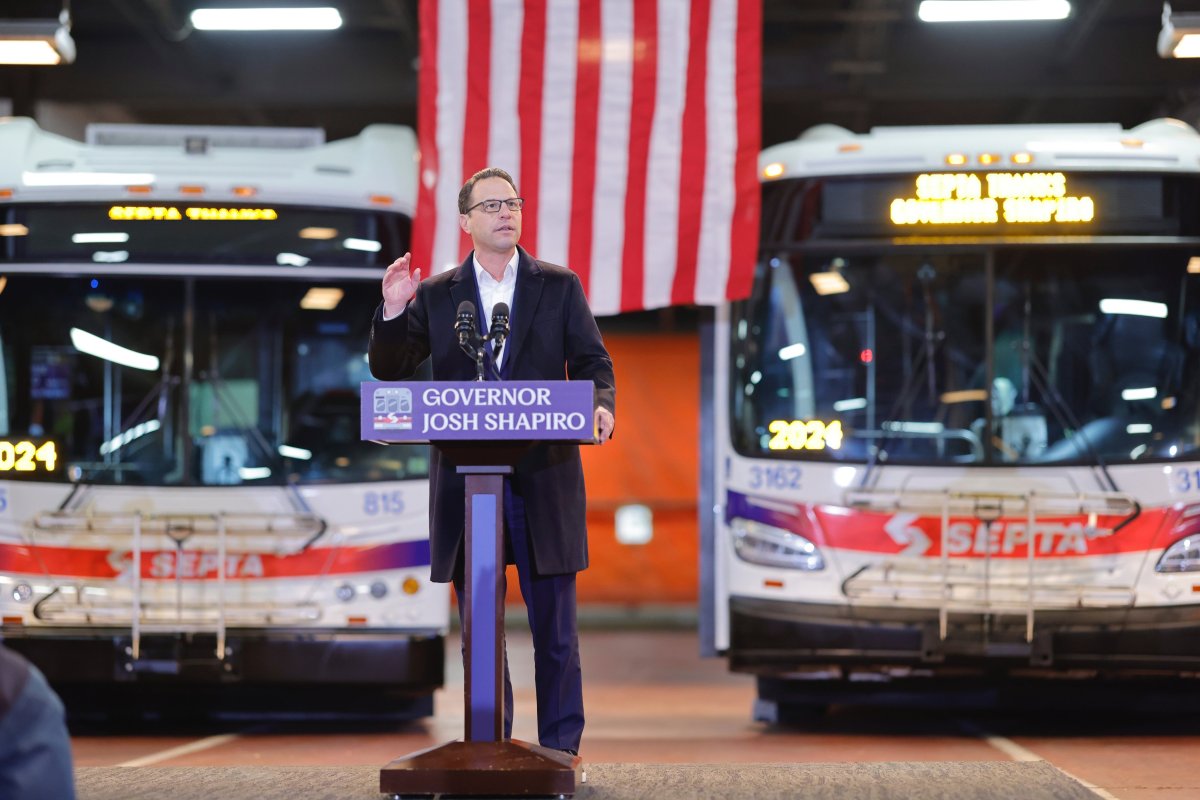
With no light at the end of the tunnel, Gov. Josh Shapiro stepped in and temporarily stopped SEPTA from going into a “death spiral.” Shapiro announced that he is transferring $153 million in federal highway capital funds to the beleaguered public transit agency. The one-time infusion of cash will cover this year’s operating budget deficit, and delay dramatic fare increases and service cuts.
Also last week, SEPTA released a draft report about the impact of the Philadelphia 76ers’ proposal to build an arena atop Jefferson Station. The Econsult Solutions Inc. report is the only impact study not paid for by the Sixers. The report debunks the claim that 76 Place would boost SEPTA’s bottom line:
Construction of 76 Place will cause significant disruption and cost SEPTA $22 million – $50 million during construction;
Additional service to achieve arena’s 40 percent transit share will cost SEPTA $20 million – $25 million annually.
The ESI study and SEPTA officials’ testimony at the arena public hearing should signal the end of the 76 Place saga. But this is Philadelphia where as President-elect Donald Trump infamously said, “bad things happen.” So, City Council could ignore the writing on the wall and pass enabling legislation for the proposed arena. Meanwhile, Mayor Cherelle Parker continues to hold “community meetings” about the project.
Fact is, neither City Council nor Parker will have the last word. 76 Place must be approved by Trump’s Federal Transit Administration. The ESI impact study notes drily: “It is not clear that the FTA will approve the station design as currently proposed.”
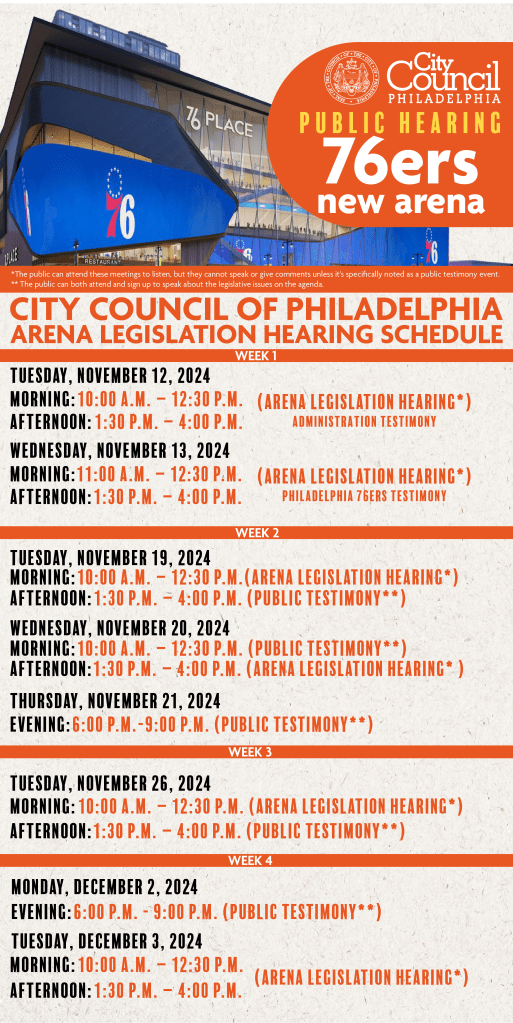
City Council has kicked off public hearings on the Philadelphia 76ers’ proposal to build an arena atop SEPTA’s regional rail Jefferson Station. Council President Kenyatta Johnson said:
Mayor Cherelle Parker’s Administration made the proposed Sixers arena legislation available to the public back in late September. Councilmember Mark Squilla, whose Council district the proposed arena would be located, introduced the 13 pieces of legislation on October 24. Councilmember Squilla has been working very hard over the past two years in addressing the concerns of his constituents.
Now that the legislation has been introduced, Council and every Council member is now going through our legislative process and I expect spirted Committee of the Whole hearings on this proposed arena. Councilmembers will have the opportunity to ask questions of officials from the Sixers, the Mayor Parker Administration, and others about the proposed arena project.
Council has launched a website to give the public up-to-date information, including the public hearing schedule.
As the first hearing was getting underway, SEPTA released a notice of public hearing on their plan to increase fares 29 percent beginning January 1, 2025. The higher fares would be “paired with major service cuts.” SEPTA Chief Operating Officer Scott Sauer said:
Today we stand with our feet on the edge of the fiscal cliff. With major service cuts and fare increases, this is the beginning of what we’ve been saying is the transit death.
…
We are managing the decline of SEPTA… Rail lines will become so infrequent that they will be useless to most of our customers.
The Sixers’ proposed arena is a public transit-oriented project anchored to a transit system on death watch. Let the 76 Place games begin.
True to form, Mayor Cherelle Parker gave “the people of Chinatown” less than 24 hours’ notice of a public meeting about the Philadelphia 76ers’ proposal to build an arena adjacent to Chinatown. At the meeting, Parker passionately defended her agreement with the Sixers, stating:
Anyone who has any challenges with what is contained in this agreement, you no longer have the Philadelphia 76ers as the villain here. I am Cherelle L. Parker. I am the 100th mayor of the city of Philadelphia. I am proud and take full responsibility for what is included in this agreement.
What Parker seems to miss is that there can be more than one villain in this story.
Parker said this “historic agreement is the best financial deal ever entered into by a Philadelphia mayor for a local sports arena.” Given the city’s track record in negotiations, “the best financial deal” doesn’t automatically mean it’s a good deal.
The Save Chinatown Coalition rightly boycotted the last-minute meeting.
Parker’s message to residents and business owners who view 76 Place as an existential threat:
I want Chinatown’s rich and vibrant community and proud history to not just survive but to thrive. We have the best Chinatown in the United States, and I am committed to working together to support it. This is a chance for new partnership and growth, based on mutual understanding and respect.
Historically, residents and supporters of Chinatowns have fought—and continue to fight—large-scale development projects that demand they and other communities of color accept disproportionate harm in the name of progress for all.
After Parker announced a Community Benefits Agreement with the Sixers, which was negotiated without input from the very community facing disproportionate harm, the National Trust released a statement:
The National Trust stands with local coalitions and the majority of Philadelphia residents who oppose the arena abutting Chinatown and will be most impacted by this devastating decision. Time and time again, history has shown us that large-scale planning decisions are made with significant consequences to communities of color. There is still time to chart a new path forward. The National Trust will continue to amplify the grave threat that this poses to one of the oldest intact Chinatown communities in the nation.
Maya Angelou’s words of caution echo here: “When someone shows you who they are, believe them the first time.”
Months ago, Parker’s Art Commission ignored the zoning code and allowed Midwood Investment and Development to renege on their commitment to preserve the legacy of Henry Minton in public memory.
An elite caterer and financier of the Underground Railroad, Minton hosted figures like Frederick Douglass and John Brown. The developer erased Black history without a word from Parker.
Why should the Save Chinatown Coalition trust Parker to respect their history and cultural heritage?
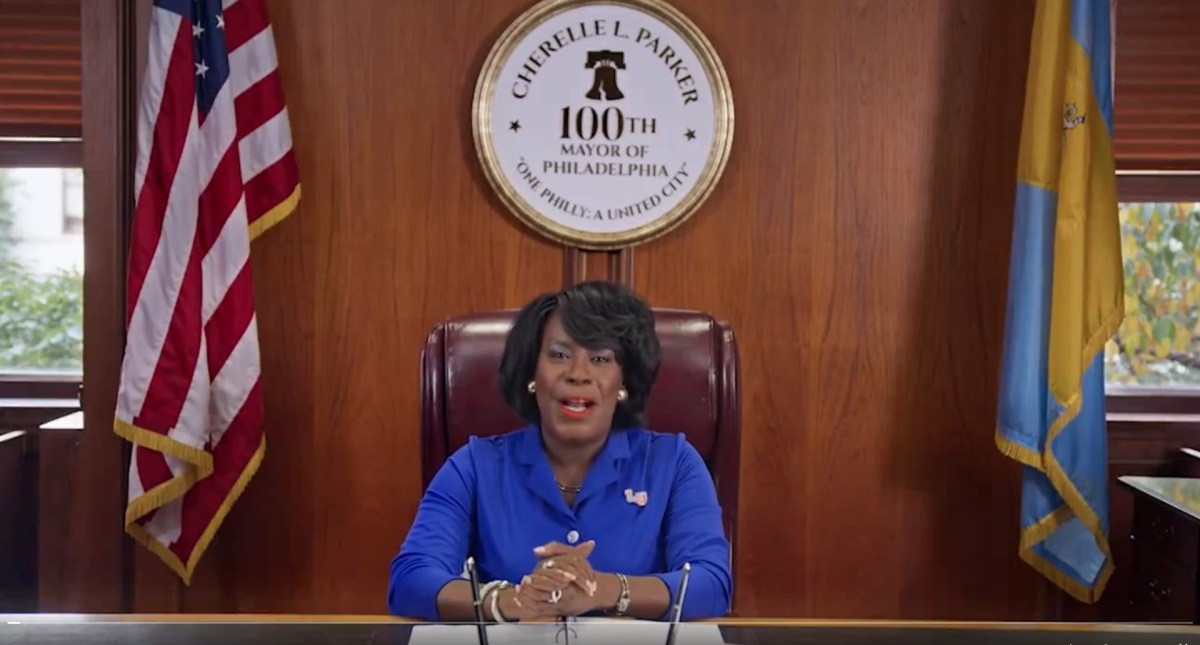
With less than 24 hours’ notice to “the People of Chinatown,” Mayor Cherelle L. Parker announced her endorsement of the Philadelphia 76ers’ proposal to build an arena that would abut against the historic neighborhood.
As your Mayor, I'm speaking from my City Hall office with a very important announcement. I am proud to share that I have made my decision, and an agreement has been reached to ensure that our Sixers are staying home.
Parker may “hear” the People of Chinatown, but she is not listening. If she were, she would know 76 Place is an existential threat to Chinatown. So, the Asian American Legal Defense and Education Fund threw down the gauntlet: See you in court!
AALDEF is disappointed that Mayor Parker took a stance in support of 76 Place arena's construction—before city council has had the opportunity to officially consider the proposal with public participation.
The billionaire owners of the Philadelphia 76ers are used to calling the shots. So they keep setting deadlines for City Council to give them what they want. First they said they wanted government approvals by June 2023. Then they said December 2023. The wannabe shot callers have set a new deadline of “early September.” A 76ers spokesperson told CBS News Philadelphia:
We remain focused on bringing a state-of-the-art arena to Philadelphia as we have been for the last four years. We are hopeful to reach an agreement with the city this summer to ensure legislation is introduced in early September, which will allow the 76ers to open our new home in time for the 2031-32 NBA season.
The billionaires don’t give a fig that the “independent studies” which they paid for have not been released. They don’t give a fig that Councilmember Mark Squilla repeatedly promised to give the public 30 days’ notice before legislation is introduced.
Squilla said he “expects a yes-or-no decision on the project by the end of the year.” As we approach the dog days of summer, the wannabe shot callers will miss yet another deadline.
A few days after setting the “early September” deadline, 76ers limited partner David Adelman told Marc Zumoff that “our timeline has always been for us to get approvals by the end of this calendar year.” For those keeping count, that’s the fourth deadline.
The Philadelphia Art Commission falls under the Department of Planning and Development. When questioned by Valerie Russ of The Philadelphia Inquirer about the short notice given for the Art Commission’s May 8, 2024 meeting, Department spokesperson Bruce Bohri said, “Public notice for this Art Commission meeting is compliant with the Sunshine Act.”
Under the Sunshine Act, public agencies must provide at least three days advance notice of a regular public meeting. Art Commission staff met with Midwood Investment & Development’s art curator for over a year but the public was given the minimum notice.
Tellingly, Bohri is silent about whether Odili Donald Odita’s concept design is compliant with Section 14-702(5) of the Philadelphia Zoning Code:
The items or programs provided to earn this bonus must meet the definition of “On-site Public Art” or “On-site Cultural Programming” in Chapter 14-200 (Definitions). It is not the intention of these requirements to allow decorative, ornamental, or functional elements of the building or public space that are not designed by an artist and created specifically for the site, nor to have landscaped areas or other furnishings or elements required by this Zoning Code, to qualify as part of the public art requirement.
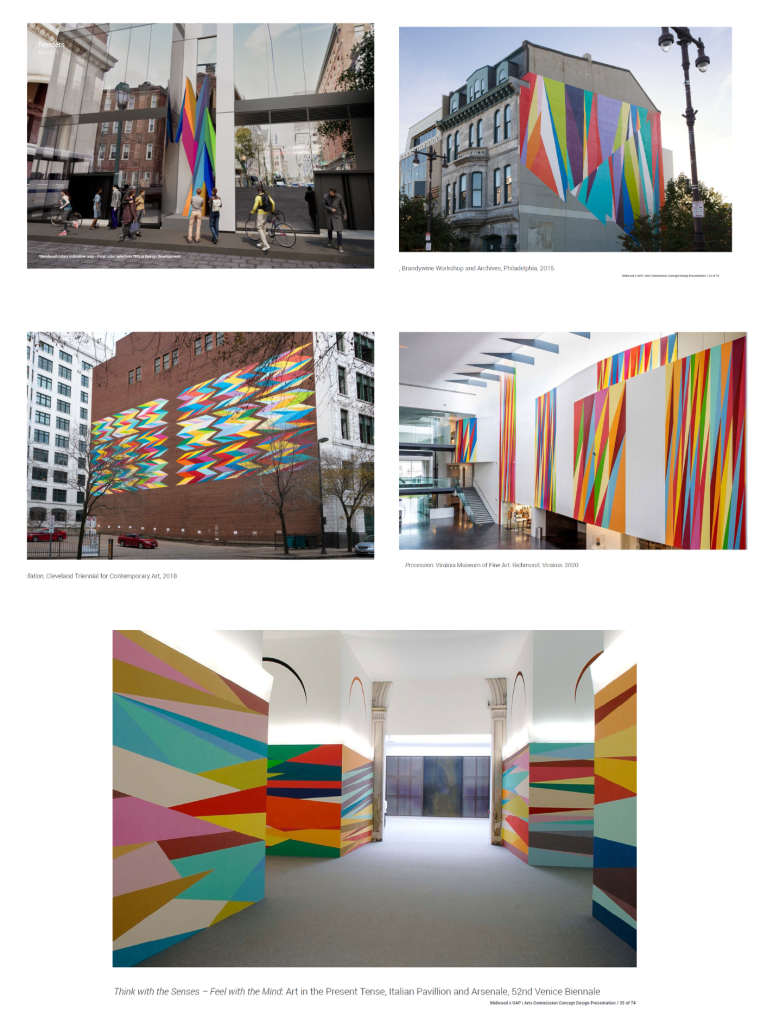
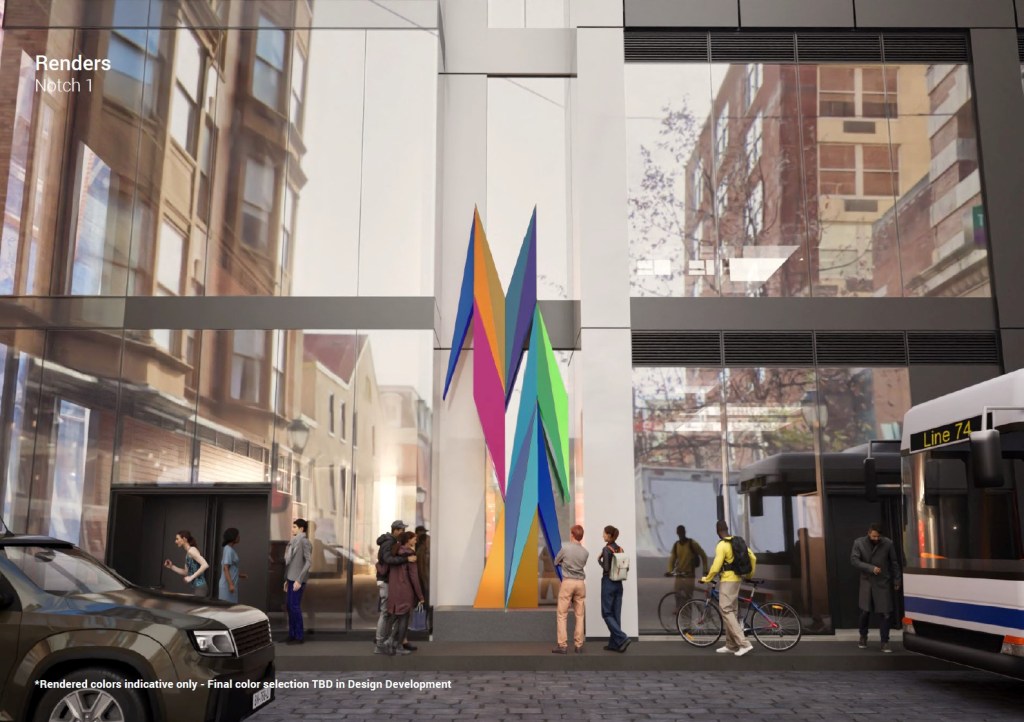
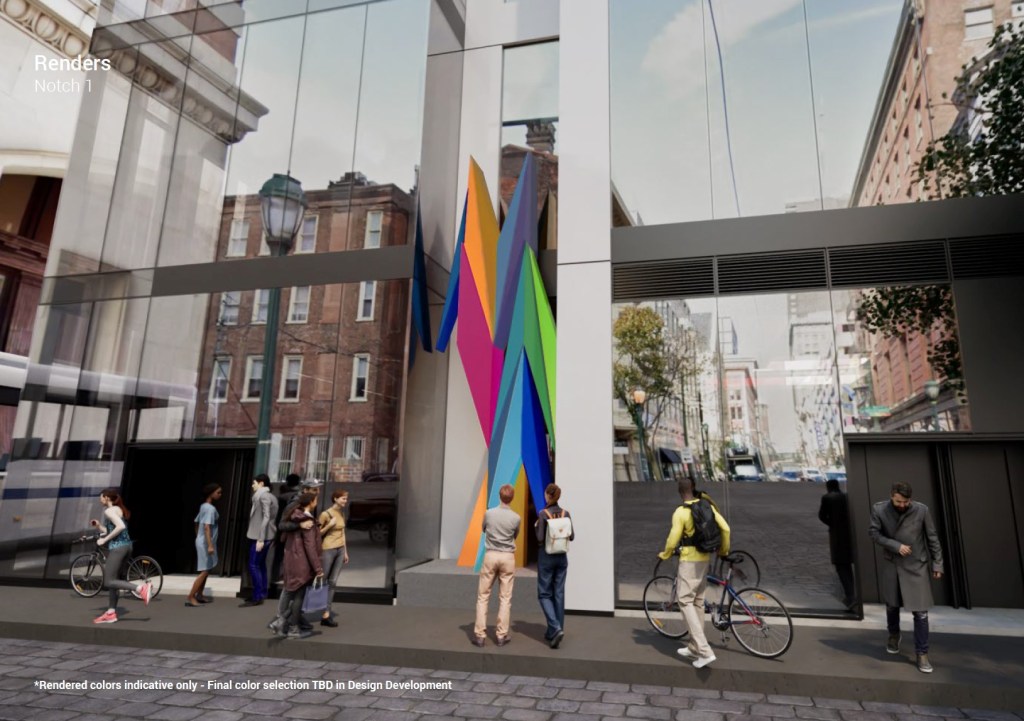
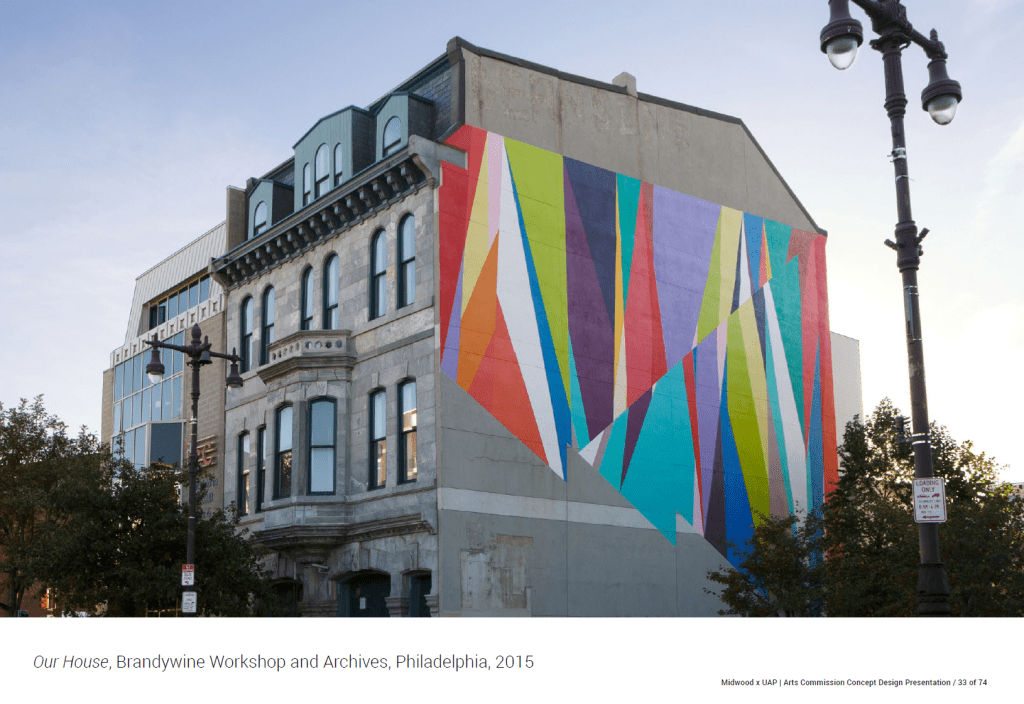
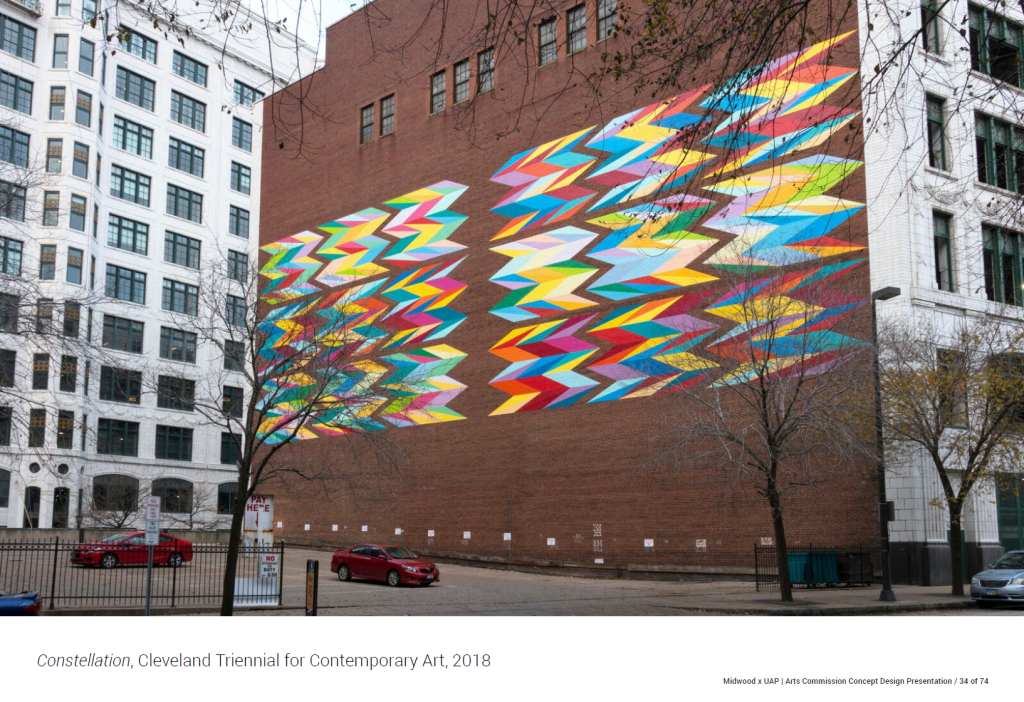
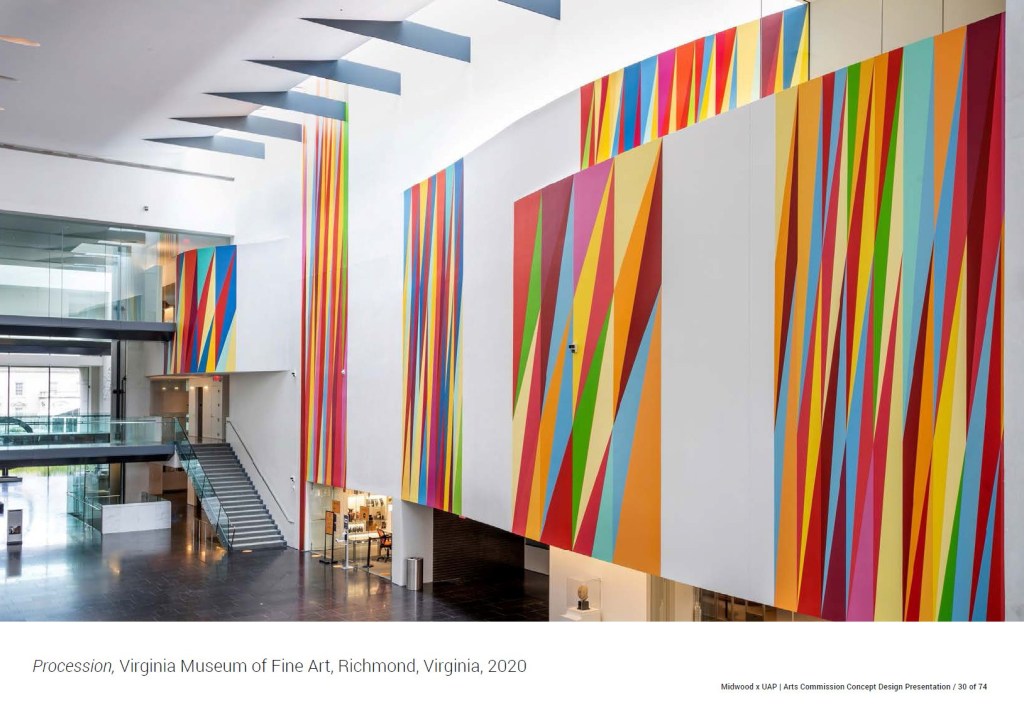
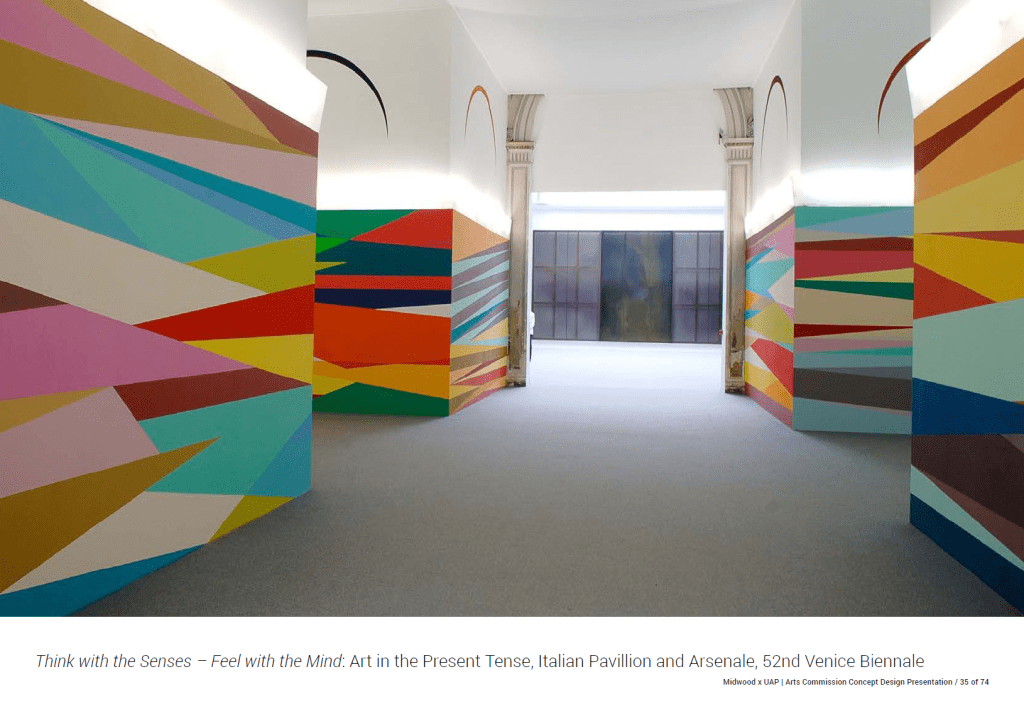
After 40 minutes of “deliberation,” Commissioners gave final approval to Odita’s repetitive design that has been installed on walls from Philadelphia to Venice, Italy. The only thing new about Odita’s “Newfound Forms” is the medium. This would be his first public sculpture.
To be honest, I question whether Odita ever visited the site. If he had, he would know that 12th Street is one way and the correct SEPTA bus route.
Bohri claimed the review was “consistent with longstanding Art Commission procedure.” But get this: In their submission to the Art Commission, Midwood acknowledged that “this will be the first public art erected pursuant to this zoning bonus.” The 40 minutes from presentation of the concept design to final approval by the Commissioners is without precedent.
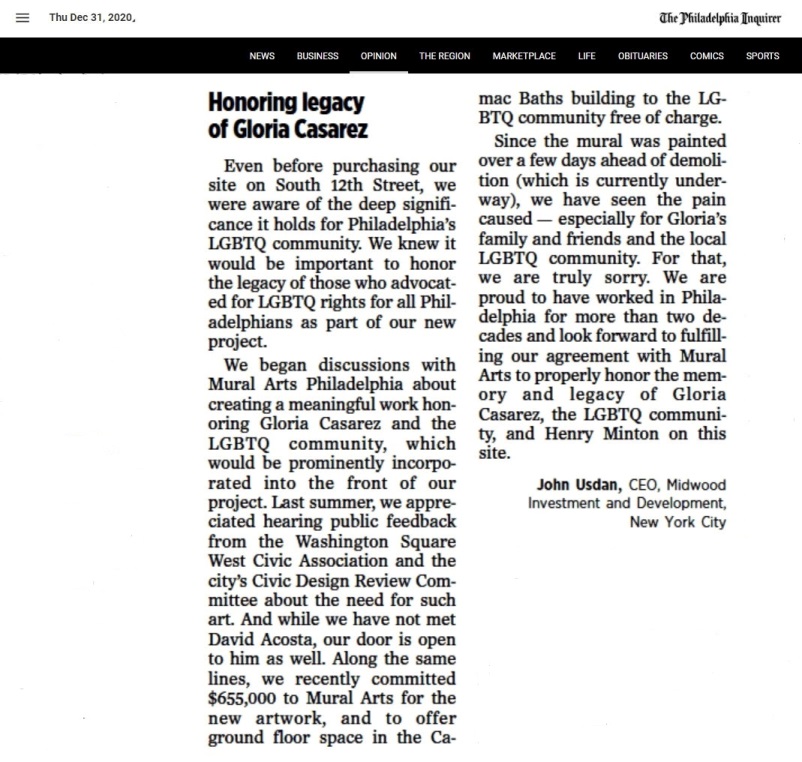
In a letter to the editor published by The Inquirer on December 31, 2020, Midwood CEO John Usdan promised “to properly honor the memory and legacy of Gloria Casarez, the LGBTQ community, and Henry Minton on this site.”
A nameless representative told The Inquirer Midwood’s offer to recreate the Gloria Casarez mural “still stands.” Will Mayor Cherelle L. Parker hold Usdan to his promise to honor Black abolitionist Henry Minton?
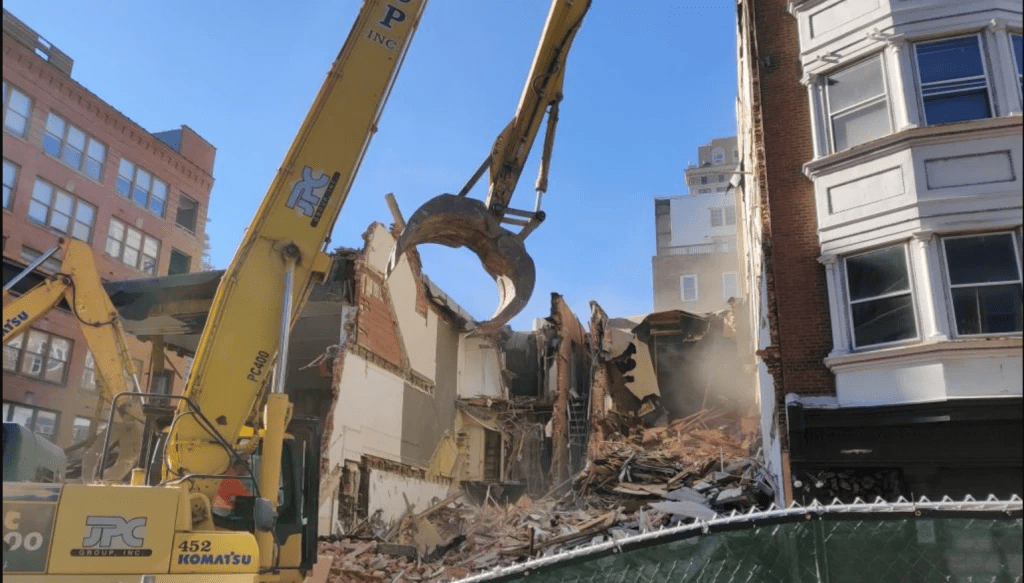
On the eve of Black History Month 2021, Midwood Investment & Development demolished one of the few extant buildings associated with the Underground Railroad. The New York City-based developer demolished the former home of Henry Minton, an elite caterer and abolitionist who played host to icons of American history, including John Brown, Frederick Douglass and William Still.
The Henry Minton House had been the subject of a heated discussion at the Philadelphia Historical Commission in 2019. The road to demolition was paved by the Commissioners who ignored the unanimous recommendation of the Committee on Historic Designation.
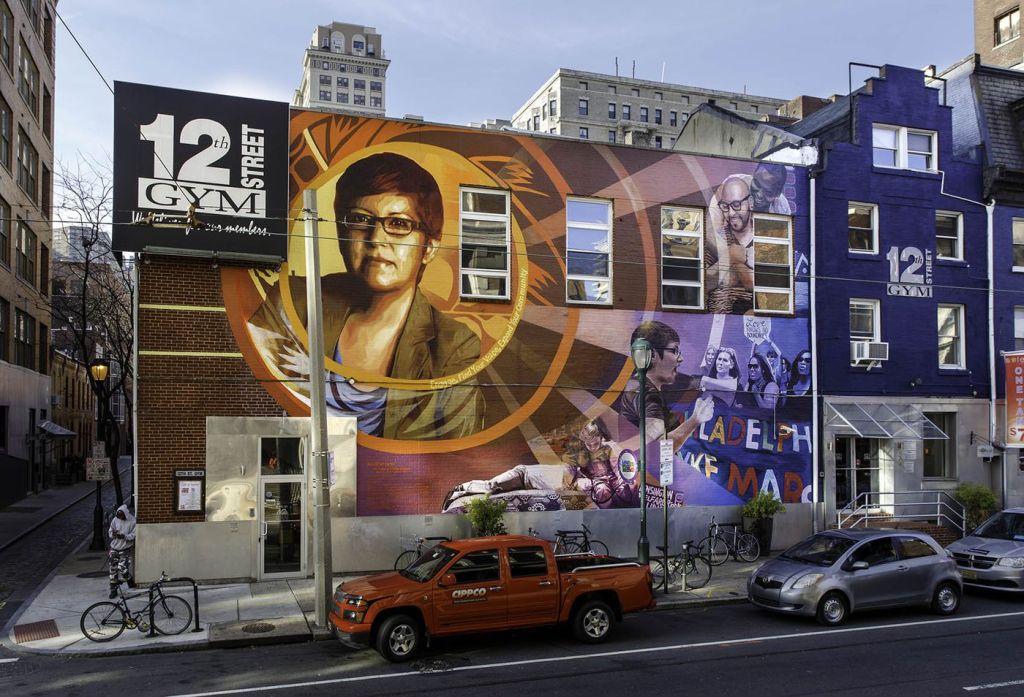
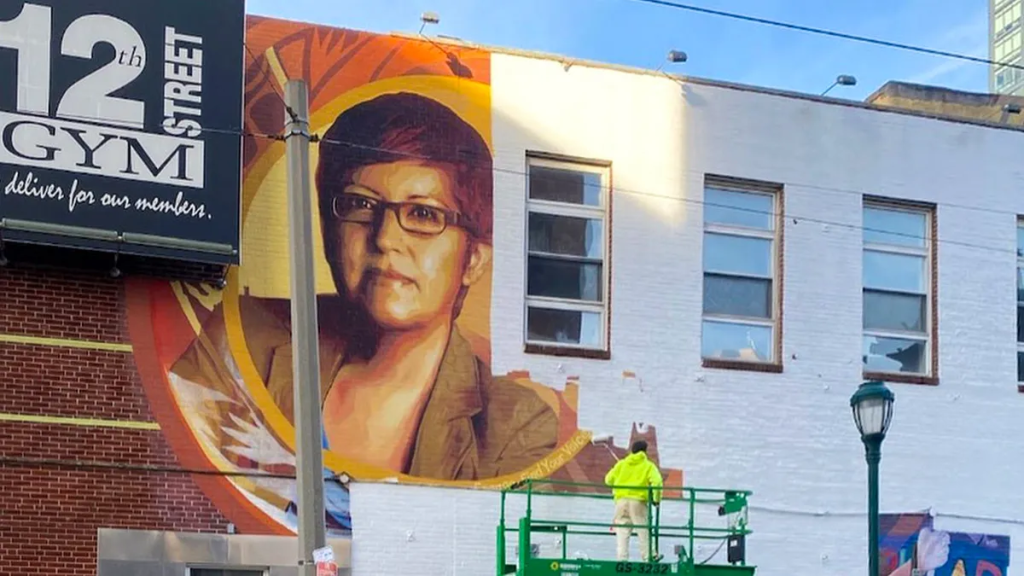
Before demolishing the Henry Minton House, Midwood had painted over a mural honoring LGBTQ+ activist Gloria Casarez which adorned a wall of the 12th Street Gym.
The whitewashing of Gloria’s mural triggered a media firestorm. Midwood CEO John Usdan promised “to properly honor the memory and legacy of Gloria Casarez, the LGBTQ community, and Henry Minton on this site.”
Demolition of the Henry Minton House and 12th Street Gym was not the end of the story. Midwood has a conditional public art density bonus that allows the developer to build more cookie-cutter apartments on the site. 210 S 12th Street is in the footprint of the Henry Minton House and 12th Street Gym. The public art zoning density bonus is site-specific and must be approved by the Philadelphia Art Commission.
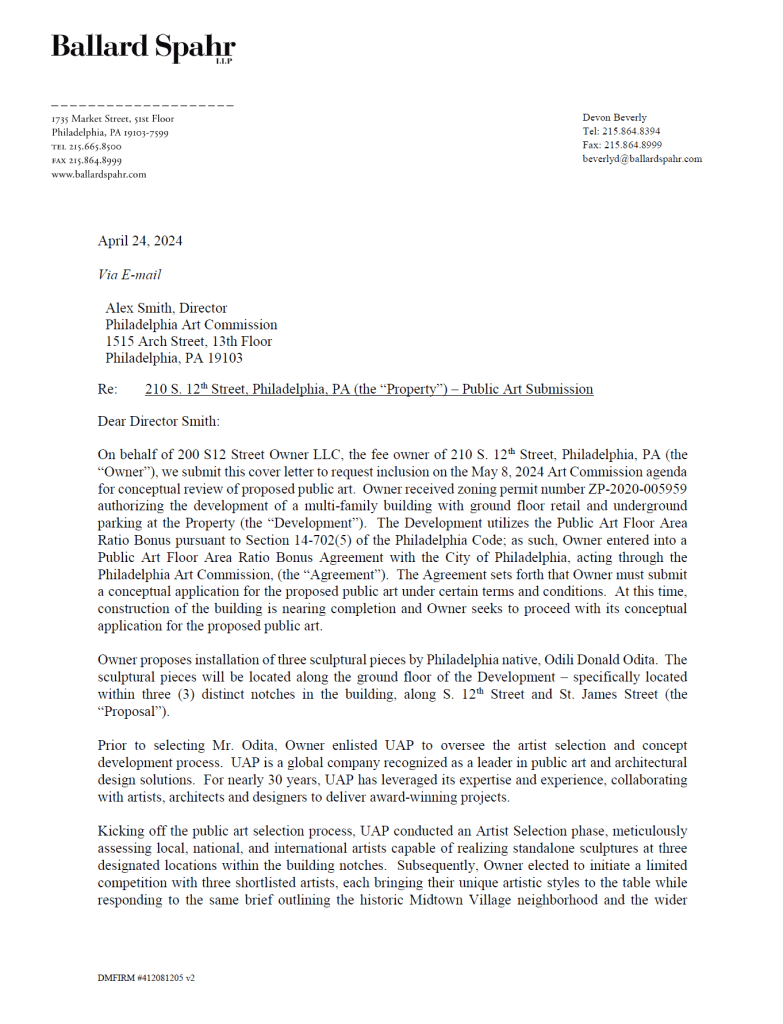
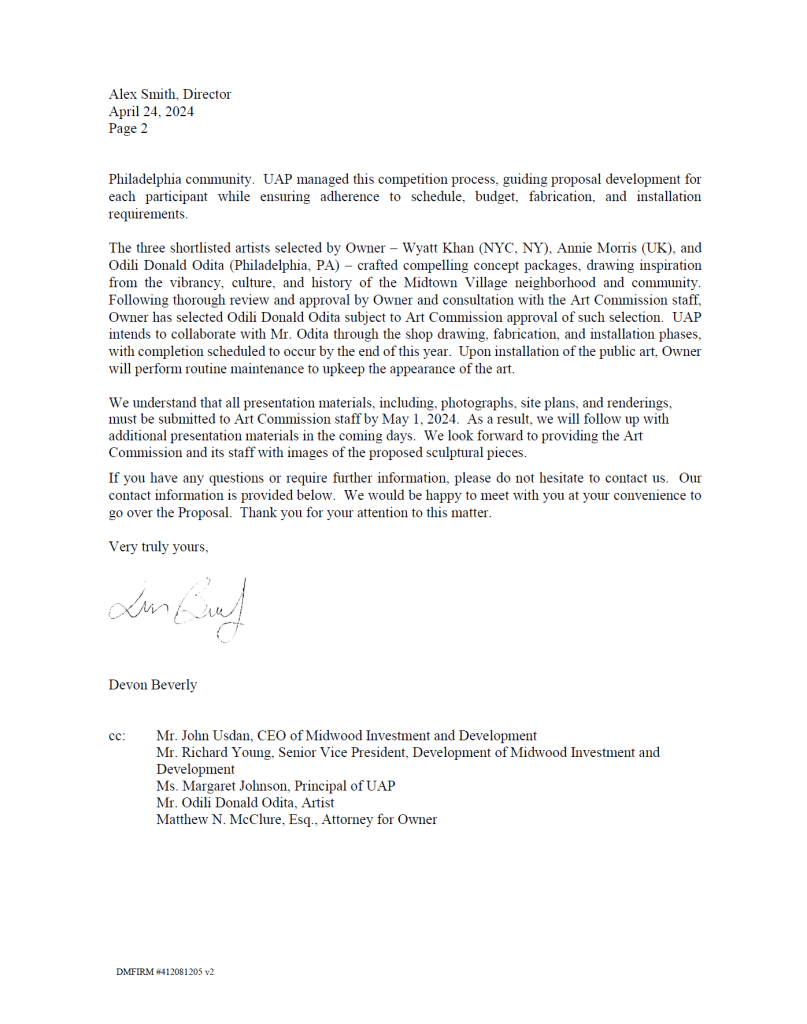
Fast forward to April 24, 2024, the law firm that represented Midwood at the contentious Historical Commission meeting asked to be placed on the Art Commission’s May 8, 2024 agenda. The Commission’s response: Done.
While Art Commission Director Alex Smith met with Midwood’s art curator “over the past year,” the public was given three business days’ notice. The agenda was posted on Friday, May 3, 2024. The Art Commission meeting was held on Wednesday, May 8, 2024.
In this shamelessly “corrupt and contented” city, the Art Commission conducted a sham review of Midwood’s concept design. In less than 40 minutes, the Commissioners voted to give final approval to a concept design that erased the African American and LGBTQ+ history of the site. The Commission approved a pig in a poke, e.g., “Rendered colors indicative only – Final color selection TBD in Design Development.”
The rendered colors’ similarity to the Pride Rainbow flag is a mere coincidence. Other than the medium, there is nothing new about “Newfound Forms.” Painter Odili Donald Odita’s repetitive design was installed in Philadelphia on a now-blocked mural, Cleveland, Richmond and Venice, among other cities.
Author E.A. Bucchianeri said, “Art is in the eye of the beholder, and everyone will have their own interpretation.” Ray Charles and Stevie Wonder could see final approval of Odita’s repetitive design made a mockery of the site-specific public art density bonus.
I have submitted a Right-To-Know Law request that will shed light on the Art Commission’s perversion of the public art review process.