Year: 2025

Remembering Moses Williams (1776-1830)
Master silhouette artist Moses Wlliams passed away on December 13, 1830. Born into slavery in August 1776, Moses lived in the shadow of his enslaver, Charles Willson Peale. Moses grew up in the same household with Peale’s children, but he was denied the opportunity to learn the fine art of painting that was afforded his enslaver’s children.
Moses made a way out of no way. He excelled as a silhouette artist and earned a place in history. Moses’ Pennsylvania historical marker will be dedicated in 2026, the 250th anniversary of his birth.
Moses was interred at Northwest Burial Ground on December 20, 1830. Sometime between 1853 and 1868, the burial ground was sold, the bodies disinterred, and a church constructed on the site. Some of the remains were removed to Section 203 at Mount Moriah Cemetery in 1868 under a monument that reads: “Sacred to the memory of the dead whose remains were removed from the 16th and Coates St. Cemetery of St. Georges M. E. Church Philadelphia to this place in the year 1868.”
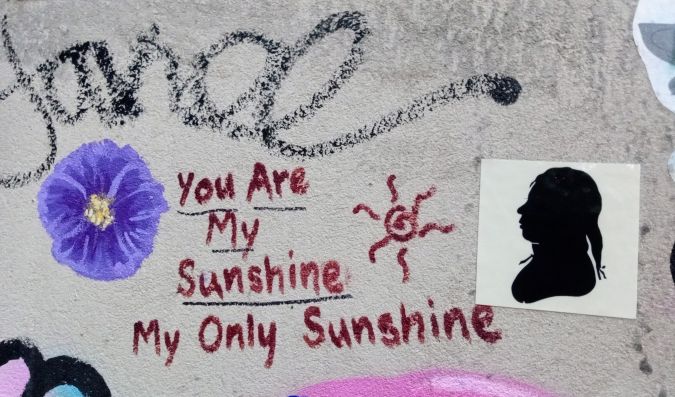
Mount Moriah has no record that Moses’ remains were among those reinterred in Section 203. In the absence of a final resting place, All That Philly Jazz Director Faye Anderson plastered the only known image of Moses in Freeman Alley, a graffitied place of remembrance in New York City.


Pasting over others’ stickers is part of the culture of Freeman Alley.


When Moses Williams’ historical marker is unveiled in 2026, he will have a permanent place in public memory.

The dedication ceremony is open to the public. If you are interested in attending, send your name and email address to phillyjazzapp@gmail.com.
Fall of Freedom Update
A few days before Fall of Freedom walking tour of Billie Holiday’s Philadelphia, the Philadelphia Inquirer published All That Philly Jazz Director Faye Anderson’s opinion piece in which she wrote:
No artist has met the moment with more courage than Lady Day, whose 1939 recording of “Strange Fruit” was named song of the century by Time magazine in 1999, and was added to the National Recording Registry in 2002.
“Strange Fruit” is a timeless and empowering act of creative resistance
While Holiday is sui generis, jazz musicians were the vanguard of the civil rights movement.
At so-called black and tan clubs like the Down Beat and the Blue Note, Black and white people intermingled on an equal basis for the first time.
Jazz clubs were constantly harassed by Philadelphia police led by vice squad Capt. Clarence Ferguson and his protégé, Inspector Frank Rizzo. The nightspots became battlegrounds in the struggle for racial justice. Jazz musicians’ unbowed demeanor fashioned a new racial identity
[…]
Courage is contagious. When we gather on South Broad, we are the resistance.

In collaboration with Scribe Video Center, the walking tour began at the Academy of Music where Billie had several engagements, including on May 6, 1946.

We stopped at the former location of the Radnor Hotel, a Green Book site, where Billie and her husband-manager, Louis McKay, were arrested on February 23, 1956. The raid was led by Captain Clarence Ferguson of the Philadelphia Police vice squad. The arrest is depicted in the biopic United States vs. Billie Holiday.

The penultimate stop was the site of Emerson’s Tavern, the jazz club where Billie last performed in Philadelphia. Emerson’s is the setting for the Broadway play, “Lady Day at Emerson’s Bar and Grill.”

The walk and talk ended at the former Attucks Hotel where on May 15, 1947, Billie’s room was raided while she was performing at the Earle Theater. Billie got a heads-up and fled to New York City where three days later she was arrested. She was subsequently convicted of narcotics possession and sentenced to one year and one day. Billie served her time at Alderson Federal Prison Camp in West Virginia.

The following Monday, Faye plastered the sticker that was given to participants all over Freeman Alley, a graffitied place of remembrance on the Lower East Side. Freedman Alley is located about a mile from Café Society, the Greenwich Village jazz club where Billie first sang “Strange Fruit.”


In the participant feedback survey, Faye expressed her hope that Fall of Freedom would lead to Winter of Our Discontent and Freedom Summer.
To stay in the loop, send your name and email address to phillyjazzapp@gmail.com.
Billie Holiday’s Philadelphia Walking Tour
Authoritarian regimes throughout history have targeted artists and cultural institutions. Early in his administration, President Trump issued an executive order that targeted the Smithsonian Institution.
Trump has taken over federal arts agencies and installed himself as chairman of the John F. Kennedy Center for the Performing Arts. He threatens to withhold federal funding from organizations that do not bend the knee.
Nina Simone said an artist’s duty is to reflect the times and the situations in which they find themselves.
Today, we find ourselves in a situation in which Trump wants to control the narrative.
Fall of Freedom issued an urgent call to artists, creators and cultural workers to stand united against the assault on our constitutional rights and authoritarian control. Fall of Freedom is a celebration of art, courage, and free expression.
No artist reflected the times more courageously than Billie Holiday whose recording of “Strange Fruit” was named Song of the Century by Time magazine in 1999 and included in the National Recording Registry in 2002.
Join All That Philly Jazz and Scribe Video Center on November 22, 2025 for this nationwide wave of creative resistance.
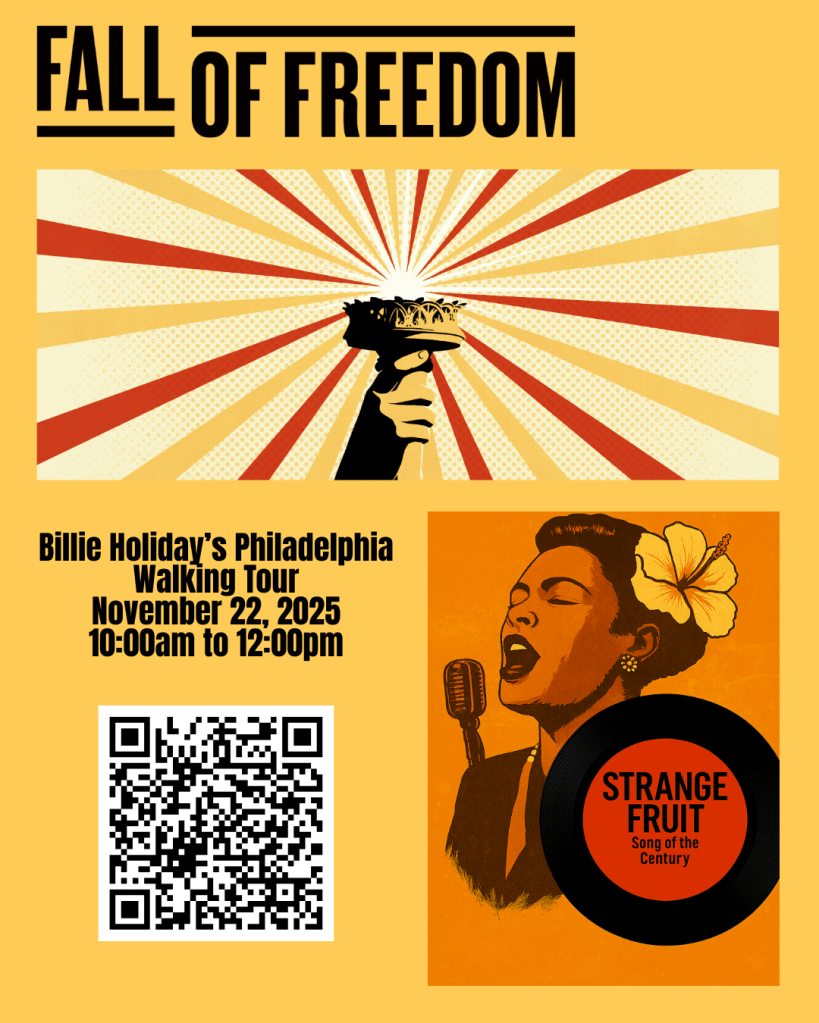
The walking tour will be guided by All That Philly Jazz Director Faye Anderson whose advocacy led to Billie’s induction into the Philadelphia Walk of Fame. We will visit the venues where Billie sang, the hotels where she stayed, and the site of the jazz club immortalized in the Tony Award®-winning “Lady Day at Emerson’s Bar and Grill.”
Along the way, we will stop at places connected to Nina Simone and Paul Robeson, artists who, like Billie, used their voices to speak truth to power.
The event is free and open to all, but registration is required. To reserve your spot, scan the QR code or go here.
Art matters. Courage is contagious. We are the resistance.
Election Day 2025
Early voting is underway in many states. Election Day is Tuesday, November 4, 2025.
Your vote is your voice. A high voter turnout will send a message to the wannabe dictator in the White House. So be careful how you vote.
Sixers’ Second Bad Call on East Market Street
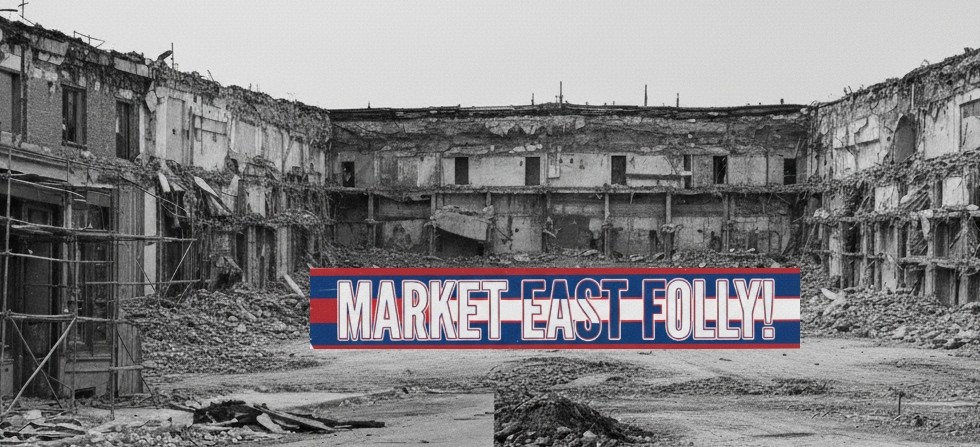
This time last year, the billionaire owners of the Sixers were going hard for a new basketball arena on East Market Street. 76 Place was a public transit-oriented project hitched to a beleaguered public transit agency. Then as now, SEPTA is facing a fiscal cliff. U.S. Transportation Secretary Sean Duffy is threatening to push the mismanaged agency over the cliff.
Market East has been in decline for decades. Empty storefronts line the once thriving shopping district. The Sixers and their new bestie, Comcast, plan to demolish buildings and build, well, nothing. The Philadelphia Inquirer reported:
The companies that own the 76ers and Flyers earlier this year made a high-profile commitment to help transform the long-distressed East Market Street corridor.
The first development to come out of that promise? Perhaps a mini-soccer pitch. Or a pop-up beer garden.
The teams recently hired a contractor to demolish buildings they own on the 1000-block of the beleaguered thoroughfare with the goal of eventually erecting a major development that could help revitalize the area.
But, until then, City Councilmember Mark Squilla said Friday the teams and city leaders hope to “activate” the lots slated for demolition with “pop-up” opportunities related to the FIFA World Cup and the nation’s 250th birthday being hosted in Philadelphia next summer.
The Sixers and Comcast’s development plan to shoot first and aim later was shot down by the Design Advocacy Group:
In the meantime, the sports teams that now own many buildings on the 900 and 1000 blocks of Market Street are already planning to begin tearing them down with nothing more in mind than a “pop up” beer garden or miniature soccer field.
If popups are wanted by FIFA and the 250th, Market Street already has large demolition sites—the surface parking lot at 13th and Market and the gigantic “Disney Hole” at 8th and Market. Not far away is the gaping void on Jewelers Row, a cautionary tale about premature demolition. These places remind us of past failures where rushed demolition yielded no replacement.
Of course, Market Street needs dressing up in time for the flood of visitors we look forward to in 2026. And pop-ups on existing empty sites should be part of that. But it makes no sense to stage such impulsive demolition on Market Street to create spaces we don’t need now for the not yet planned projects that may come next.
UPDATE: The Philadelphia Inquirer Architecture Critic Inga Saffron doesn’t trust the Sixers and Comcast’s process:
The long-awaited effort to reinvent Market East began in the same bombshell manner as the Sixers’ arena proposal did three years ago — with no transparency and no planning.
First, the two new BFFs of the Philadelphia sports world — the Sixers and Comcast — blindsided Mayor Cherelle L. Parker (and the rest of us) by announcing that they intended to raze several buildings on the 1000 block of Market Street, an area covering half the block. As for what they would put in their place, well, they’ll get back to us on that.
This has to be the worst idea for fixing Market Street’s woes since the last bad idea: the Sixers basketball arena.
Save Our Signs Launches the People’s Archive of National Park Signs
The federal government shutdown has paused the whitewashing of American history prescribed by the Secretary of the Interior’s order implementing President Trump’s Executive Order, “Restoring Truth and Sanity to American History.” It is insane to believe that “truth” is on the side of Trump and his monochromatic and chaotic administration.
The Save Our Signs project is a crowdsourced archive dedicated to documenting and preserving signs, exhibits and plaques at National Park Service sites. SOS has launched an open-access, searchable digital archive of photographs of interpretive signs taken by visitors to National Park Service sites. As of October 13, 2025, the SOS Archive has over 10,000 photos.
In a statement, Jenny McBurney, Government Publications Librarian at the University of Minnesota and SOS co-founder, said:
I’m so excited to share this collaborative photo collection with the public. As librarians, our goal is to preserve the knowledge and stories told in these signs. We want to put the signs back in the people’s hands. We are so grateful for all the people who have contributed their time and energy to this project. The outpouring of support has been so heartening. We hope the launch of this archive is a way for people to see all their work come together.
[…]
The SOS Archive includes an online collection of the crowdsourced photos organized by NPS site, and a spreadsheet that houses volunteer-provided details for each individual photo submission. In addition to the name of the park, this includes the date that the photo was taken, and may include the title of the sign, if it was submitted by the volunteer.
SOS is still collecting photos. To add your photos, go here.
Collective Resistance to Censorship
Since his return to the White House, President Trump has punished individuals and institutions that refuse to bend the knee. In a guest essay published in the New York Times, Henry J. Farrell, a professor of democracy and international affairs at Johns Hopkins University, argues that collective action is the best defense against authoritarianism:
President Trump is trying to seize power that he is not entitled to under the law or the Constitution.
But Mr. Trump will fail in remaking American politics if people and institutions coordinate against him, which is why his administration is targeting businesses, nonprofits and the rest of civil society, proposing corrupting bargains to those who acquiesce and punishing holdouts to terrify the rest into submission.
This is one part of Mr. Trump’s bigger agenda to remake American politics so that everyone wants to be his friend and no one dares to be his enemy.
[…]
Those who oppose authoritarianism have to play a different game, creating solidarity among an unwieldy coalition, which knows that if everyone holds together, they will surely succeed.
Coordinated resistance stopped the National Park Service from removing interpretive signs at the President’s House for now.
In a recent editorial, the Philadelphia Inquirer acknowledged the impact of vigilance and collective courage:
Kudos to everyone who pushed back against Donald Trump’s attempt to whitewash the history of slavery at the President’s House site near the Liberty Bell.
Trump’s ridiculous executive order instructed the National Park Service to remove or cover up displays on federal sites that “inappropriately disparage Americans past or living.”
The arbitrary Sept. 17 deadline to remove the material has passed. For now, the President’s House exhibits remain untouched. But vigilance is still required, given Trump’s erratic policy approach and alarming cognitive state.
I am name-checked in the editorial. All That Philly Jazz is one of 255 signatories to an open statement pushing back against Trump’s attacks on arts and cultural institutions.

Mobilized by the National Coalition Against Censorship and the Vera List Center for Art and Politics, we are standing together to resist censorship:
Arts and culture bring people together. They spark joy, foster belonging, enrich communities, and help us imagine new possibilities. Arts and culture also open space for complexity—for grappling with different perspectives, for hearing what we might rather ignore, and for facing what makes us uncomfortable. Cultural organizations, including art, culture, history, and science museums, as well as libraries, theaters, and dance and performance spaces, make these encounters possible. They are key to the functioning of a democracy, as they promote freedom of expression, encourage critical thinking, and create important opportunities for public discussion and dissent.
[…]
As contributors to the sphere of art and culture, and as representatives of US art and cultural institutions that create space for art, ideas, innovation, and public engagement, we stand firm in the shared values that make for a robust arts and culture landscape: free expression, active debate, responsibility, and care.
Add your voice to the resistance at collective-courage.com.

 PHL Watchdog