I have President Trump fatigue. And I’m not alone. According to the latest Quinnipiac poll, only 37 percent of voters approve of the way Trump is handling his job; 55 percent disapprove.
There are signs of resistance to the chaos and madness. So this Labor Day, the message is in the music.
In my recent opinion piece published in the Philadelphia Inquirer, I wrote: “The review of content at the President’s House is an Orwellian descent into censorship. It’s interpretive panels and books today. Will it be National Park Service videos and trading cards tomorrow?
Two days later, President Trump applied new pressure on Smithsonian interpretive texts and exhibitions. The Washington Post reported that White House officials are conducting a comprehensive review of Smithsonian museums:
The White House will launch a sweeping review of Smithsonian exhibitions, collections and operations ahead of America’s 250th-birthday celebrations next year — the first time the Trump administration has detailed steps to scrutinize the institution, which officials say should reflect the president’s call to restore “truth and sanity” to American history.
The vetting process would include reviewing public-facing and online content, curatorial processes and guidelines, exhibition planning and collection use, according to a letter sent to Smithsonian Secretary Lonnie G. Bunch III on Tuesday and signed by White House senior associate Lindsey Halligan, Domestic Policy Council Director Vince Hale and White House Office of Management and Budget chief Russell Vought.
[…]
The letter states that the initial review will focus on eight museums: the National Museum of American History, the National Museum of Natural History, the National Museum of African American History and Culture, the National Museum of the American Indian, the National Air and Space Museum, the Smithsonian American Art Museum, the National Portrait Gallery and the Hirshhorn Museum and Sculpture Garden.
For nearly two centuries, the Smithsonian has served as a globally renowned model of scholarship and public engagement. Smithsonian museums and sites are beloved, trusted destinations for millions of visitors annually looking to gain knowledge, spark curiosity, and find connection. The administration is maligning the expertise and autonomy of an institution that represents the pinnacle of museum and scholarly practice.
This pressure on Smithsonian history museums, in particular, reveals the administration’s ambition to delegitimize the work of the history field and to rob the public of its ability to learn from the past. Sound historical practice depends upon meticulous research of a wide array of sources, open-minded embrace of complexity and ambiguity, and a willingness to update understandings as new information arises. Time and again, Americans have said that they want our country’s full story. Censoring and manipulating content to fit a predetermined, triumphalist narrative is the antithesis of historical practice and a disservice to us all.
Smithsonian exhibitions are grounded in scholarly research. The ahistorical, willfully ignorant Trump wants to impose his interpretation of American history.
Truth is, Trump knows little, if anything, about Black history. He thought Frederick Douglass was still alive in 2017.
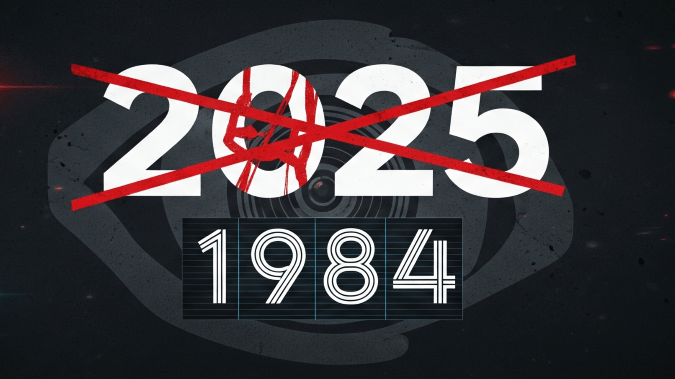
While gleaning clues from Project 2025, Trump’s whitewashing of American history is foretold in George Orwell’s 1984:
The Party told you to reject the evidence of your eyes and ears. It was their final, most essential command.
[…]
And if all others accepted the lie which the Party imposed—if all records told the same tale—then the lie passed into history and became truth.
Trump’s Big Lie that the Smithsonian had “come under the influence of a divisive, race-centered ideology” is straight out of the dictator’s playbook.
In Gulliver’s Travels, Jonathan Swift wrote: “I said there was a society of men among us, bred up from their youth in the art of proving, by words multiplied for the purpose, that white is black, and black is white, according as they are paid. To this society all the rest of the people are slaves.”
President Trump claims he wants to restore “truth and sanity to American history.” Facing the threat of termination, National Park Service employees may be forced to acquiesce to the insane notion of “a concerted and widespread effort to rewrite our Nation’s history, replacing objective facts with a distorted narrative driven by ideology rather than truth.”
For the wannabe king, the truth is what he says it is.
In a joint statement, the American Association for State and Local History, Organization of American Historians, Association for the Study of African American Life and History, Association of African American Museums, and National Council on Public History, denounced Trump’s diktat to rewrite history:
National Park Service (NPS) sites are being forced to remove historical content that the White House views as “negative about either past or living Americans.” This top-down directive erases people and events that do not fit within a narrow, triumphalist view of history.
What makes this erasure even more alarming is that the U.S. Department of the Interior (DOI), which runs NPS, is couching its censorship efforts in the very terms that historians and educators often use to explain their own work. Federal officials are eliminating the experiences of Native Americans, African Americans, women, members of the LGBTQ+ community, and others from history while calling it—to quote a DOI spokesperson—“honest, respectful storytelling” that “honor[s] the complexity of our nation’s shared journey.” In fact, they are doing the opposite. And requiring knowledgeable NPS staff to attribute these alterations to the White House’s interest in “historical accuracy” is doubly deceptive and contrary to the professional standards by which historians conduct their work.
Our country’s 433 NPS sites, which serve millions of visitors per year, are just the starting point for this skewed approach to history, but they will not be the last. Recent pressure on the Smithsonian Institution, National Endowment for the Humanities, Institute for Museum and Library Services, and others show just how far this administration is willing to go to distort the past toward ideological aims in the present. This drive to sanitize and warp history endangers vital sources of public knowledge, from state and local history museums to social studies classrooms to libraries.
Memorial Day is a time to remember and honor military personnel who paid the ultimate sacrifice to protect the nation’s freedoms and democratic ideals.
The DEI – Didn’t Earn It – crowd that’s attacking diversity, equity and inclusion likely doesn’t know the origin of Memorial Day. Originally called Decoration Day, Memorial Day was first observed on May 1, 1865 in Charleston, South Carolina.
Thousands of African Americans, including formerly enslaved, the 54th Massachusetts Infantry Regiment, and the 34th and 104th United States Colored Troops, were led by children as they gathered to honor 257 Union soldiers who were buried in a mass grave behind the grandstand of the city’s Washington Race Course. The ancestors exhumed the mass grave, reburied the bodies and decorated their graves; hence, Decoration Day.
Check out the history of Memorial Day that President Trump wants to erase.


 PHL Watchdog