SEPTA Officials Deleted 76 Place Records

Although SEPTA is in a transit death spiral, the agency is wasting money on outside counsel fighting release of records related to the Philadelphia 76ers’ proposal to build an arena atop Jefferson Station.

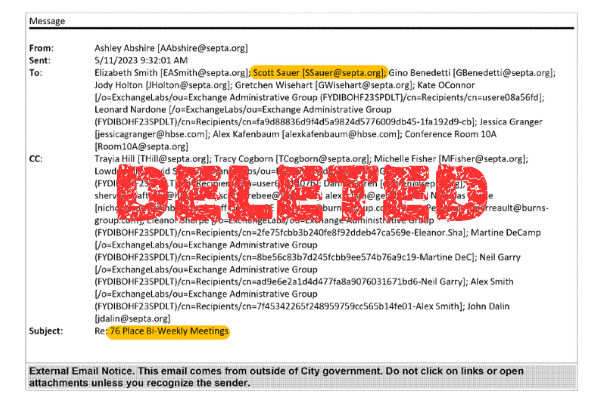
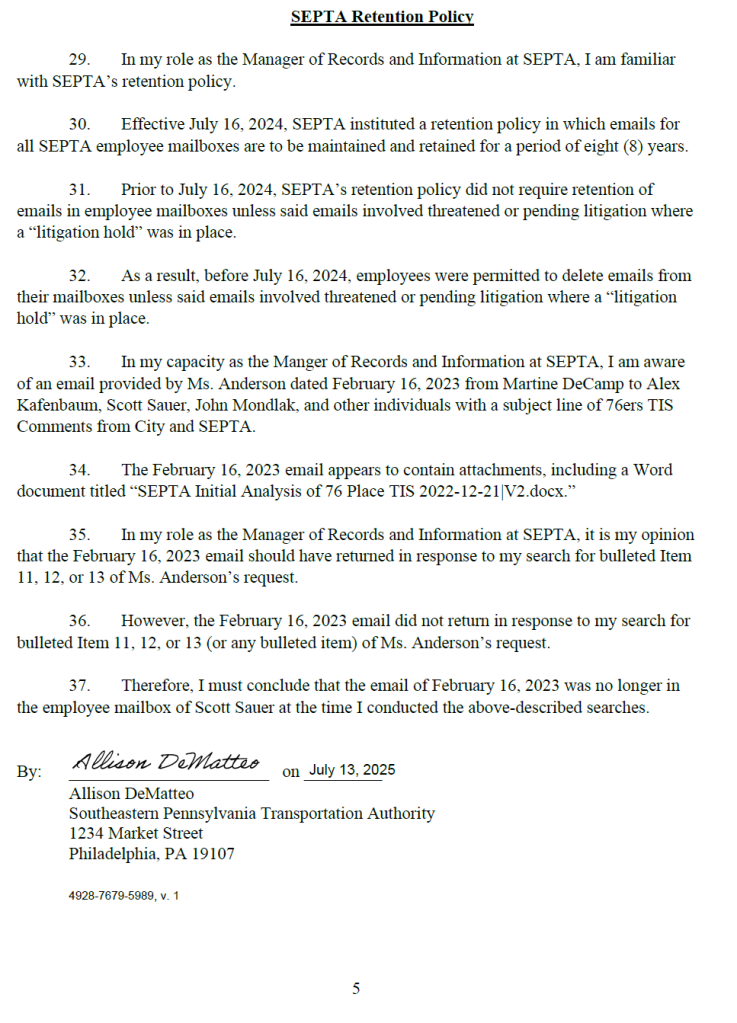
I submitted a Right-To-Know Law request on August 1, 2023 for records related to 76 Place for the timeframe of April 1, 2022 to July 31, 2023. After losing before the Office of Open Records and the Commonwealth Court of Pennsylvania, SEPTA now claims more than seven gigabytes of data were deleted. Former CEO Leslie Richards and current CEO Scott Sauer deleted records related to the most controversial proposal in the transit agency’s history.

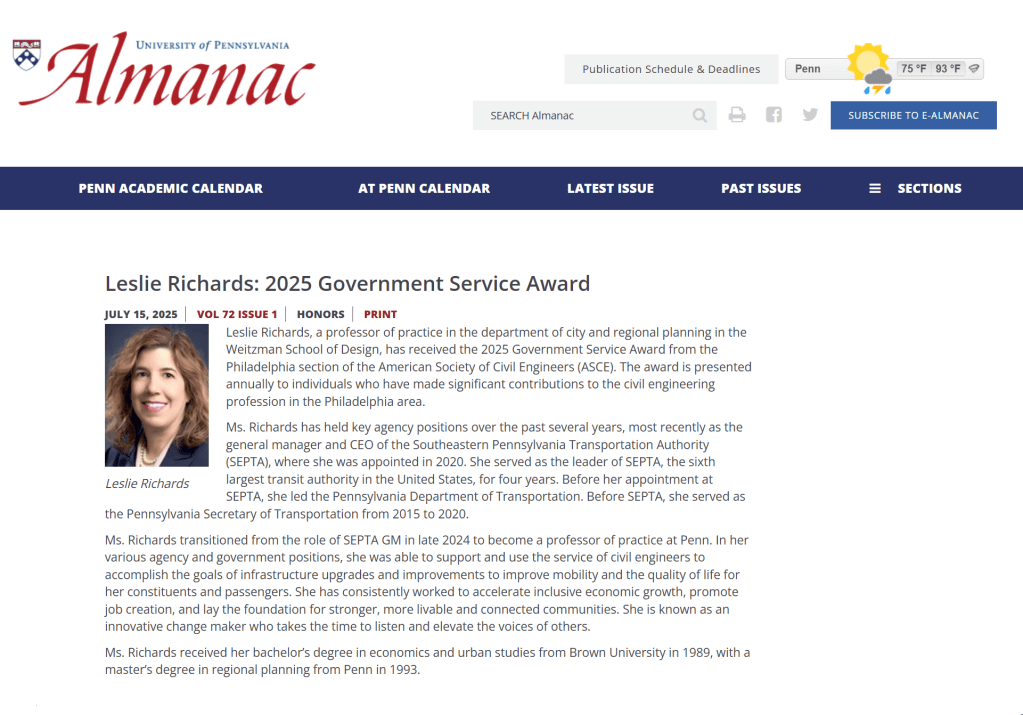
Richards left the cash-strapped agency in November 2024 but she’s still collecting a check from SEPTA.

It is said that those who can, do; those who can’t, teach. Fittingly, Richards is now teaching at the University of Pennsylvania. Penn recently announced that Richards received the 2025 Government Service Award from the Philadelphia chapter of the American Society of Civil Engineers.

In deleting 76 Place records, Richards did a disservice to the public. We have the right to know how SEPTA could have been stuck paying tens of millions of dollars for the Sixers billionaire owners’ now-abandoned vanity project.

SEPTA is Exhibit 1 as to why the Pennsylvania House of Representatives should pass Senate Bill 686, sponsored by Pennsylvania Senate State Government Committee Chairman Sen. Cris Dush. The legislation makes the intentional destruction or alteration of Right-To-Know Law records a third-degree felony.

Following passage of SB686, Sen. Dush said:

I find it deeply troubling that Pennsylvania’s long-standing RTK law mentions no criminal offense for destroying or altering records subject to a RTK request. Not surprisingly, the rule of law is entirely thwarted whenever government officials or their staff intentionally dispose or suppress records that have been requested under RTK provisions, and which the public has every right to examine.

Those who cannot handle the truth should not get away with criminally suppressing the truth. In short, the punishment for violating our Commonwealth’s RTK law must fit the crime. It’s well past time in Pennsylvania to balance the scales of justice against this preposterous ‘get-out-of-jail-free-card’ for the flagrant destruction of RTK records with a maximum third-degree felony conviction.

It is deeply troubling officials destroyed records knowing that if SEPTA approved 76 Place, lawsuits would fly.

What Are SEPTA and City of Philadelphia Hiding?

The Philadelphia 76ers abandoned their plan to build an arena atop SEPTA’s Jefferson Station. But SEPTA is still playing games to block disclosure of communications with the Sixers’ billionaire owners and their representatives.

SEPTA lost their appeal of the Office of Open Records’ Final Determination to the Commonwealth Court of Pennsylvania. The beleaguered transit agency was directed to conduct a good faith search for records responsive to my Right-To-Know Law request for, among other things, invoices, reports, feasibility studies, traffic impact studies, architectural designs and cost estimates.

In a sworn statement, Allison DeMatteo, SEPTA’s Manager of Records and Information, claimed her search using the keywords “76 Place” and “76 Devcorp” returned 7.60 gigabytes of data, including 5.71 gigabytes of email.

According to ChatGPT, one gigabyte of email data is roughly 100,000 pages. As of this writing, SEPTA has produced 30 records.

Meanwhile, the City of Philadelphia has petitioned the OOR to reconsider its final determination, dated May 30, 2025. The OOR should tell the City: We said what we said. “[T]he appeal is granted in part and denied in part, and the City is required to provide unredacted responsive records, as designated in this Final Determination, to the Requester within thirty days.”

UPDATE: Office of Open Records Deputy Chief Counsel Kathleen A. Higgins to the City of Philadelphia: The Petition is DENIED:

Therefore, after a review of the complete appeal file, including the Final Determination Upon Remand and the arguments set forth in the Petition, the record indicates that all evidence and submissions before the OOR were considered and given proper weight, and as a result, I cannot conclude that the Appeals Officer committed an error of law or an abuse of discretion. Accordingly, the Petition is DENIED.

In other words, the City of Philadelphia got to give it up.

SEPTA Ordered to Give Up 76 Place Documents — Again

On August 1, 2023, I filed a Right-To-Know Law request for records related to the Sixers’ now-abandoned proposal to build a basketball arena atop Jefferson Station. SEPTA denied the request, claiming the entirety of my Request was “insufficiently specific.”

I appealed the denial to the Pennsylvania Office of Open Records. The OOR determined that several Items were sufficiently specific and ordered SEPTA to conduct a good faith search for the records on December 20, 2023.

Rather than comply with the OOR’s final determination, the cash-strapped public transit agency paid outside counsel to appeal the order to the Commonwealth Court of Pennsylvania.

On May 1, 2025, the Commonwealth Court affirmed the OOR’s findings, stating that my Request was sufficiently specific, in part. SEPTA was, again, directed to conduct a good faith search for records responsive to my Request for, among other things, invoices, reports, feasibility studies, traffic impact studies, architectural designs and cost estimates.

​The Commonwealth Court effectively said game over. Like the 76ers playing in the second round of the NBA playoffs, SEPTA blew its chance to assert any exemptions from disclosure. SEPTA must give up 76 Place records.

Black History Under Attack

While still a British colony, South Carolina passed the first law that denied enslaved Africans the right to learn. The Negro Act of 1740 outlawed teaching enslaved people to read. President Trump threatens to withhold federal funding from schools that teach uncomfortable truths about American history.

Across the country, churches, civil rights organizations, activists and concerned citizens are speaking up and resisting efforts to erase Black history. We have come too far to go back.

The Freedom to Learn Network, convened by the African American Policy Forum, has launched the National Week of Action to resist Trump’s attempt to erase Black history, and defend our freedom and right to learn.

The activations include a #HandsOffOurHistory gathering in DC on Saturday, May 3, 2025.

To register for the DC gathering, go here.

Black History Matters

With little fanfare, President Trump has tapped Hillsdale College to produce a video series, “The Story of America.” A member of the Project 2025 network, the conservative Christian college’s demographically monochromatic faculty and student body does not look like America.

The teaching of Black history is under attack from the White House to state houses. It is not in my DNA to bend the knee. I am speaking about Moses Williams at the upcoming public history teach-in co-hosted by the Historical Society of Pennsylvania and 1838 Black Metropolis.

Moses Williams was enslaved by Charles Willson Peale whose portrait of George Washington is prominently displayed in Trump’s tricked out Oval Office. The title of my presentation is “Mapping Moses Williams’ Philadelphia.”

On Friday, April 25, historian and artist Nell Irvin Painter will give a keynote address, “Arrived, New Names.” Painter “will set the tone for exploring how creative projects can share complicated and compelling histories.”

On Saturday, April 25, public historians, educators, artists, preservationists and community members will share strategies on how they are breathing life into the archives to tell untold or undertold stories, and stories of belonging.

The event is open to the public. To register, go here.